
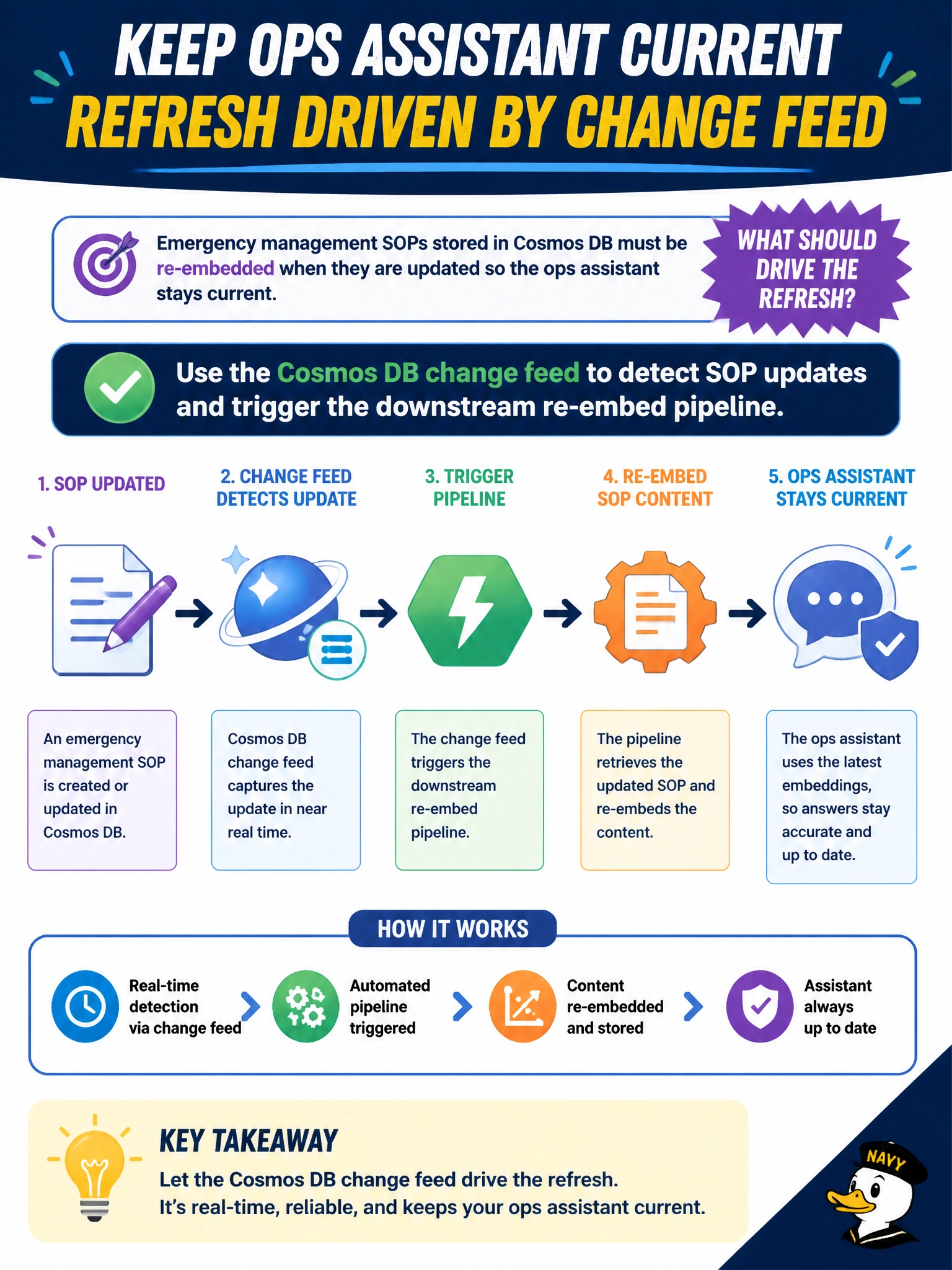
Emergency management SOPs stored in Cosmos DB must be re-embedded when they are updated so the ops assistant stays current. What should drive the refresh?
Select an answer to reveal the explanation.
Short Explanation
When an SOP changes, change feed rings the bell for the re-embed crew—ops gets fresh vectors without waiting for the yearly drill binder update.
Full Explanation
Emergency management SOPs stored in Cosmos DB must keep their embeddings synchronized when documents update; otherwise an ops assistant will retrieve outdated procedure semantics. Driving the downstream re-embed pipeline from the Cosmos DB change feed detects SOP inserts and updates and triggers embedding refresh only when content actually changes. That event-driven approach keeps municipal emergency knowledge current without constant full-corpus reprocessing.
Manually pasting each SOP into a spreadsheet and re-embedding only during annual drills fails operational readiness—incident procedures change more often than yearly drills, and manual copy steps introduce error. Turning off writes to SOPs so embeddings never need to change freezes living emergency doctrine and is unsafe. Re-embedding the entire emergency corpus on every single chat message from dispatch wastes compute, adds latency under incident load, and is not how change-driven pipelines are designed.
Exam caveat: associate questions often pair “document updated in Cosmos” with “downstream AI asset must refresh”—change feed (or equivalent change detection) is the expected glue, not chat-time full re-embed. Operational check: on SOP update, confirm change feed notification, successful re-embed job, replacement of the prior vector for that document id, and a smoke retrieval that returns the revised procedure language before declaring the ops assistant current.