
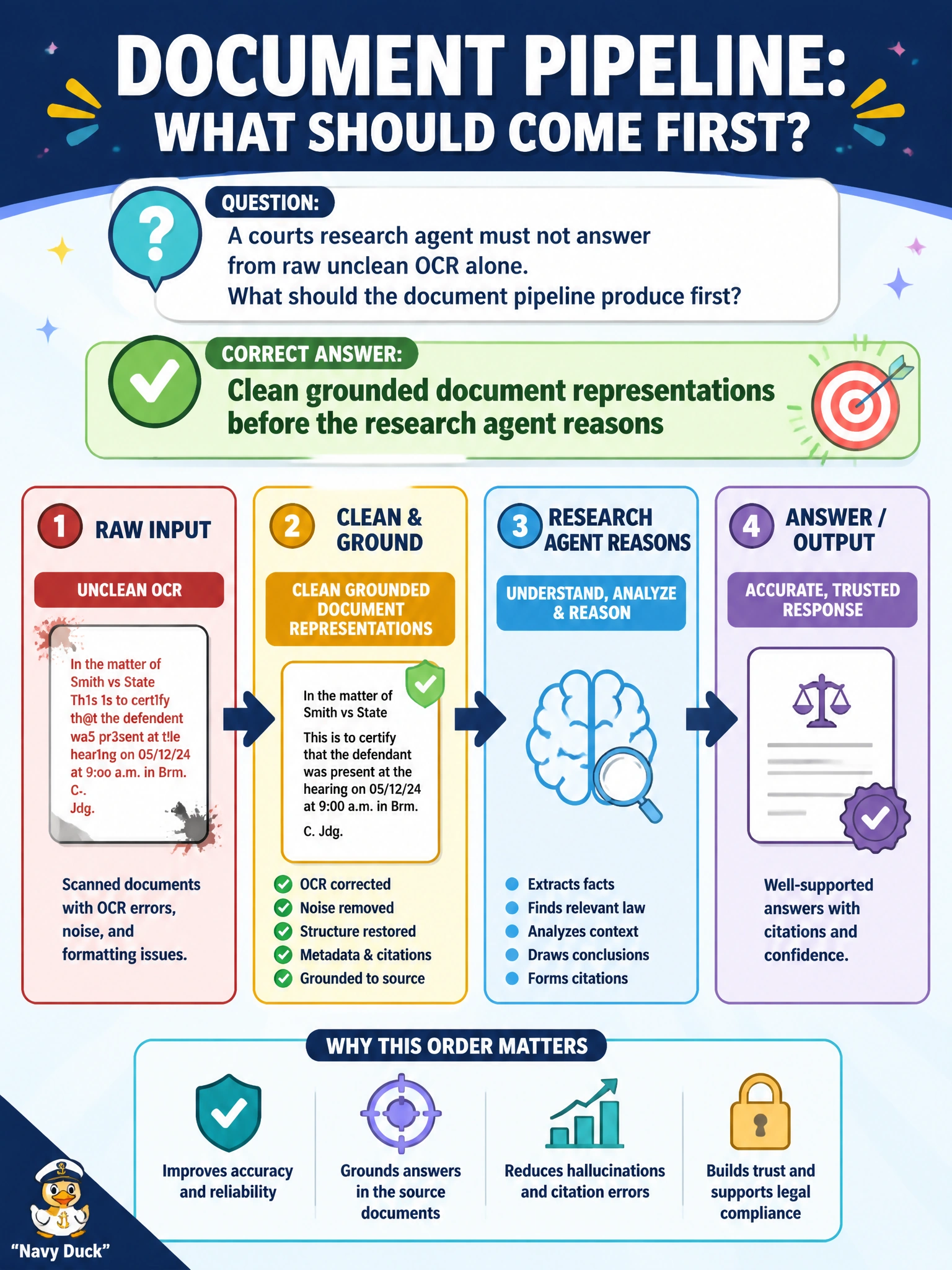
A courts research agent must not answer from raw unclean OCR alone. What should the document pipeline produce first?
Select an answer to reveal the explanation.
Short Explanation
Clean grounded citation graphs sound authoritative, but you'll still lack the full documents you've got to cite. Produce clean grounded representations first, then let the research agent reason. It's the same with semantic embeddings or holding summaries — they're useful derivatives, but they can't replace the grounded text.
Full Explanation
A courts research agent must receive clean grounded document representations before reasoning, not raw unclean OCR alone. OCR output from opinions and filings is noisy—broken columns, headers, watermarks, hyphenation artifacts—and feeding it straight to the agent invites confident errors on holdings and citations. Cleaning and grounding first yields trustworthy segments the agent can cite in municipal or court research workflows. Clean grounded citation relationship graphs before the research agent reasons are a downstream derivative, not the first output, because trustworthy citation graphs cannot be built until clean grounded document representations exist to extract them from. Clean grounded semantic vector embeddings before the research agent reasons are a search index derived from grounded documents, not a substitute for the documents themselves, so they cannot provide the clause-level evidence the agent must cite. Clean grounded case holding summaries before the research agent reasons are downstream condensations derived from grounded documents, so starting with summaries deprives the agent of the full verifiable text it needs to reason. Exam caveat: municipal/legal research agents require clean grounded representations upstream of reasoning—not clean grounded citation relationship graphs, semantic vector embeddings, or case holding summaries first, since those are all derivatives that depend on the grounded documents. Operational check: insert a cleaning/Content Understanding stage after OCR; gate the research agent on grounded document objects; evaluate holding and citation questions for citation fidelity; block direct raw-OCR prompts in the production tool policy.
Prefer to study offline? Printable PDF study book + test engine ($7.50, unofficial). These questions stay free here.