
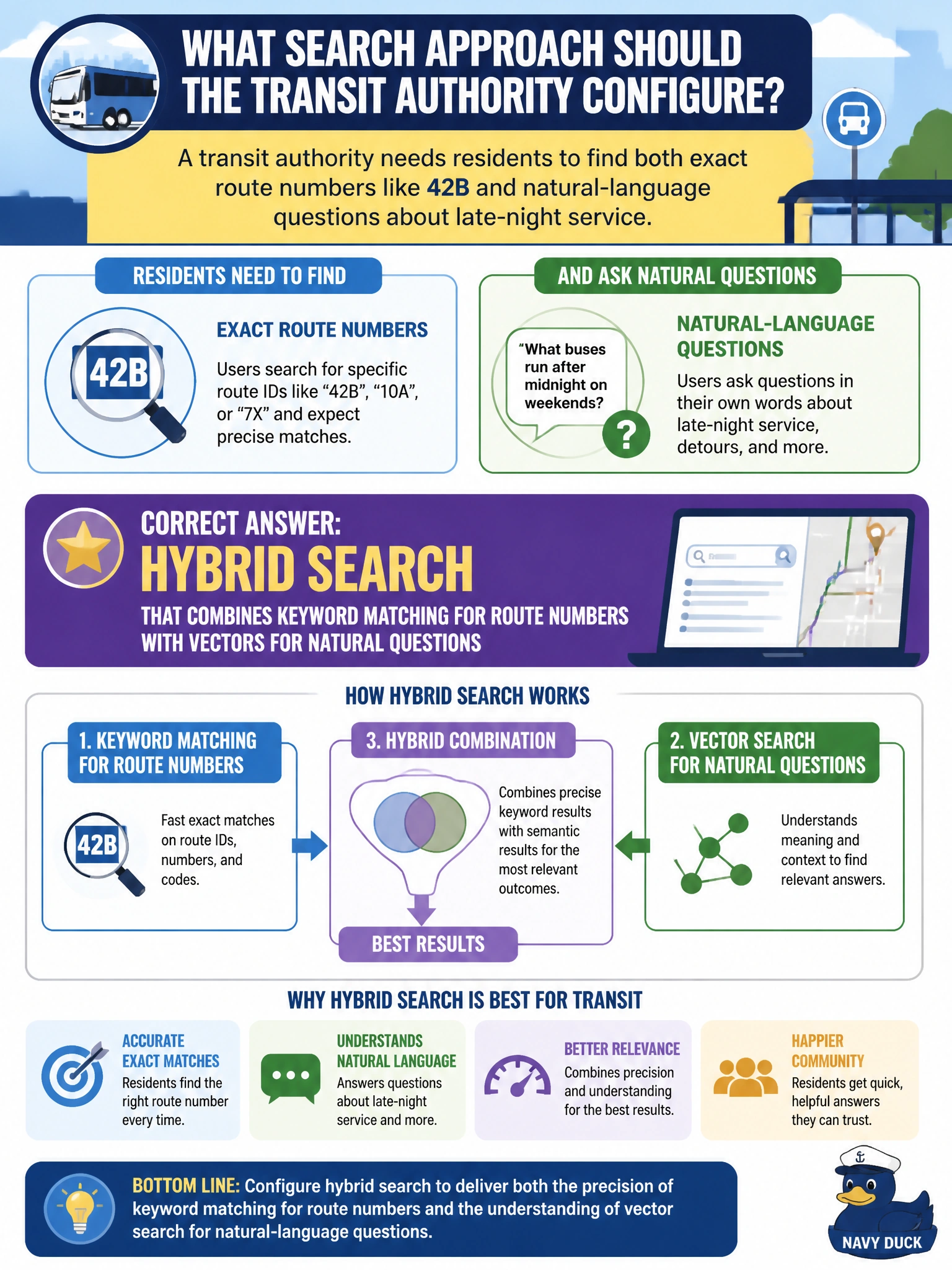
A transit authority needs residents to find both exact route numbers like 42B and natural-language questions about late-night service. Which search approach should they configure?
Select an answer to reveal the explanation.
Short Explanation
Route numbers are picky—"42B" needs keywords—while "when does the night bus stop running?" needs meaning. Hybrid search gives transit both. Vector FAQ search, full-text synonym maps, and BM25 keyword search each leave one side of your ask stranded.
Full Explanation
Hybrid search is the right configuration for a transit authority whose residents look up both exact route identifiers and conversational service questions. Keyword matching preserves precise tokens such as 42B, express suffixes, and abbreviated route codes that vector search on FAQ passages often soft-matches incorrectly or ranks below near neighbors. Vector retrieval covers paraphrased intents—late-night cutoffs, weekend frequency, wheelchair boarding—where residents do not know the official route string. Combining both in one ranking pipeline lets the municipal search surface return operational facts whether the query is a code or a natural-language ask. Vector search that embeds FAQ passages for semantic similarity on late-night service questions handles meaning but does not index exact route numbers as keywords, so it fails the exact-identifier half of transit demand and can bury the correct schedule behind semantically related but wrong routes. Full-text search with synonym maps linking night service terms and route aliases across transit documents relies on lexical expansion rather than true vector semantics, so it cannot reliably serve both exact route codes and paraphrased natural-language questions in a single ranked pipeline. Keyword search with custom analyzers and BM25 scoring tuned for exact transit route codes and stop names handles exact-code lookups fine but still cannot embed FAQ prose for meaning, so it cannot connect a paraphrased late-night-service question to the right passage, leaving half of the transit queries unresolved. Exam caveat: prefer hybrid when the stem requires both exact municipal identifiers and semantic phrasing; do not treat vector-only FAQ embedding as sufficient for codes. Operational check: index route numbers and aliases as keywords, embed schedule and FAQ prose, run hybrid retrieval on a mixed evaluation set of code queries and natural-language night-service questions, and verify that 42B-style hits and meaning-based hits both land in the top results before the resident-facing bot goes live.
Prefer to study offline? Printable PDF study book + test engine ($7.50, unofficial). These questions stay free here.