
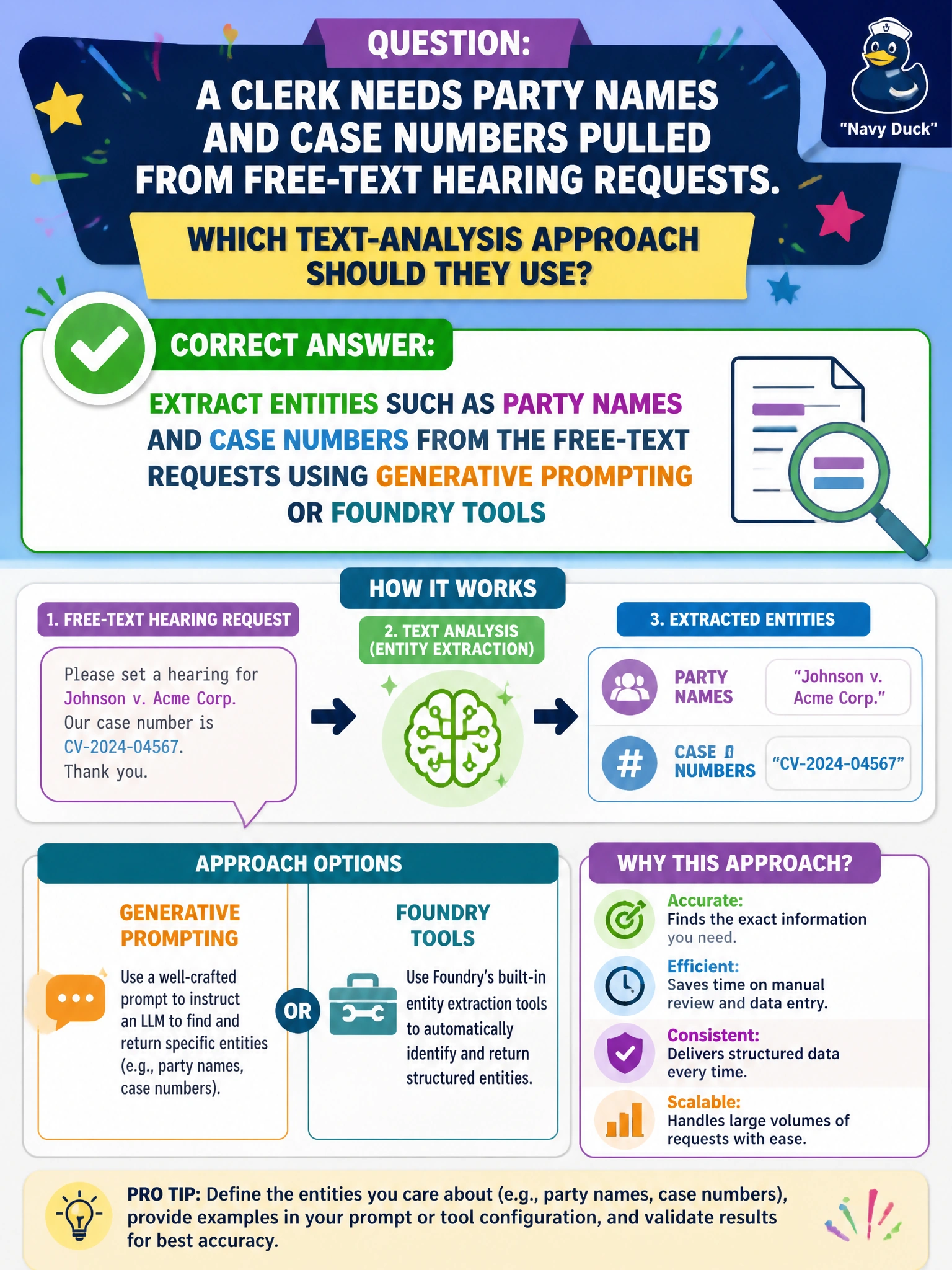
A clerk needs party names and case numbers pulled from free-text hearing requests. Which text-analysis approach should they use?
Select an answer to reveal the explanation.
Short Explanation
Entities are the name tags and case stickers hiding in messy free text. Use generative prompting or Foundry Tools to pull party names and case numbers out of hearing requests. Intent classification labels request types, key phrase extraction ranks general topics, and PII detection hides sensitive data, so they won't give you the exact names and numbers you'll need to fill the docket.
Full Explanation
Entity extraction turns free-text civic intake into labeled fields such as party names and case numbers. A clerk processing free-text hearing requests should extract those entities using generative prompting or Foundry Tools text-analysis capabilities so docketing systems receive structured identifiers instead of relying on custom text classification for intent labels, which assigns intent categories without locating the party names and case numbers the docket needs. Generative or tool-assisted extraction is the text-analysis approach matched to unstructured hearing language.
Extracting entities such as party names and case numbers from the free-text requests using custom text classification for intent labels fails because classification assigns broad intent labels, not specific identities, and it is still not the generative-prompting or Foundry Tools extraction approach the stem asks the clerk to use. Extracting entities such as party names and case numbers from the free-text requests using prebuilt key phrase extraction with ranking fails because key phrase extraction surfaces salient topics with importance scores without labeling names or numbers as structured entity fields the docket requires. Extracting entities such as party names and case numbers from the free-text requests using prebuilt PII detection with redaction workflow fails because PII detection masks sensitive personal data for privacy and does not preserve party names or case numbers as structured docket fields.
Exam caveat: extraction can miss nicknames, OCR errors from scanned requests, or ambiguous case-number formats; low-confidence entities need clerk confirmation before filing. Operational check: run entity extraction on sample hearing requests, verify party names and case numbers against the source text, write confirmed entities into the case system, and keep the original free text linked for audit.
Prefer to study offline? Printable PDF study book + test engine ($7.50, unofficial). These questions stay free here.