
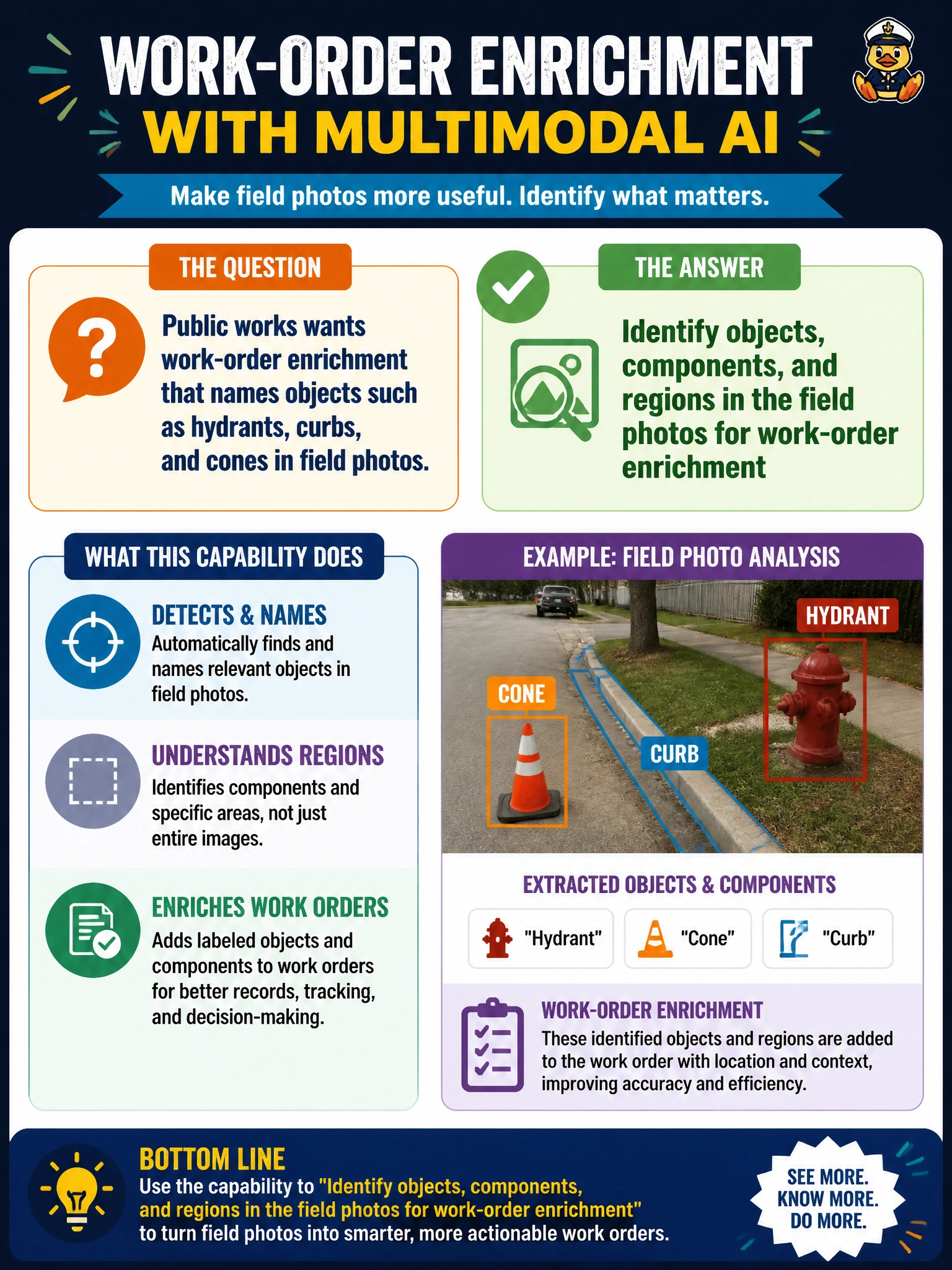
Public works wants work-order enrichment that names objects such as hydrants, curbs, and cones in field photos. Which multimodal capability should they use?
Select an answer to reveal the explanation.
Short Explanation
The hydrant is in the photo—have the model point it out. Object and region identification turns field pictures into enriched work orders. Captioning them won't label them for you, reading text off them won't identify hydrants and curbs, and discussing them won't tag regions either, so you'll miss the structured enrichment you need.
Full Explanation
Object, component, and region identification is the multimodal capability that labels what appears in field imagery so work systems can be enriched automatically. Public works should use that capability on field photos to name assets such as hydrants, curbs, and cones, and to mark relevant regions, then attach those labels to the work order. Enrichment grounded in the photo reduces blank inventory fields and helps crews arrive with the right context.
Captioning objects, components, and regions in the field photos for work-order enrichment produces descriptive prose but does not systematically identify and localize specific assets such as hydrants, curbs, and cones, so it cannot populate structured work-order fields. Reading text on objects, components, and regions in the field photos for work-order enrichment reads visible writing on assets but does not identify the physical assets such as hydrants, curbs, and cones or mark their regions, so it cannot provide the object identification the work order needs. Discussing objects, components, and regions in the field photos for work-order enrichment provides conversational commentary but does not systematically label the objects, components, and regions required for structured work-order enrichment.
Exam caveat: detectors can confuse similar street furniture or miss occluded assets; enrichment should be presented as assistive labels, not unquestioned GIS truth. Operational check: run identification on representative field photos, confirm labeled objects match what supervisors see, write accepted labels into the work-order enrichment fields, and allow field crews to correct false positives before closing the job.
Prefer to study offline? Printable PDF study book + test engine ($7.50, unofficial). These questions stay free here.