
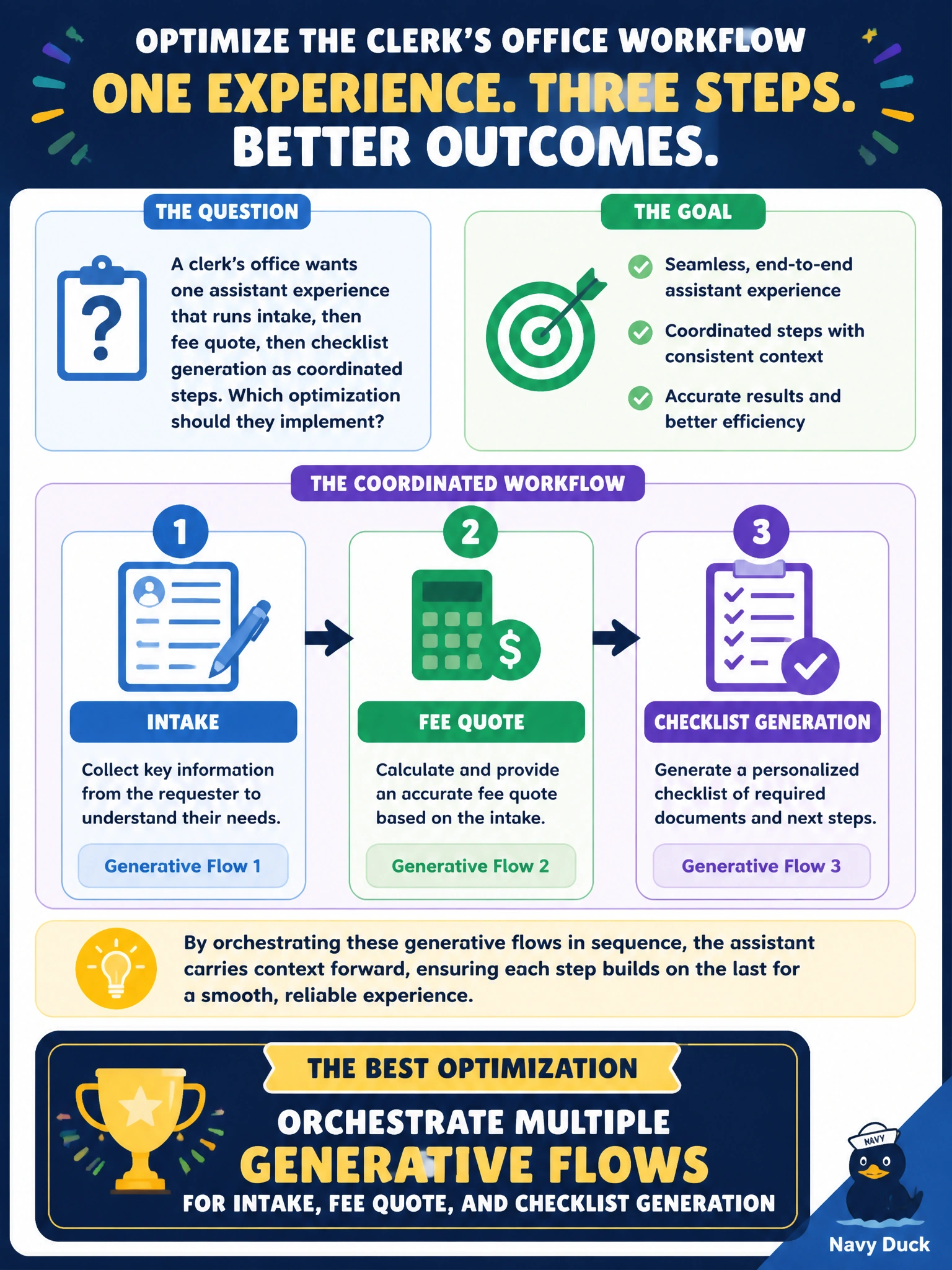
A clerk's office wants one assistant experience that runs intake, then fee quote, then checklist generation as coordinated steps. Which optimization should they implement?
Select an answer to reveal the explanation.
Short Explanation
Filing help is a relay, not three strangers shouting across the lobby. Orchestrate intake, fee quote, and checklist generation as connected flows so the clerk assistant feels like one trip. One dynamic agent running everything on its own can't keep the steps coordinated, so you'll lose context between intake, quoting, and checklists.
Full Explanation
A clerk’s office that wants one assistant experience running intake, then fee quote, then checklist generation as coordinated steps should orchestrate multiple generative flows across that sequence. Residents experience filing help as one journey. Orchestration shares case context from intake into fee quote and checklist generation so each step builds on the last instead of restarting. That multi-flow coordination is the optimization for a unified clerk assistant.
Combining intake, fee quote, and checklist into a single generative flow fails by concept: it merges coordinated steps into one monolithic flow instead of orchestrating multiple generative flows with shared context between stages. Deploying one autonomous agent to manage intake, quoting, and checklists dynamically fails because an autonomous agent lacks the structured orchestration and shared context needed for coordinated steps, causing continuity to break. Sequencing intake, fee quote, and checklist steps using rigid scripted handoffs between stages fails because rigid scripts cannot adapt to case type or orchestrate generative steps with shared context.
Exam caveat: unified clerk assistants need orchestrated multi-step generative flows with shared context—not a single combined flow, one autonomous dynamic agent, or rigid scripted handoffs. Operational check: implement a workflow that passes intake state into fee quote and checklist steps, verify case-type branching, measure completion across all three steps, and fix drop-offs where context is lost between flows.
Prefer to study offline? Printable PDF study book + test engine ($7.50, unofficial). These questions stay free here.