
A city portal routes simple how-to questions cheaply and complex policy questions to a stronger model. Which optimization describes this?
Select an answer to reveal the explanation.
Short Explanation
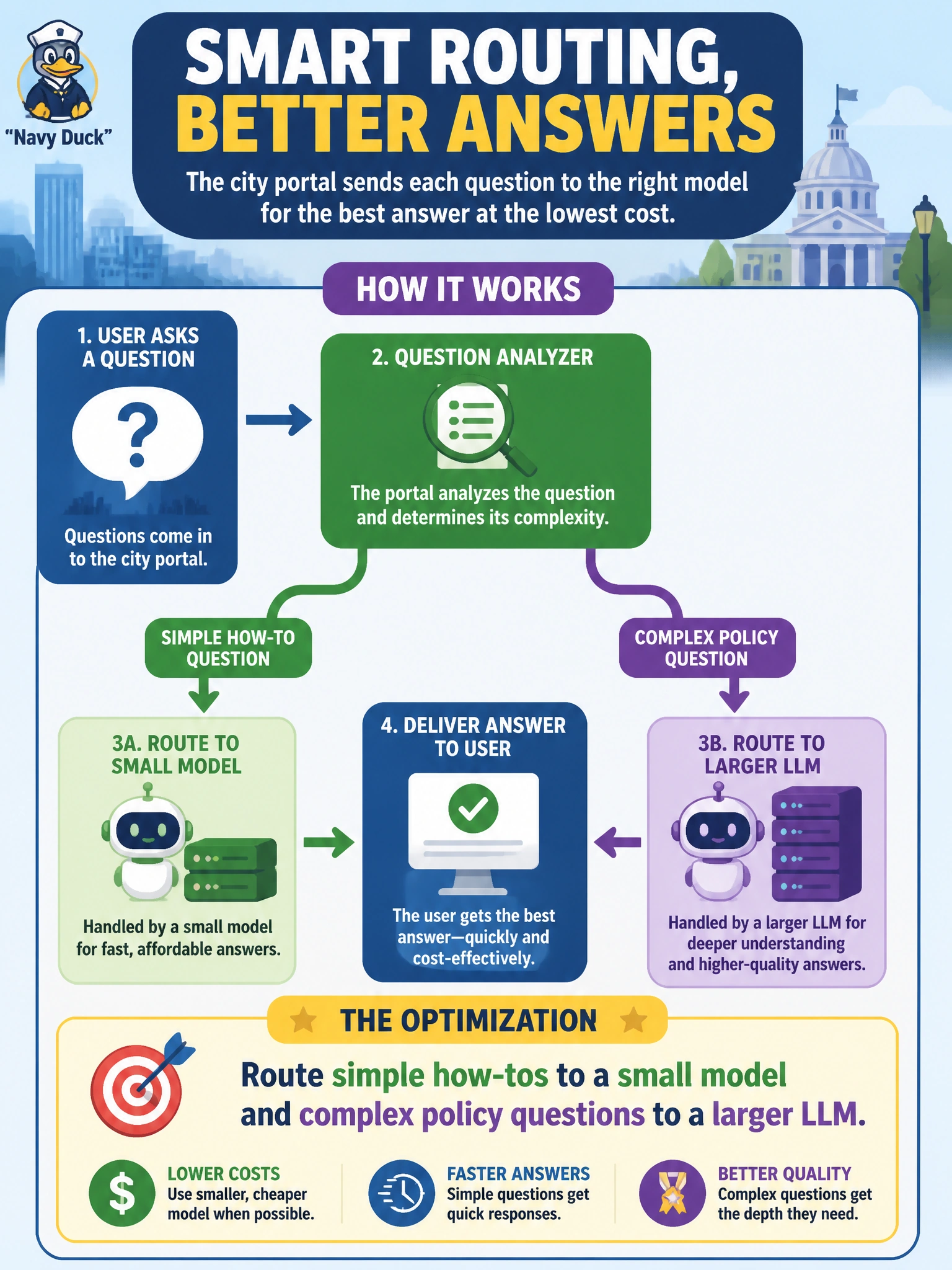
Password-reset how-tos don't need the same horsepower as reading a dense ordinance. Route the easy stuff to a small model and keep the big LLM for policy that actually needs it. If you send how-tos to a prompt cache, send how-tos to search, or hand policy to a classifier, you're not matching model size to complexity and you'll waste money or lose quality on policy.
Full Explanation
A city portal that routes simple how-to questions cheaply and complex policy questions to a stronger model is using multi-model routing: send simple how-tos to a small model and complex policy questions to a larger LLM. Password resets and hours questions do not need the same capacity as multi-page ordinance interpretation. Routing by complexity preserves answer quality on hard policy while controlling spend on routine how-tos—the optimization the stem describes.
Routing simple how-tos to a prompt cache and complex policy questions to a larger LLM fails because sending easy questions to a cache instead of a small model is cache reuse, not routing between small and large models by complexity. Routing simple how-tos to a search index and complex policy questions to a larger LLM fails because sending easy questions to retrieval instead of a small model is search routing, not routing between small and large models by complexity. Routing simple how-tos to a small model and complex policy to a fine-tuned classifier fails because a classifier only assigns labels instead of generating answers, so dense ordinance interpretation loses the larger LLM capacity it needs.
Exam caveat: this optimization is complexity-based model routing—not routing how-tos to a prompt cache instead of a small model, routing how-tos to a search index instead of a small model, or routing policy to a fine-tuned classifier instead of a larger LLM. Operational check: classify portal intents into how-to versus policy buckets, route accordingly, measure cost and accuracy per bucket, and escalate low-confidence how-tos to the larger model when needed.
Prefer to study offline? Printable PDF study book + test engine ($7.50, unofficial). These questions stay free here.