
A clerk agent’s fees API sometimes times out. What should the team design after analyzing those tool failures?
Select an answer to reveal the explanation.
Short Explanation
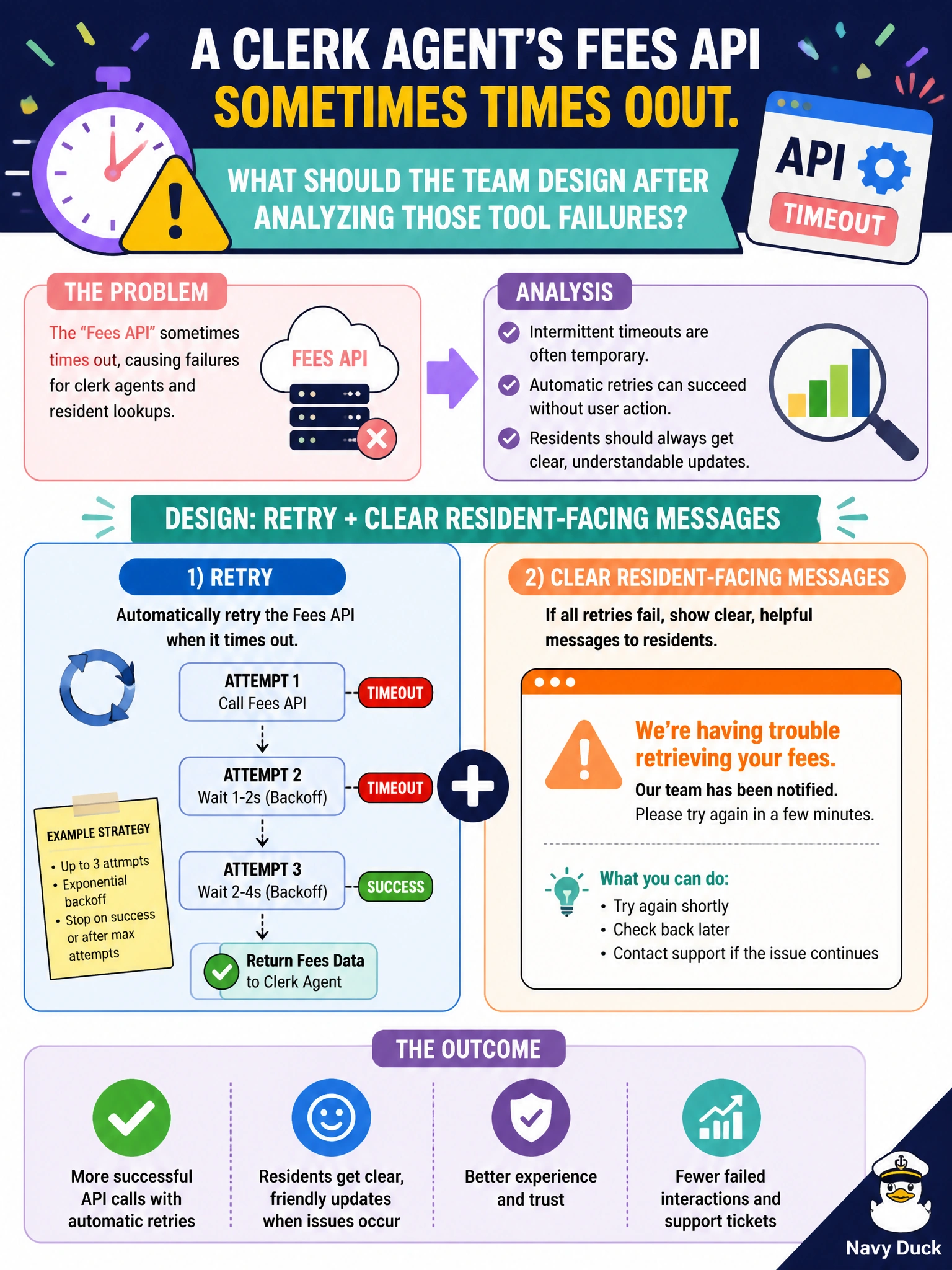
When the fees API times out, you need honesty and a plan—not cached fees with a disclaimer, a longer deadline, or being asked to restate the request. Analyze the failure, then design sensible retries and clear messages. Asking you to repeat the lookup after a timeout doesn’t fix the problem; it just delays an honest answer.
Full Explanation
After analyzing fees-API timeouts for a clerk agent, the team should design retries and clear resident-facing messages for that failure mode. Error analysis identifies timeouts as a transient dependency fault; good agent design then retries within bounded policy and tells the resident the fee lookup failed instead of serving cached schedules, extending the deadline with status updates, or asking the resident to restate the request. That graceful degradation preserves trust at the clerk desk when finance systems blip. Serving the cached fee schedule with a disclaimer to verify at payment is an integrity risk—residents may still act on a stale amount at payment, and the disclaimer shifts the verification burden to them instead of giving an honest failure message now. Extending the fees API deadline and displaying interim status updates ignores the need for bounded retries and honest failure messaging; it only delays the timeout while keeping the resident waiting without a real answer. Recording timeout patterns for tuning and asking residents to restate the fee request does not resolve the current timeout; it passes the work back to the resident without providing bounded retries or a clear answer now. On the exam, post-analysis design means bounded retry plus honest user messaging; distractors serve cached schedules with disclaimers, extend deadlines with status updates, or log patterns and ask residents to repeat the request. Caveat: retry storms can worsen outages—use capped exponential backoff, idempotent reads, and circuit breaking aligned with the fees API's guidance. Operational check: inject a fees-API timeout in test, verify limited retries, confirm the resident sees a clear failure/retry message rather than a cached schedule, an extended deadline, or a request to restate, and ensure timeout events remain in logs for operators.
Prefer to study offline? Printable PDF study book + test engine ($7.50, unofficial). These questions stay free here.