
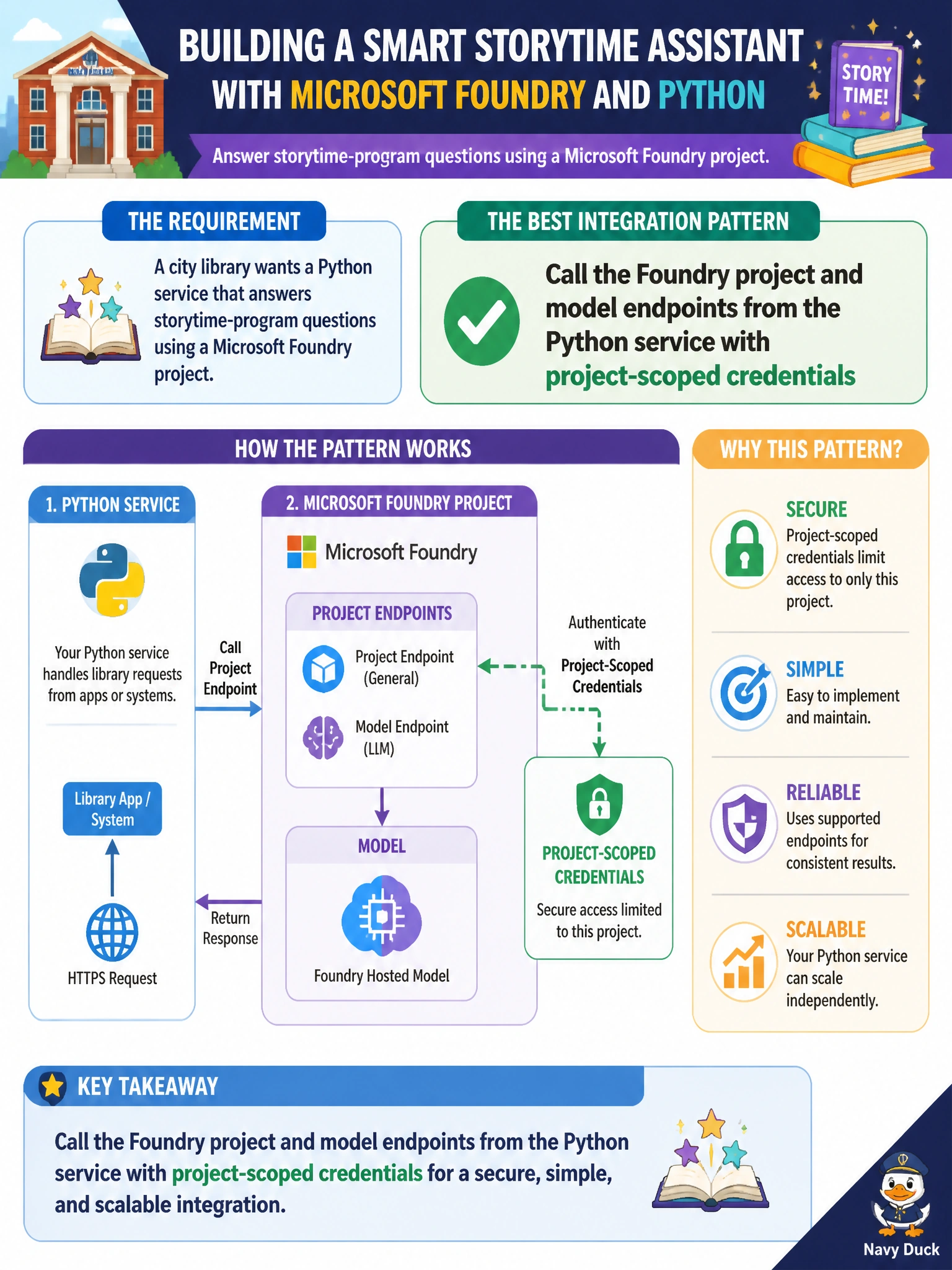
A city library wants a Python service that answers storytime-program questions using a Microsoft Foundry project. Which integration pattern should the developer implement?
Select an answer to reveal the explanation.
Short Explanation
Think of Foundry like the library’s shared service desk—you call it with the right badge, you don't run inference locally in every branch script. The Python service authenticates to the project and talks to the deployed model endpoints. That keeps credentials and models managed in one place for civic Q&A.
Full Explanation
A city library Python service should consume a Microsoft Foundry project the same way other municipal apps consume managed platform services: authenticate with project-scoped credentials and call the project and model endpoints from application code. That pattern keeps model hosting, versioning, quotas, and credential rotation in Foundry while the library service remains a thin client for storytime-program Q&A. Residents get answers from the current deployment without each branch website shipping model binaries. Running the Foundry model inference locally in the Python service with project-scoped credentials abandons managed deployment, bloats the service, and forces every update through a service redeploy instead of a controlled model swap through Foundry. Calling the Foundry control-plane endpoint from the Python service with project-scoped credentials for inference misuses the management plane for data-plane work and is not a substitute for calling the existing storytime model endpoint. Calling the Foundry project and model endpoints from the Python service with subscription-scoped credentials uses an overly broad scope that violates least privilege and risks access beyond the storytime project, and is not the project-scoped credential pattern the Python service should use. On the exam, Foundry app integration means call project/model endpoints with scoped credentials; distractors run inference locally in the Python service, misuse the control-plane endpoint for inference, or call project/model endpoints with subscription-scoped credentials. Caveat: project-scoped credentials still need least privilege, secret store usage, and network controls—calling Foundry does not replace municipal identity or private-networking baselines. Operational check: from the Python service, acquire project-scoped credentials, invoke the storytime model endpoint with a sample patron question, verify the response path and audit logs, and confirm no inference runs locally in the Python service and no FTP shares are shipped with the library website.
Prefer to study offline? Printable PDF study book + test engine ($7.50, unofficial). These questions stay free here.