
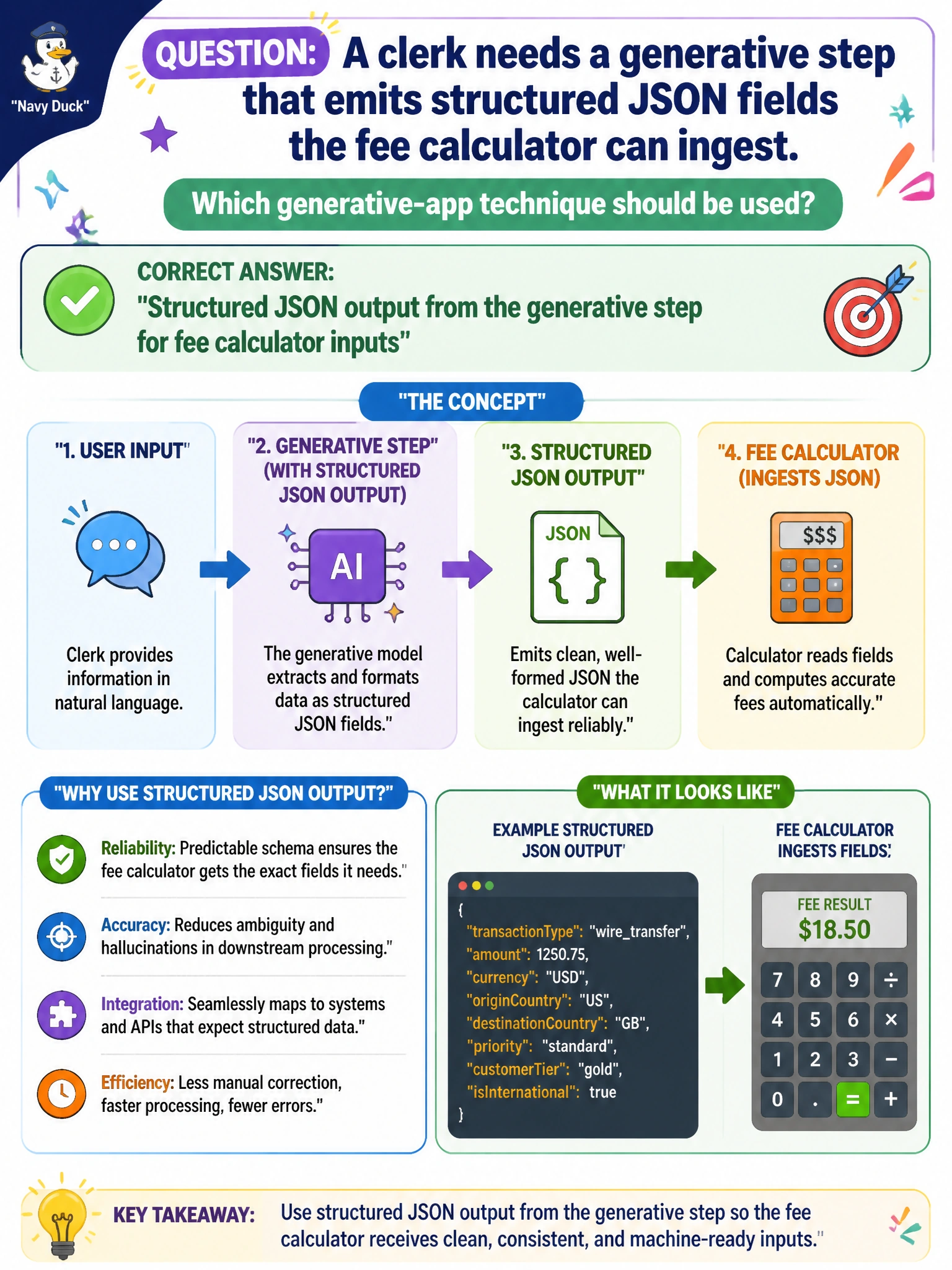
A clerk needs a generative step that emits structured JSON fields the fee calculator can ingest. Which generative-app technique should be used?
Select an answer to reveal the explanation.
Short Explanation
Fee calculators need structured fee fields, not schemaless JSON you'll have to fix by hand because it's missing schema guarantees. Shape the generative step to emit JSON the calculator can ingest. That bridge is how generative AI plugs into real clerk workflows.
Full Explanation
Structured JSON output from the generative step for fee calculator inputs is the generative-app technique the clerk's office needs. Downstream civic systems parse discrete fields—filing type, page counts, party counts, exemptions—not schemaless JSON that the fee calculator cannot reliably ingest without schema-defined fields. Constraining or schema-guiding the model to emit JSON for fee calculator inputs makes the generative classification and extraction step a reliable producer for the fee calculator instead of schemaless JSON that cannot be reliably ingested for calculation without schema validation.
Returning schemaless JSON output from the generative step still leaves the calculator without reliable inputs, because without a defined schema field names, types, and required values can vary and fail ingestion. Providing a structured JSON citation from the generative step gives the calculator a well-formed provenance pointer, but a citation identifies the source rather than supplying the discrete fee inputs the calculation logic requires to ingest. Producing summarized JSON output from the generative step condenses the filing into an abbreviated object, but summarization drops or merges the discrete structured values the calculator needs to ingest and compute.
Exam caveat: generative applications that feed municipal business systems should use structured outputs such as JSON with schema validation rather than schemaless JSON, summarized JSON, or a structured JSON citation from the generative step. Operational check: validate generative responses against the JSON schema required by the fee calculator, reject nonconforming payloads before calculation, and confirm calculator totals match expected fees on a golden set of representative filings.
Prefer to study offline? Printable PDF study book + test engine ($7.50, unofficial). These questions stay free here.