
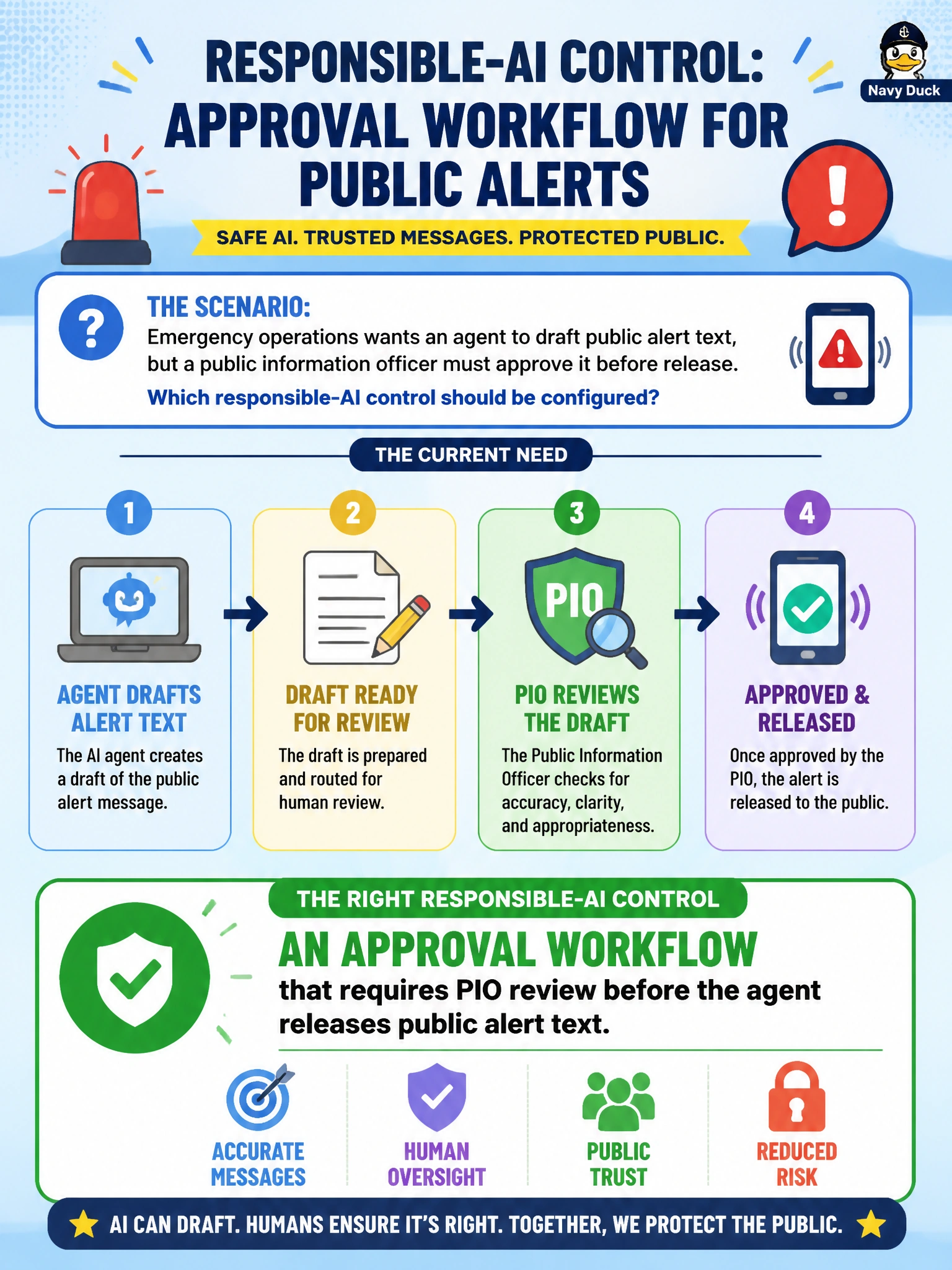
Emergency operations wants an agent to draft public alert text, but a public information officer must approve it before release. Which responsible-AI control should be configured?
Select an answer to reveal the explanation.
Short Explanation
Public alerts are like press releases—you do not hit send until the PIO signs off. Wire an approval workflow so the agent drafts, then a human releases. That keeps speed without letting an unsupervised bot speak for the city.
Full Explanation
An approval workflow that requires public information officer (PIO) review before release is the responsible-AI control that matches Emergency Operations' need for agent-drafted public alert text under human gatekeeping. Generative agents can accelerate first drafts of weather, evacuation, or utility notices, but public release is a high-impact civic act: wording errors, incomplete instructions, or premature publication can misdirect residents and erode trust. Configuring the agent so drafts remain in a pending state until a designated PIO approves publication preserves speed while enforcing accountability and municipal communications policy.
A notification workflow that records PIO review before the agent releases public alert text only provides visibility and an audit record, it does not block publication until approval is granted, so it cannot guarantee that unreviewed wording is stopped before reaching residents. A content-safety filter that requests PIO review before the agent releases public alert text remains an automated screen for policy violations, not an enforcement gate for human approval, so it does not satisfy the requirement that a designated public information officer approve release. A fine-tuned model that applies PIO edits before the agent releases public alert text can improve wording quality by learning municipal tone but does not add the approval gate the scenario calls for, since learned style alone does not stop a draft from publishing without PIO review.
Exam caveat: human-in-the-loop and approval workflows are distinct from a notification workflow that records PIO review before the agent releases public alert text, because logging a review for audit visibility does not deny the publish tool pending an explicit approval signal, so it does not stop a bad alert from going live. Operational check: verify that the agent's publish or send tool is denied until an approval signal from an authorized PIO role is recorded, and that rejected drafts cannot be reposted without a new review cycle.
Prefer to study offline? Printable PDF study book + test engine ($7.50, unofficial). These questions stay free here.