
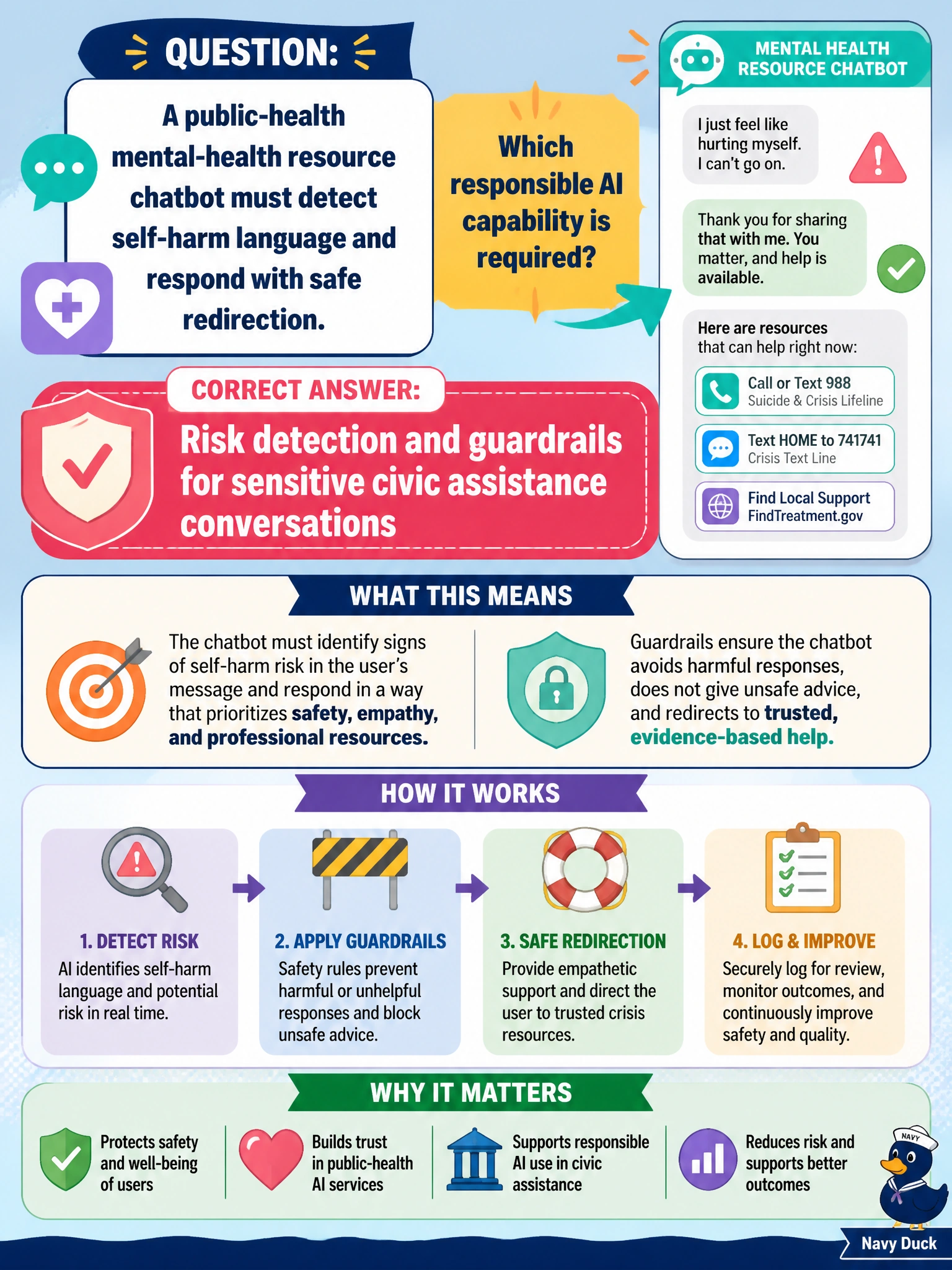
A public-health mental-health resource chatbot must detect self-harm language and respond with safe redirection. Which responsible AI capability is required?
Select an answer to reveal the explanation.
Short Explanation
When someone in crisis talks to a city chatbot, you'll need a safety net—not grounding checks, jailbreak defenses, or toxicity filters. Risk detection spots self-harm language and steers people to appropriate resources. Guardrails keep the bot in its lane while still showing compassion.
Full Explanation
A public-health mental-health resource chatbot must implement risk detection and guardrails for sensitive civic assistance conversations so self-harm language triggers safe redirection rather than unsafe free-form replies. The capability works because specialized classifiers and policy layers can detect crisis cues, suppress harmful generative advice, and steer users to approved helplines and resources the health department designates. For municipal mental-health support bots, risk detection is a required safety property of the conversation stack.
Grounding and citation checks for sensitive civic assistance conversations fails because it verifies factual claims against trusted sources; it cannot recognize self-harm cues in real time or trigger safe redirection, so a resident in crisis would not receive immediate help. Jailbreak and injection defenses for sensitive civic assistance conversations fails because blocking prompt injections and policy bypasses does not detect crisis language or initiate safe redirection; the bot's role is resource navigation and safety redirection, not adversarial exploit prevention. Toxicity and profanity filters for sensitive civic assistance conversations fails because filtering offensive or profane wording protects civility but does not intervene in real time when self-harm language appears; toxicity controls must not override the duty to detect risk and steer users to approved helplines.
Exam caveat: detection models produce false positives/negatives—pair automated guardrails with clear escalation paths and periodic review of flagged transcripts under privacy rules. Operational check: enable risk categories for self-harm, verify canned safe-redirection responses and official resource links, test with approved evaluation prompts, and assign clinical/program owners to review safety metrics for the health chatbot.
Prefer to study offline? Printable PDF study book + test engine ($7.50, unofficial). These questions stay free here.