
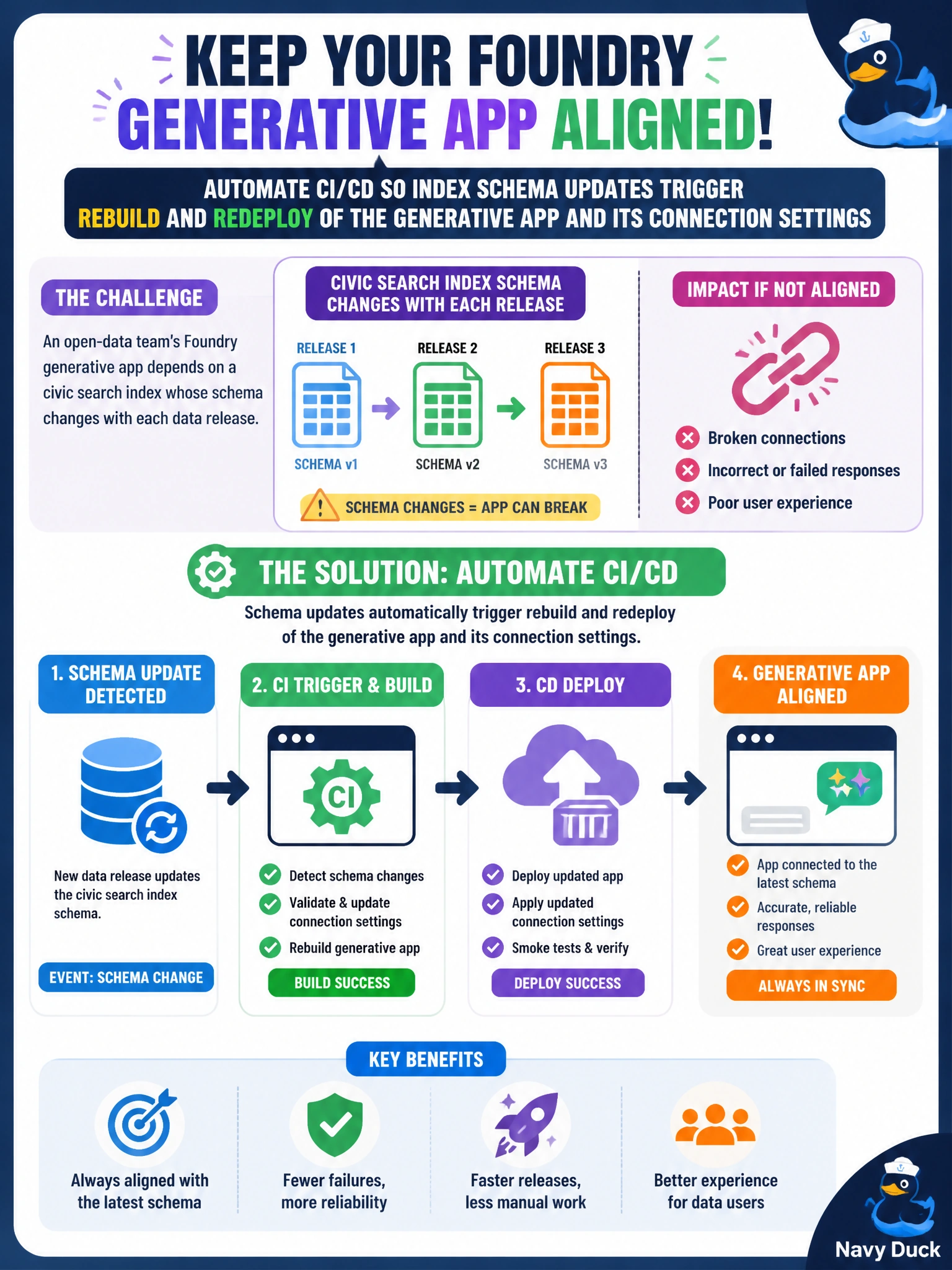
An open-data team’s Foundry generative app depends on a civic search index whose schema changes with each data release. How should they keep the app aligned?
Select an answer to reveal the explanation.
Short Explanation
When the open-data catalog changes shape, the app that reads it has to change too—same as updating a map after new streets open. Hook schema releases into CI/CD so the Foundry generative app rebuilds and redeploys with matching connection and query settings. That won't work if you're only updating the Foundry prompt template by hand and pushing it through manual staging validation—schema changes need the app and its connection settings rebuilt and redeployed automatically.
Full Explanation
Automating CI/CD so civic search-index schema updates trigger rebuild and redeploy of the Foundry generative app keeps connection settings, field mappings, and retrieval configuration synchronized with each open-data release. The approach works because schema drift is an integration change: when the municipal search index adds, renames, or removes fields, the generative app’s index definitions, filters, and prompt grounding assumptions must be rebuilt from the same pipeline that publishes the data, not discovered after residents see broken answers. Treating schema alignment as a deployment dependency reduces manual error and shortens the window where the open-data app answers against an obsolete contract.
Updating the Foundry prompt template to reference new fields and releasing it through manual staging validation fails because prompt edits are not schema management—manual validation is fragile, does not rebuild connection settings or retrieval configuration, and can still let the app run against an obsolete contract between releases. Rebuilding the Azure AI Search index with updated skillset mappings while retaining the existing app deployment fails because it updates the index but leaves the generative app's connection settings, field mappings, and prompt grounding pointed at the old schema, so the app can still retrieve or interpret the wrong fields. Configuring scheduled evaluation runs in Foundry to score grounded responses using versioned test datasets fails because evaluation only detects schema drift after answers are generated—it does not rebuild or redeploy the app, its connection settings, or its retrieval configuration to match the new index.
Exam caveat: CI/CD must validate schema compatibility (required fields, types, vectorizer settings) before cutover; a blind redeploy can still ship a mapping that compiles but retrieves the wrong fields. Operational check: on each data release, run pipeline tests that assert index fields match app configuration, deploy to a staging slot, sample retrieval against known records, then promote only after grounding checks pass.
Prefer to study offline? Printable PDF study book + test engine ($7.50, unofficial). These questions stay free here.