
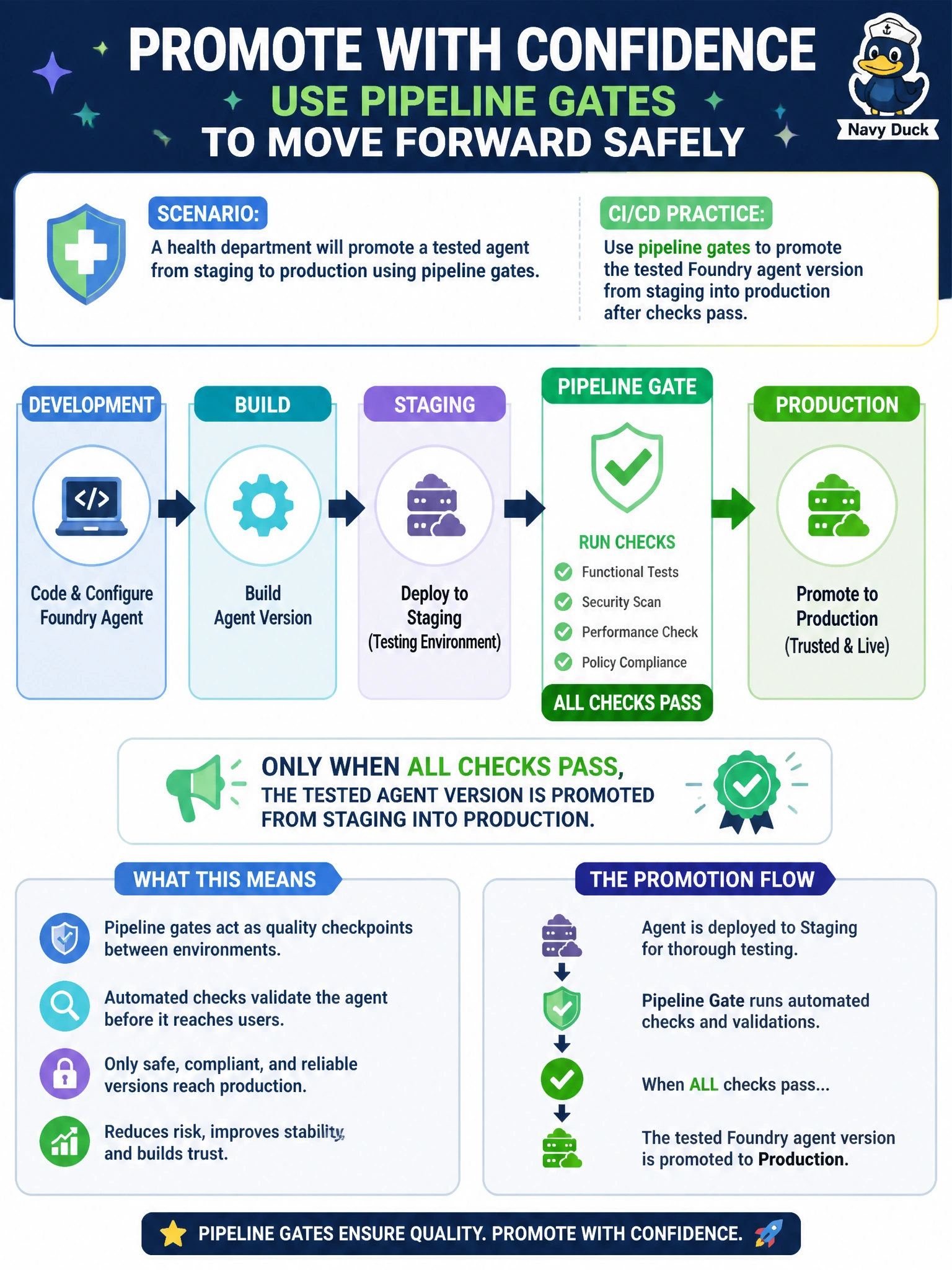
A health department will promote a tested agent from staging to production using pipeline gates. Which CI/CD practice applies?
Select an answer to reveal the explanation.
Short Explanation
Staging is the dress rehearsal; pipeline gates are the stage manager’s go/no-go. You'll promote the tested health agent itself after those checks pass, since moving only the endpoint leaves the old agent in place.
Full Explanation
A health department promoting a tested agent from staging to production should use pipeline gates so the tested Foundry agent version promotes only after checks pass. CI/CD gates encode go/no-go controls between environments. For civic Foundry delivery, gated promotion preserves change control during sensitive service hours and keeps version identity intact for rollback and audit.
Using pipeline gates to promote the latest Foundry agent build from staging into production after checks pass fails quality and auditability—promoting the latest build bypasses the tested version and ships unchecked changes to health-facing systems. Using pipeline gates to promote the tested Foundry agent endpoint from staging into production after checks pass fails relevance: it moves the access point, not the agent, so patient-facing workflows still depend on the unpromoted version. Using pipeline gates to promote the tested Foundry agent prompt from staging into production after checks pass fails completeness: it moves only prompt text, not the full tested agent, so patient-facing workflows still depend on the unpromoted versioned logic.
Exam caveat: gates should include automated tests and human approval appropriate to health-service risk—not merely a ceremonial checkbox with no evidence. Operational check: run a staging validation suite, require gate approval, promote a named agent version, and verify production reports that version while clinic operations continue uninterrupted.
Prefer to study offline? Printable PDF study book + test engine ($7.50, unofficial). These questions stay free here.