
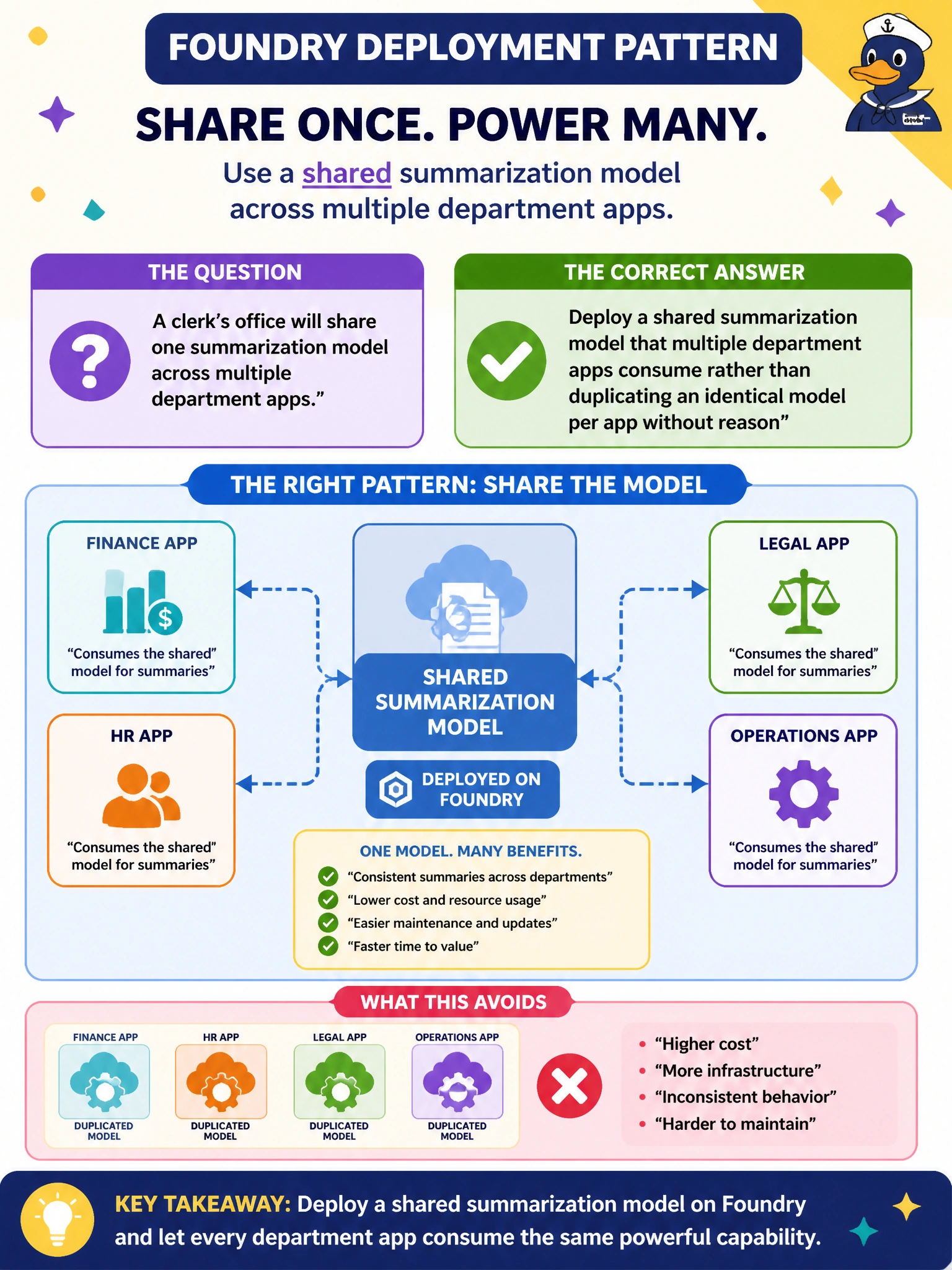
A clerk’s office will share one summarization model across multiple department apps. Which Foundry deployment pattern fits?
Select an answer to reveal the explanation.
Short Explanation
You can point planning, courts, and finance apps at one shared summarization deployment, like using a shared printer on the floor. You'll save cost when you share one deployment, and you don't need separate endpoints per desk for scaling unless isolation demands it.
Full Explanation
When a clerk’s office will share one summarization model across multiple department apps, the fitting Foundry pattern is a shared summarization model deployment that those apps consume rather than duplicating an identical model per app without reason. Shared deployments centralize versioning, cost management, and operational monitoring for a common generative capability across municipal apps. Deploying a shared summarization model definition that each department app hosts through its own managed online endpoint for independent scaling fails efficiency and misreads the need: a shared Foundry model deployment already serves generative summarization, and separate hosted endpoints per app duplicate cost and management without required isolation. Registering a shared summarization model in the Foundry model catalog that department apps invoke directly for summaries using catalog-hosted inference fails the business goal because catalog registration alone provides no inference capacity, and department apps need a shared deployed endpoint to generate summaries. Publishing the summarization model to a shared Foundry batch endpoint that multiple department apps call for daytime counter summaries to optimize cost fails the business goal because batch inference is asynchronous and isn't suited to interactive daytime counter service and blocks the shared, low-latency pattern departments need. Exam caveat: share by default when isolation is not required; isolate when compliance or noisy-neighbor concerns demand dedicated deployments. Operational check: point two department apps at the shared summarization deployment, verify quota and auth per app, and monitor latency/cost as a shared service rather than just registering the model in the catalog expecting direct catalog-hosted inference.
Prefer to study offline? Printable PDF study book + test engine ($7.50, unofficial). These questions stay free here.