
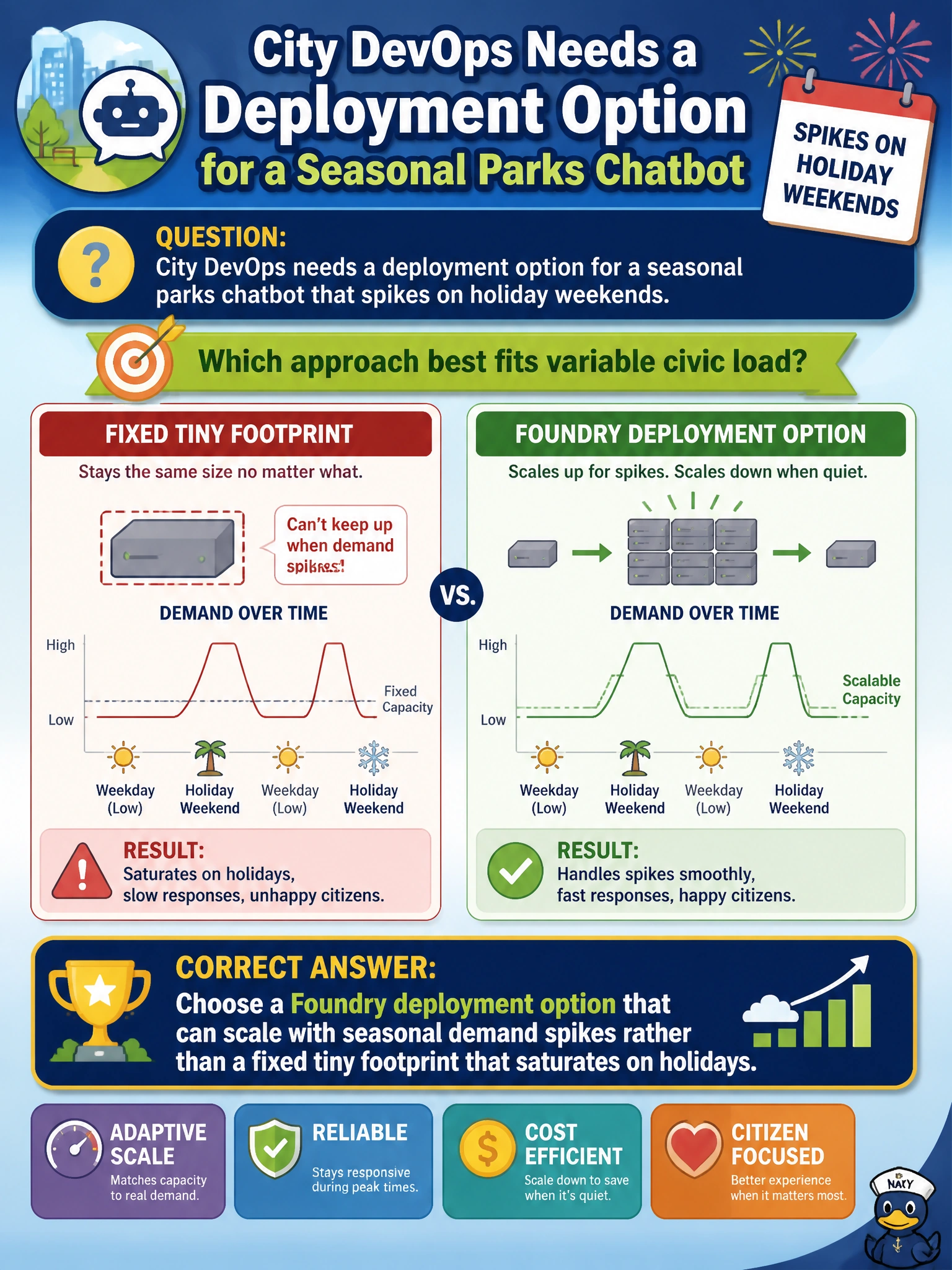
City DevOps needs a deployment option for a seasonal parks chatbot that spikes on holiday weekends. Which approach best fits variable civic load?
Select an answer to reveal the explanation.
Short Explanation
Holiday weekends are the park's rush hour—you'll need headroom to flex, not locked-in provisioned throughput with reserved capacity that sits idle between spikes. Pick a Foundry option that can ride those seasonal spikes.
Full Explanation
City DevOps supporting a seasonal parks chatbot that spikes on holiday weekends should choose a Foundry deployment option that can scale with demand spikes rather than a fixed tiny footprint that saturates on holidays. Variable civic load is a deployment-planning concern: capacity must flex with resident traffic patterns, not stay locked in reserved provisioned throughput capacity that sits idle between seasonal spikes. Parks chatbots often see bursty holiday and weekend demand that a provisioned throughput deployment with reserved capacity cannot handle efficiently because reserved capacity forces payment for idle peak headroom year-round. Choosing a Foundry provisioned throughput deployment with reserved capacity for seasonal demand spikes rather than a low quota that throttles on holidays fails the variable-load need by construction—reserved capacity is built for steady predictable throughput, so the deployment carries peak-cost headroom year-round even when off-season traffic is idle instead of scaling elastically with demand. Choosing a Foundry batch inference deployment with queued jobs for seasonal chatbot spikes rather than a small limit that blocks on holidays fails a citywide chatbot that must respond to residents in real time, not process dialogue offline in queued batches. Choosing a Foundry standard deployment with single-region throughput for seasonal demand spikes rather than a tiny base that stalls on holidays fails the business need because single-region throughput cannot expand for production holiday-weekend surge, so traffic saturates the deployment and stalls exactly when residents need park services. Exam caveat: scaling options still need cost controls, quotas, and rate limits so spikes do not produce unbounded spend or starve other municipal apps. Operational check: load-test a holiday-weekend concurrency profile before peak season, verify autoscale or reserved headroom engages under that profile, and set alerts for throttling, elevated latency, or error rates during events.
Prefer to study offline? Printable PDF study book + test engine ($7.50, unofficial). These questions stay free here.