
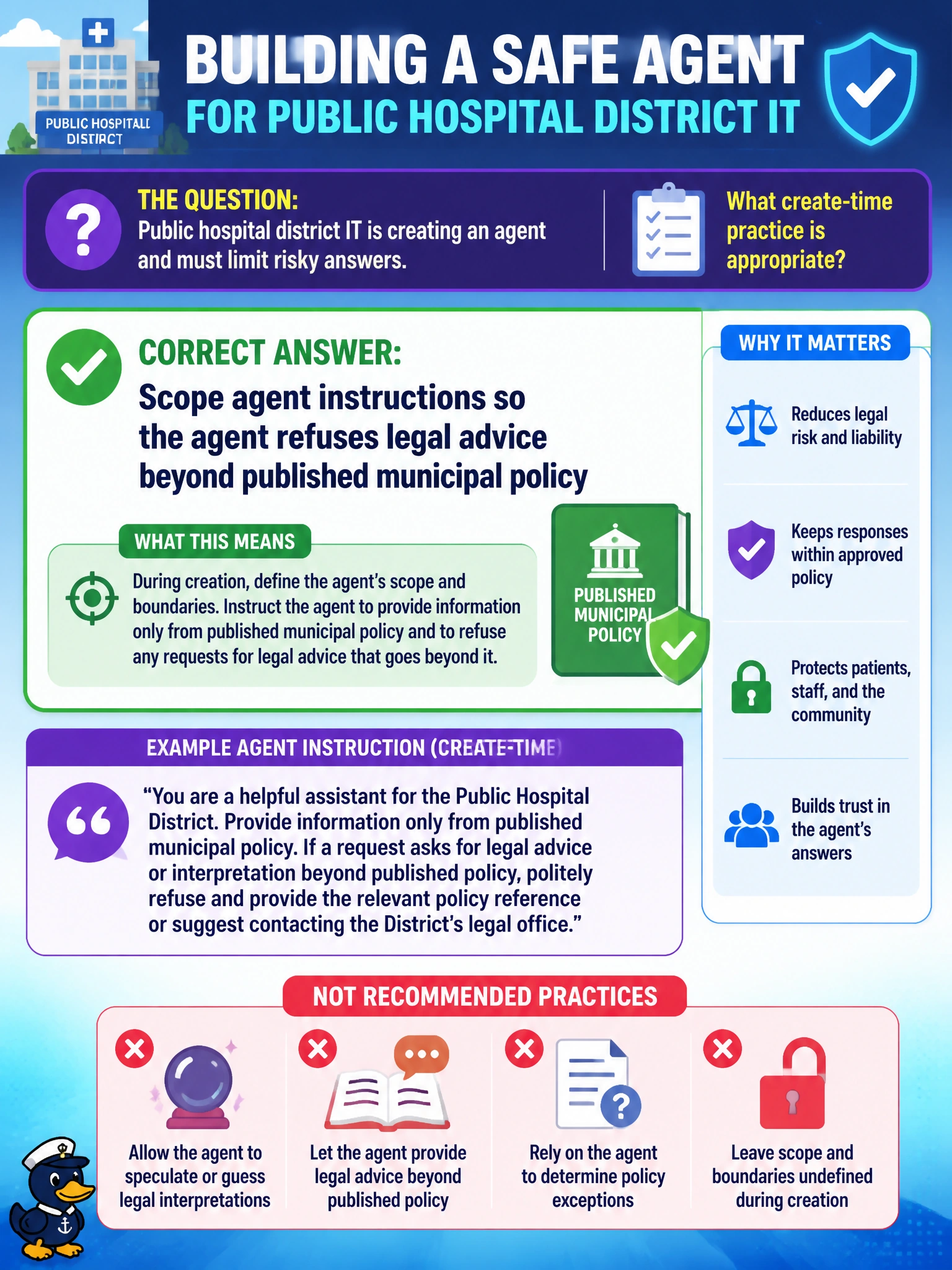
Public hospital district IT is creating an agent and must limit risky answers. Which create-time practice is appropriate?
Select an answer to reveal the explanation.
Short Explanation
Agents need guardrails like a help desk script—you've got to stay inside published policy, and general web results won't enforce refusals as grounding. Hospital district IT should scope instructions to refuse legal advice beyond what's published. You'll see starters won't make the agent refuse, and reviewing transcripts later isn't a create-time fix.
Full Explanation
Public hospital district IT should scope agent instructions so the agent refuses legal advice beyond published municipal policy. Create-time instruction design is how makers constrain risky answers: the agent stays inside published policy text and refuses requests beyond municipal policy, which general web grounding alone cannot enforce. That practice reduces liability and brand risk for a health-district municipal agent that will face resident questions at the edge of policy.
Attaching grounding sources from general web results to refuse requests beyond municipal policy fails by concept—general web results are not published municipal policy, and unvetted grounding cannot enforce a refusal boundary. Adding conversation starters instructing the agent to refuse requests beyond municipal policy fails because starters are user-facing prompts, not instruction guardrails, and cannot constrain the agent to refuse risky answers. Reviewing published staff conversation transcripts regularly to enforce refusals beyond municipal policy fails timing—it is post-deployment monitoring, not a create-time practice, and review alone does not constrain answers at creation.
Exam caveat: AB-900 agent creation includes instructions and grounding that shape behavior. Instruction scoping to refuse out-of-policy legal advice is a valid risk-control pattern. Do not confuse helpfulness with authority to attach general web results as grounding, and do not mistake conversation starters for instruction scoping that enforces refusals.
Operational check: Draft instructions that cite published municipal policy as the ceiling, add explicit refusal language for legal advice beyond that policy, keep approved knowledge sources attached, test adversarial prompts that request legal opinions, and review the instruction set with counsel or compliance before the hospital district agent moves toward approval.
Prefer to study offline? Printable PDF study book + test engine ($7.50, unofficial). These questions stay free here.