
A municipal call center wants its first agent to answer after-hours trash collection questions. What should makers do?
Select an answer to reveal the explanation.
Short Explanation
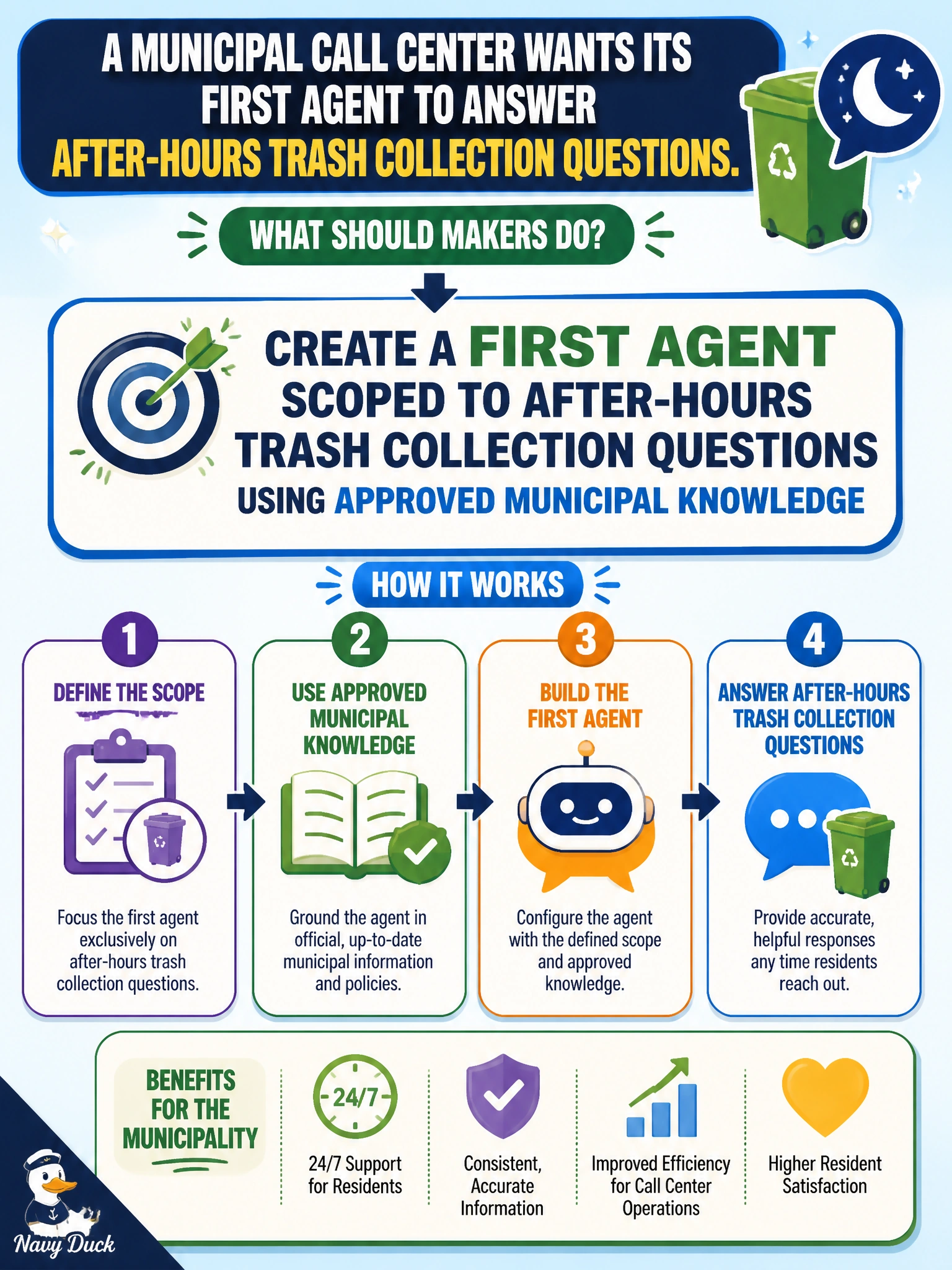
First agent? Keep the scope tiny—after-hours trash questions with approved city knowledge. You should create that focused agent, not share it broadly with staff before focused testing with sample questions. Small scoped win beats boiling the ocean.
Full Explanation
Municipal call center makers should create a first agent scoped to after-hours trash collection questions using approved municipal knowledge. Starting narrow is the correct fundamentals move: a bounded workload, approved content, and a clear resident need (after-hours trash questions) produce a manageable first agent instead of an unbounded citywide brain. Scoped creation teaches makers the create-an-agent path while limiting blast radius if answers need correction.
Creating a broad city services agent from the after-hours trash collection knowledge base fails by scope—after-hours trash questions need a bounded first agent, not an unbounded citywide brain, because a broad scope is harder to manage and correct. Grounding the trash collection agent in public web results about regional waste collection schedules fails because public web results are not approved municipal knowledge and can conflict with official collection schedules; AB-900 agent creation should use approved content, not open web results. Sharing the after-hours trash collection agent broadly with staff before focused testing with sample questions fails because broad sharing skips controlled validation and risks exposing unchecked answers before sample questions confirm they are reliable.
Exam caveat: Domain 3 expects you to know that creating an agent is a valid admin/maker task and that agents should be grounded on approved content with a sensible scope. Do not ground the agent in public web results about regional waste collection schedules instead of approved municipal content for this exam’s Copilot administration domain.
Operational check: Collect the approved trash collection FAQ or policy pages, create a first after-hours trash agent with that grounding only, limit access to call-center roles initially, test common after-hours questions (holiday schedules, missed pickup), and expand scope only after approval and monitoring show stable answers.
Prefer to study offline? Printable PDF study book + test engine ($7.50, unofficial). These questions stay free here.