
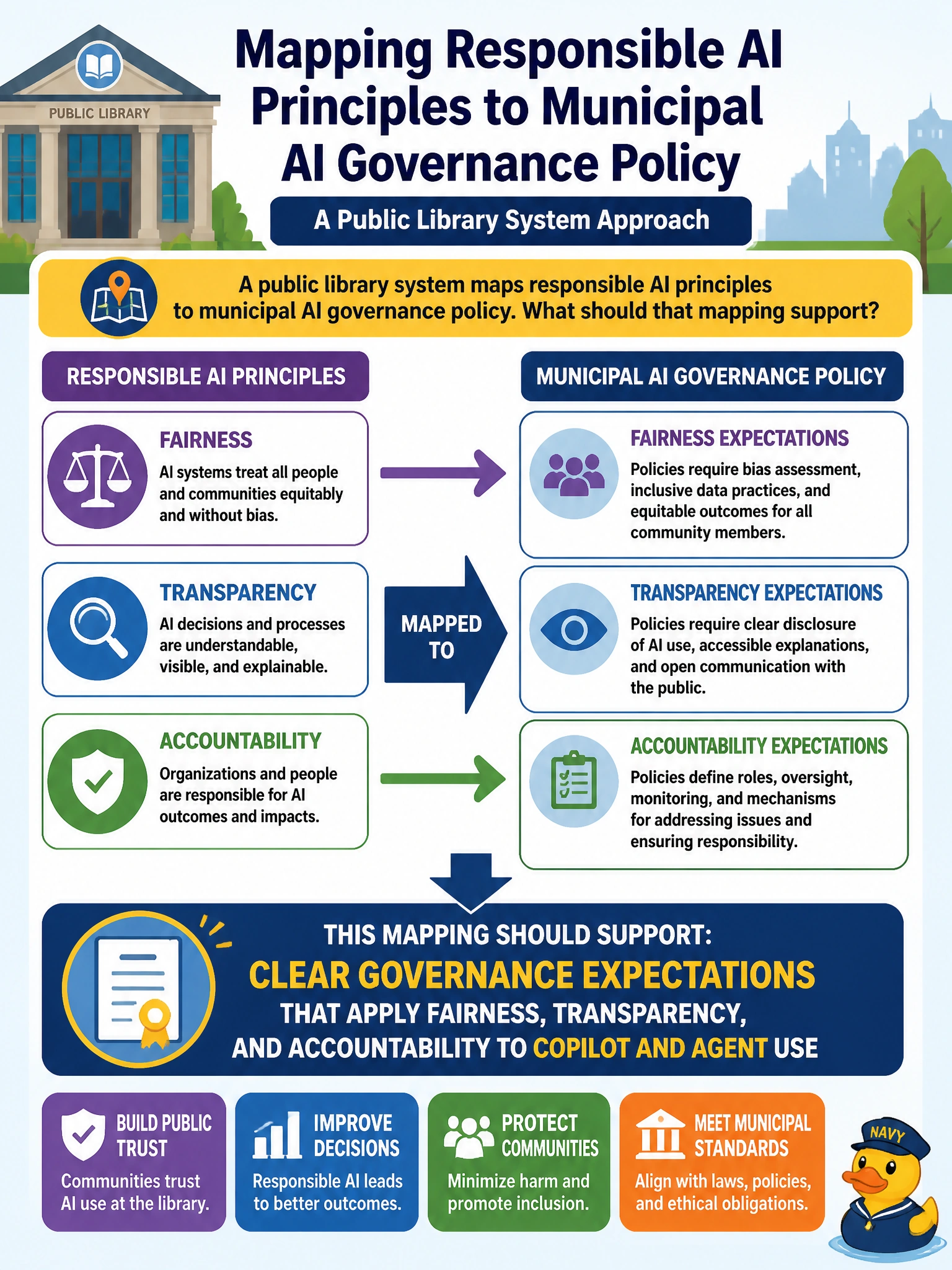
A public library system maps responsible AI principles to municipal AI governance policy. What should that mapping support?
Select an answer to reveal the explanation.
Short Explanation
Map the principles to real policy so library AI isn't a free-for-all. You want fairness, transparency, and accountability showing up in governance—not development controls, usage quotas, or throughput benchmarks. That's how municipal AI policy earns trust.
Full Explanation
Mapping responsible AI principles into municipal AI governance policy should support clear governance expectations that apply fairness, transparency, and accountability to Copilot and agent use. For a public library system, that means written expectations for how staff and AI tools handle patron privacy, how AI assistance is disclosed, and who owns decisions when Copilot drafts public or staff-facing content. Principles become operational only when they appear in policy that staff can follow—not when they remain abstract slide titles.
Defined development controls that apply fairness, transparency, and accountability to Copilot model training fails the mapping test: model training controls govern development, not the governance expectations that apply fairness, transparency, and accountability to Copilot and agent use. Documented usage quotas that enforce fairness, transparency, and accountability for Copilot and agent workloads fails the mapping test: usage quotas manage capacity allocation, but they do not establish the written governance expectations that make responsible AI principles operational and auditable. Measured throughput benchmarks that assess fairness, transparency, and accountability in Copilot and agent sessions fails the mapping test: throughput benchmarks measure operational performance, not the principle-to-policy mapping or human oversight required for responsible AI governance.
Exam caveat: AB-900 asks you to recognize that responsible AI principles should be reflected in governance for Copilot and agents. It does not require writing a full municipal AI ordinance. Related privacy tooling (labels, DLP) may support the same goals but is not the answer when the stem asks what principle-to-policy mapping should support.
Operational check: Ensure the library AI governance note explicitly cites fairness, transparency, and accountability for Copilot/agent use; confirm privacy policies still apply to AI-assisted workflows; and name owners for review of high-impact or public-facing AI outputs before go-live.
Prefer to study offline? Printable PDF study book + test engine ($7.50, unofficial). These questions stay free here.