
A county assessor's office connects Graph permissions reality to what a transit planner sees in Copilot. What connection is correct?
Select an answer to reveal the explanation.
Short Explanation
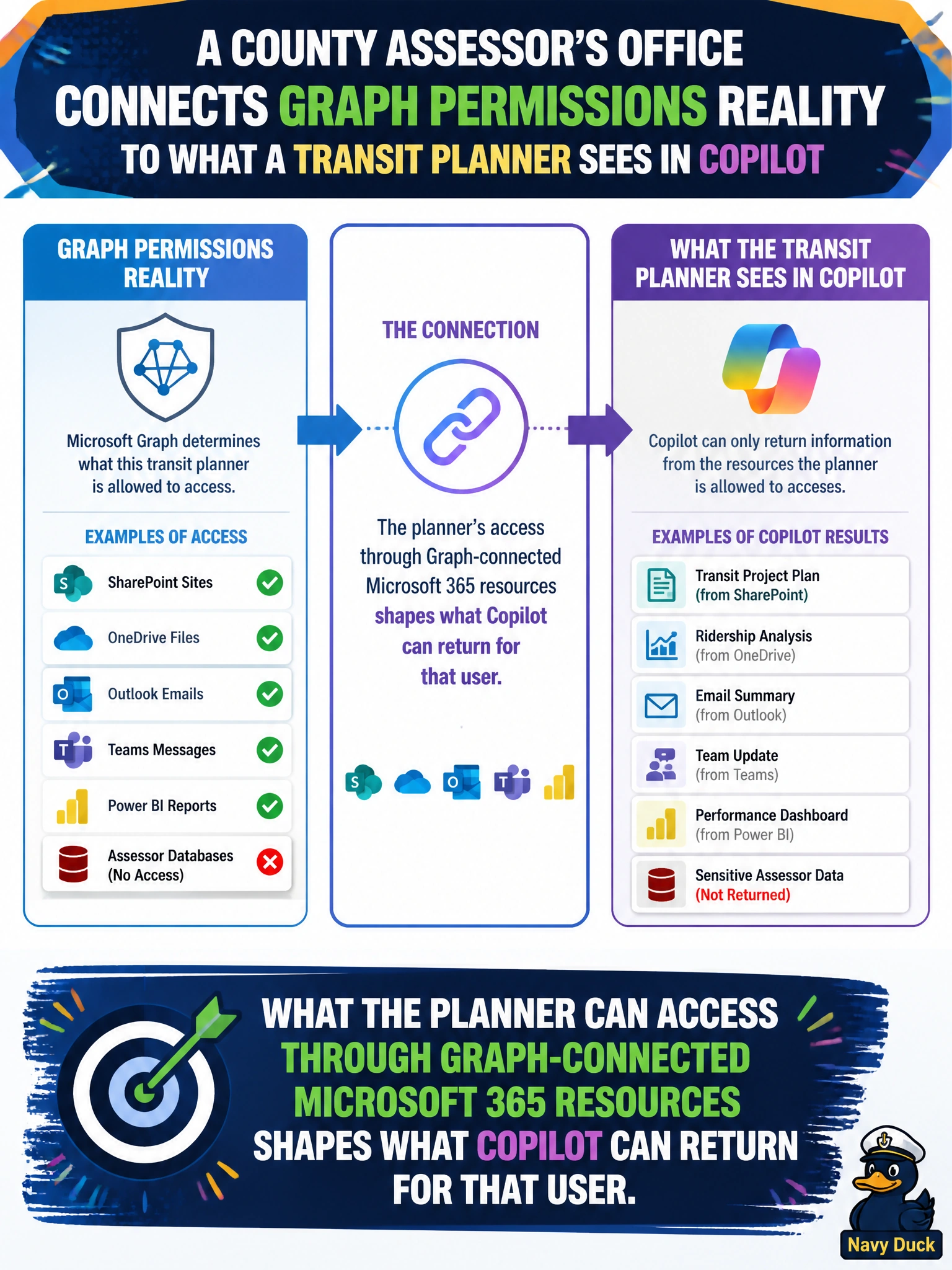
What a transit planner can access via Graph-connected resources is what Copilot can draw from for that planner. Your Entra tenant roles don't decide what you'll get, just having recently opened files doesn't mean that's all you can see, and what's in the last crawl snapshot isn't what defines your current access. Same user, same permissions reality—just surfaced through Copilot.
Full Explanation
What a transit planner can access through Graph-connected Microsoft 365 resources shapes what Copilot can return for that user. A county assessor's office connecting Graph permissions reality to Copilot visibility should state that per-user access relationship. Saying what the planner can access through Microsoft Entra tenant roles determines what Copilot can return confuses directory management roles with content permissions; Entra tenant roles govern administrative scope, while Copilot reflects each planner's own existing permissions on the Graph-connected Microsoft 365 resources themselves rather than role membership. Claiming what the planner has recently opened across Graph-connected Microsoft 365 sources shapes what Copilot can return mistakes a usage signal for a permission boundary; recent opens may affect relevance, but Copilot can return any Graph-connected content the planner is permitted to access whether it was recently opened or not, and still excludes what is not permitted. Treating what the planner could access in the last Graph connector crawl as defining what Copilot can return freezes permissions at index time; crawl timing only affects how current indexed content is, while Copilot enforces the planner's current Graph-connected permissions at query time so later grants or revocations still apply. Exam caveat: same user, same permissions—Copilot reflects accessible Graph-connected resources, not Microsoft Entra tenant roles, recent opens, or the last connector crawl snapshot. Operational check: compare Copilot results for a planner with limited access versus one with broader project access, and use differences to validate that permissions—not a global Copilot dump—drive outputs. This is why two transit planners can receive different Copilot outputs on the same prompt: Graph surfaces organizational signals through each user's permission boundary, not a single shared answer set. Assessors teaching this point should avoid implying that Copilot Chat is a tenant-wide search override; instead, frame Graph as the fabric and permissions as the gate for what any one planner sees.
Prefer to study offline? Printable PDF study book + test engine ($7.50, unofficial). These questions stay free here.