
A city attorney's office wants Identity Secure Score treated as actionable guidance, not a vanity number. Which use fits?
Select an answer to reveal the explanation.
Short Explanation
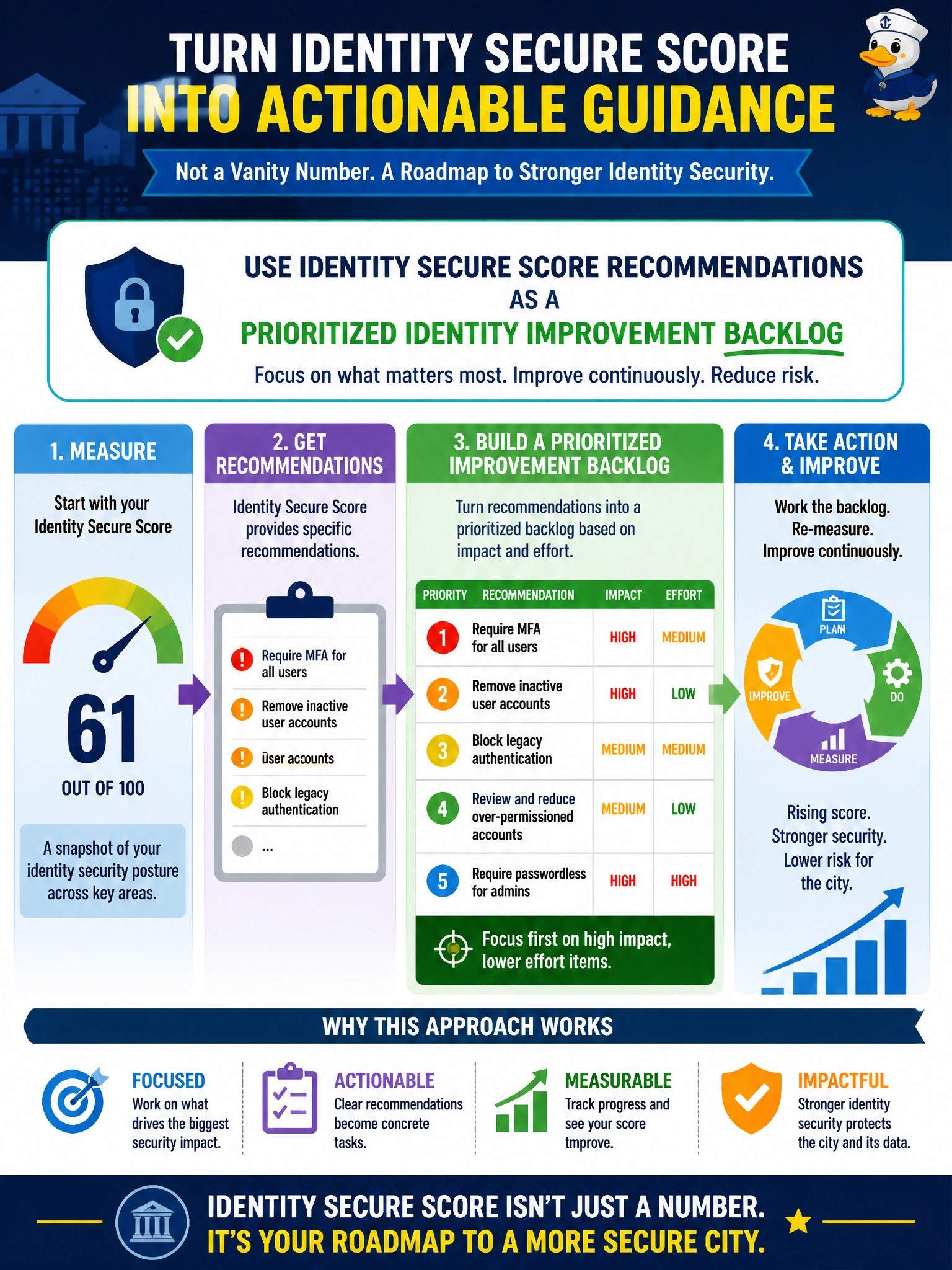
Checking your trend history won't enforce anything by itself, since you'll still need Conditional Access policies to block risky sign-ins. Use the recommendations as your ordered to-do list for identity hardening. Touting your percentage as an SLA or sharing comparisons as licensing proof won't harden anything until you've finished that backlog.
Full Explanation
A city attorney’s office that wants Identity Secure Score treated as actionable guidance—not a vanity number—should use the recommendations as a prioritized identity improvement backlog. The numeric score is a summary; value comes from remediating the listed controls that reduce identity risk for legal and citywide workloads. Treating recommendations as work items aligns counsel’s security expectations with measurable hardening.
Use Identity Secure Score trend history as automated Conditional Access enforcement confuses reporting with enforcement; trend history only shows score movement over time and cannot block or allow access, so the ranked recommendations still need separate Conditional Access policies and owned remediation. Presenting Identity Secure Score percentage as an identity service level agreement misuses a changing improvement benchmark as a contractual promise; the percentage shifts with enabled controls and Microsoft baselines and does not guarantee service performance. Sharing Identity Secure Score comparisons as formal licensing tier qualification proof misuses peer comparison as entitlement evidence; comparisons only contrast posture with similar tenants and do not certify licensing or replace hardening the listed recommendations.
Exam caveat: AB-900 emphasizes using Secure Score recommendations, not worshipping the integer. Screenshots without remediation, zero targets, trend history as enforcement, percentage as SLA, and "comparisons prove licensing tier" distractors test whether you understand measurement versus control.
Operational check: Map each high-impact Identity Secure Score recommendation to an owner in the attorney’s IT support chain, track completion in the city’s change backlog, keep Conditional Access policies in force while remediating, and report both score trend and closed recommendation count to leadership.
Prefer to study offline? Printable PDF study book + test engine ($7.50, unofficial). These questions stay free here.