
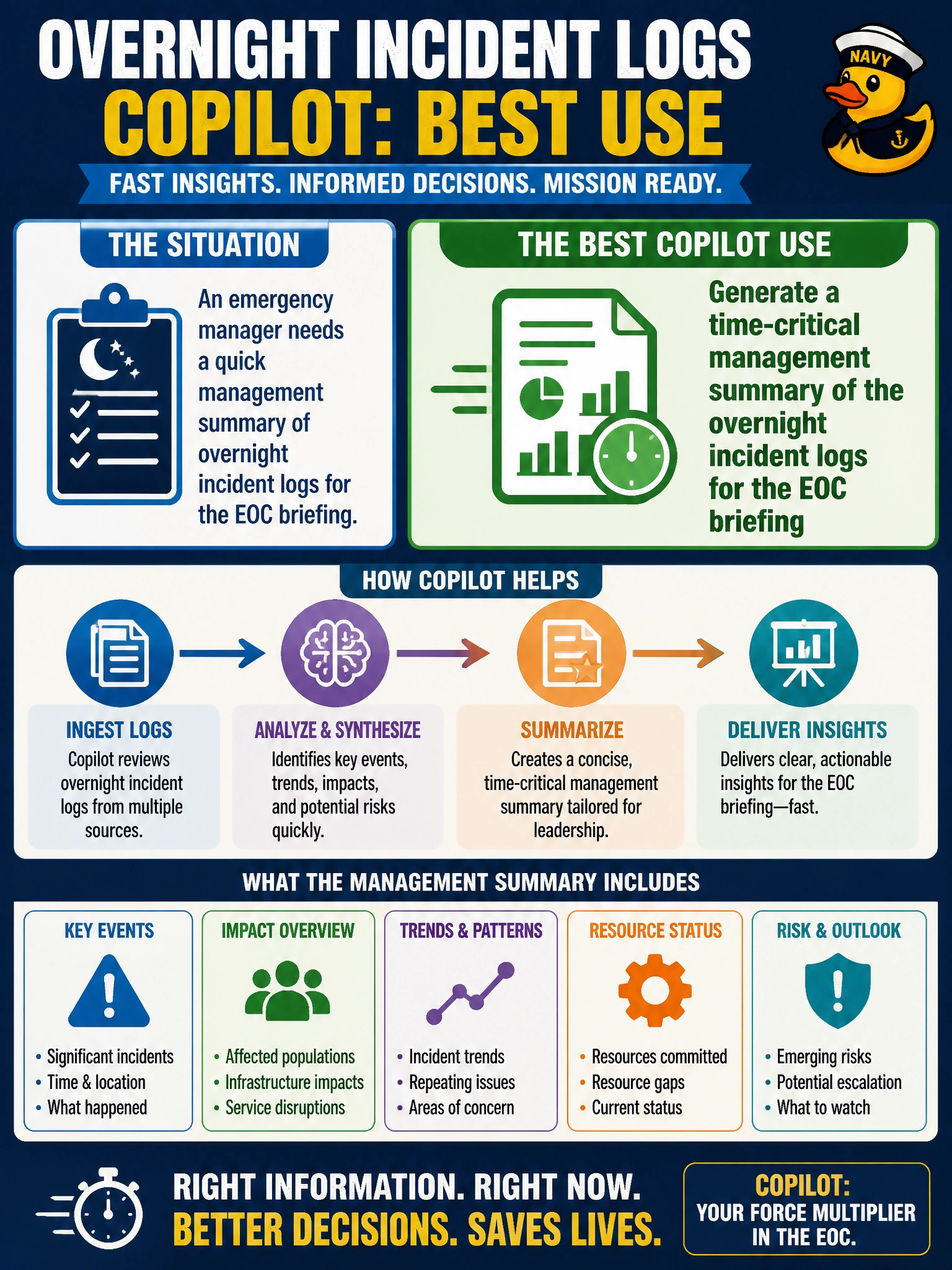
An emergency manager needs a quick management summary of overnight incident logs for the EOC briefing. What is the best Copilot use?
Select an answer to reveal the explanation.
Short Explanation
EOC briefing won’t wait—ask Copilot for a fast management summary of the overnight incident logs, then verify open items. Speed helps; fake closures don’t.
Full Explanation
Emergency Operations Center briefings are time-critical: overnight incident logs must be condensed quickly so commanders see open incidents, resource status, and safety issues. Generating a time-critical management summary of those logs for the EOC briefing is the correct Copilot use—speed with grounding—while humans still verify that items marked open remain open. Fabricating closures or publishing precise evacuated household addresses in a public summary are unacceptable.
Waiting until after the briefing to open the overnight logs at all fails the purpose of an EOC update. Asking Copilot to invent resolved status for incidents still open in the logs fails operational truth and can pull resources off live problems. Publishing precise home addresses of every evacuated household in the public summary fails privacy and can endanger residents.
Exam caveat: for overnight logs into an EOC briefing, choose a fast grounded management summary. Reject delay-without-reading, fake resolutions, and public address dumps.
Operational check: summarize overnight logs with clear open/closed status drawn only from the log fields, withhold precise home addresses from public versions, have the emergency manager verify open items before the briefing clock, and archive the summary with the log export.