
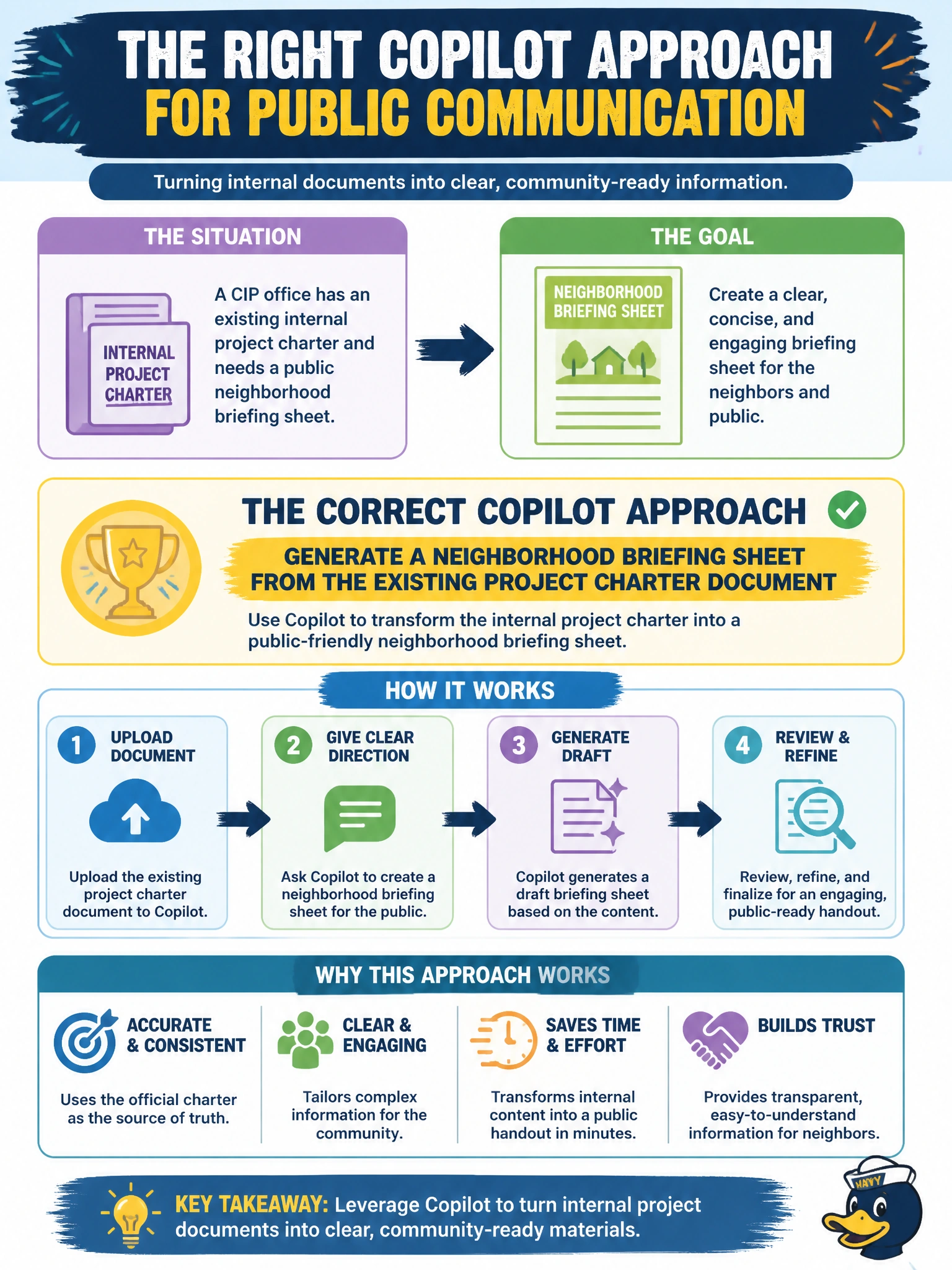
A CIP office has an existing internal project charter and needs a public neighborhood briefing sheet. What Copilot approach fits?
Select an answer to reveal the explanation.
Short Explanation
Internal charter, public briefing—ask Copilot to produce a neighborhood sheet from the existing charter, then human-review what stays public. Don’t leak confidential acquisition notes.
Full Explanation
Capital Improvement Program (CIP) offices routinely translate internal project charters into public neighborhood briefings. The fitting Copilot approach is to generate a neighborhood briefing sheet from the existing charter, then apply human review for what may be released. Grounding keeps scope, funding status, and schedule language consistent with the charter while allowing staff to strip confidential acquisition strategy before the public version goes out—exactly the municipal pattern of source-based drafting plus disclosure control.
Publishing confidential land-acquisition strategy notes from the charter without review fails procurement and negotiation sensitivity; public premature release can inflate costs or compromise deals. Asking Copilot to promise completion dates the charter marks as still unfunded fails fiscal honesty and can mislead residents. Replacing the charter with fabricated cost figures before creating the briefing corrupts the source and produces a false public record.
Exam caveat: for internal-to-public CIP messaging, generate from the charter then review—do not leak acquisition strategy, invent funded dates, or fabricate costs.
Operational check: draft the neighborhood sheet from the charter, explicitly exclude confidential acquisition sections, align dates with funded milestones only, route through CIP/communications review, and retain the charter version ID with the public briefing file.