
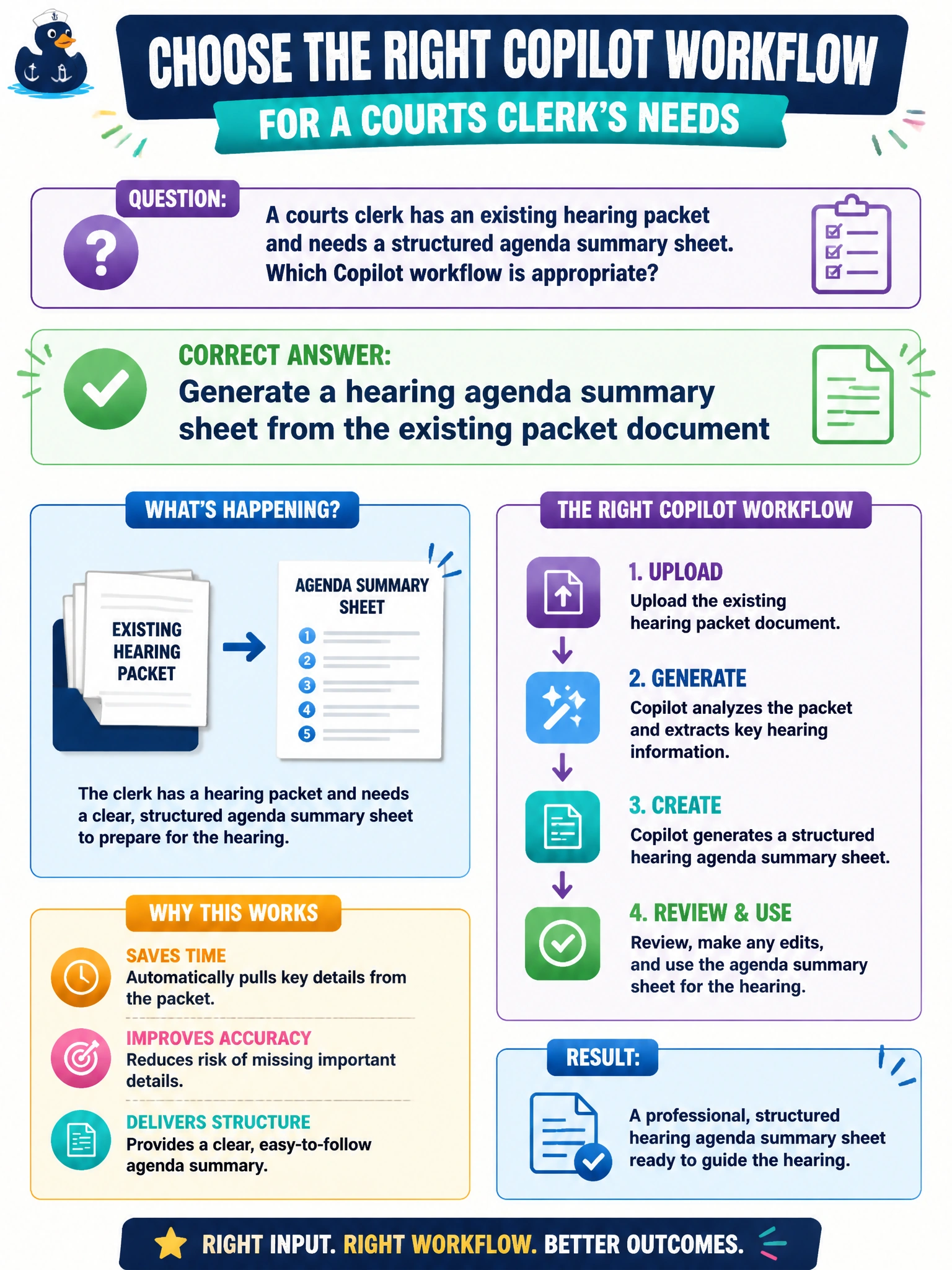
A courts clerk has an existing hearing packet and needs a structured agenda summary sheet. Which Copilot workflow is appropriate?
Select an answer to reveal the explanation.
Short Explanation
Big packet, thin summary sheet—ask Copilot to structure an agenda summary from the existing hearing packet. Stick to what’s in the file; don’t invent rulings.
Full Explanation
Court operations often start from a dense hearing packet and need a structured agenda summary staff and litigants can follow. The appropriate Copilot workflow is to generate that agenda summary sheet from the existing packet so docket items, times, and party captions stay aligned with what is already filed. Grounded structuring improves briefing speed without inventing outcomes or exposing sealed material—core to municipal courts’ duty of accurate, privacy-aware calendaring aids.
Posting sealed juvenile case attachments from the packet to a public website fails confidentiality and statutory sealing rules; generative tools do not authorize public release. Asking Copilot to invent docket outcomes for items not yet heard fails judicial process integrity—summaries must not fabricate rulings. Discarding the packet and drafting from memory alone removes the authoritative source and invites omission or error on time-sensitive dockets.
Exam caveat: choose generate-summary-from-existing-packet when the stem asks for a structured agenda sheet. Avoid publicizing sealed attachments, inventing outcomes, or working without the packet.
Operational check: use the current hearing packet as the only content source, prompt for an agenda summary limited to non-sealed calendar fields, block any sealed juvenile exhibits from prompts and outputs, have the clerk verify against the official docket, then distribute only through authorized court channels.