
A public-health lead builds an outbreak-comms agent for PIOs. How should sharing be scoped?
Select an answer to reveal the explanation.
Short Explanation
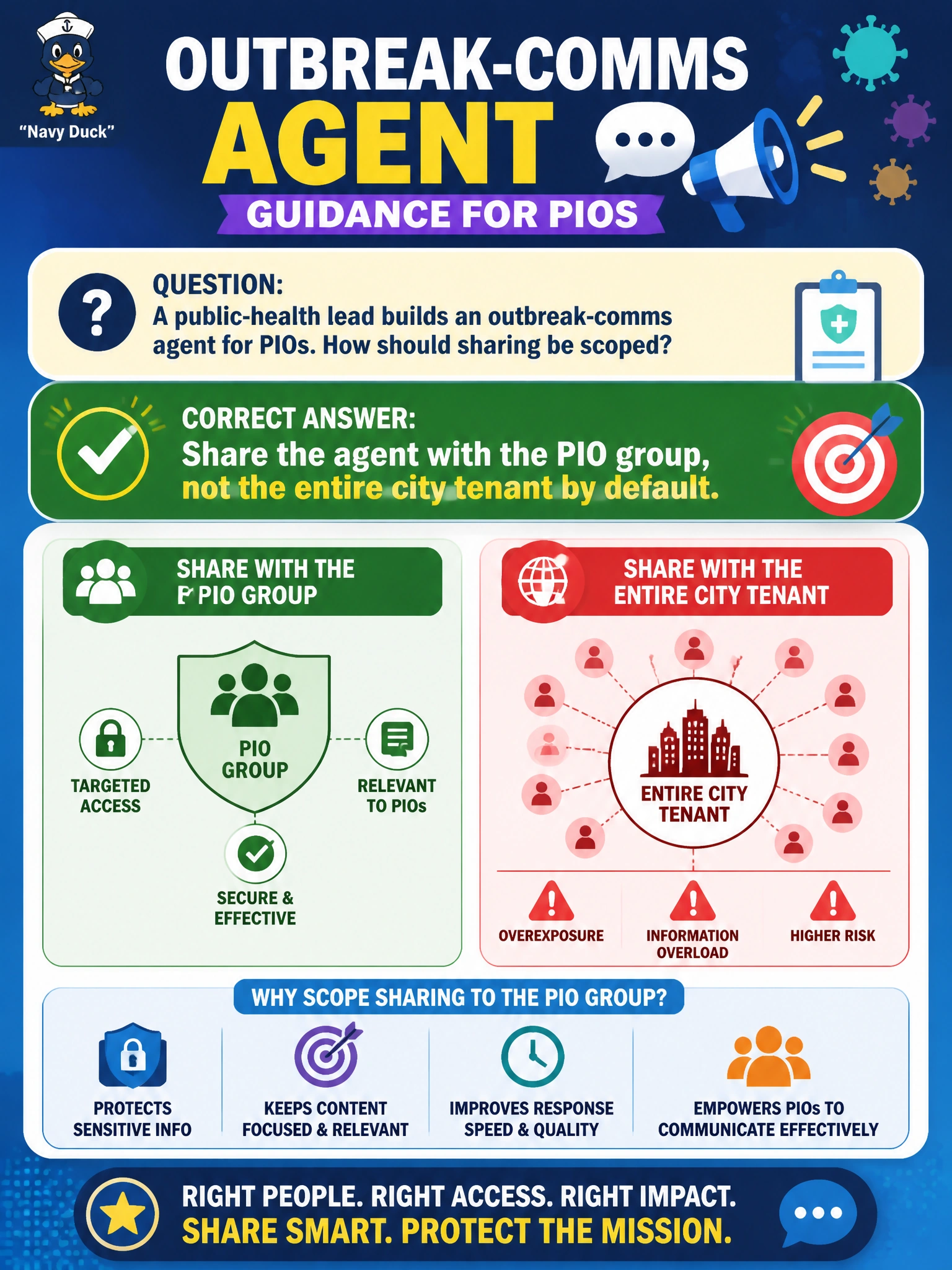
Outbreak messaging isn’t a citywide party invite—share with the PIO group, not the whole tenant. Right audience, right scope.
Full Explanation
Sharing the outbreak-comms agent with the PIO group—not the entire city tenant by default—is the correct sharing scope. Public information officers need a consistent helper for outbreak messaging, but unrelated bureaus do not need edit or use rights by default. Role-scoped sharing limits blast radius, keeps messaging aligned with public-health leads, and avoids accidental use by staff who lack context for sensitive outbreak communications.
Publishing the agent to every mailbox in the city tenant including unrelated bureaus fails by oversharing. Broad tenant publication invites off-role edits, conflicting drafts, and use of outbreak language outside PIO workflows.
Refusing to share with any PIO and requiring each person to rebuild a private copy fails on consistency and efficiency. Parallel private rebuilds diverge in instructions and knowledge, producing conflicting public messages during an outbreak.
Posting the agent link on an unsecured public website for anonymous editing fails as an exposure and integrity failure. Outbreak-comms agents may reference internal holding statements or staging guidance that must not be anonymously editable on the open web.
Exam caveat: Municipal sharing should follow least privilege—grant the operational group that needs the agent, not “everyone” and not “no one.”
Operational check: After sharing, confirm PIO members can open and use the agent while a sample user outside the PIO group cannot; verify the agent is not listed on any public anonymous page before the next briefing cycle.