
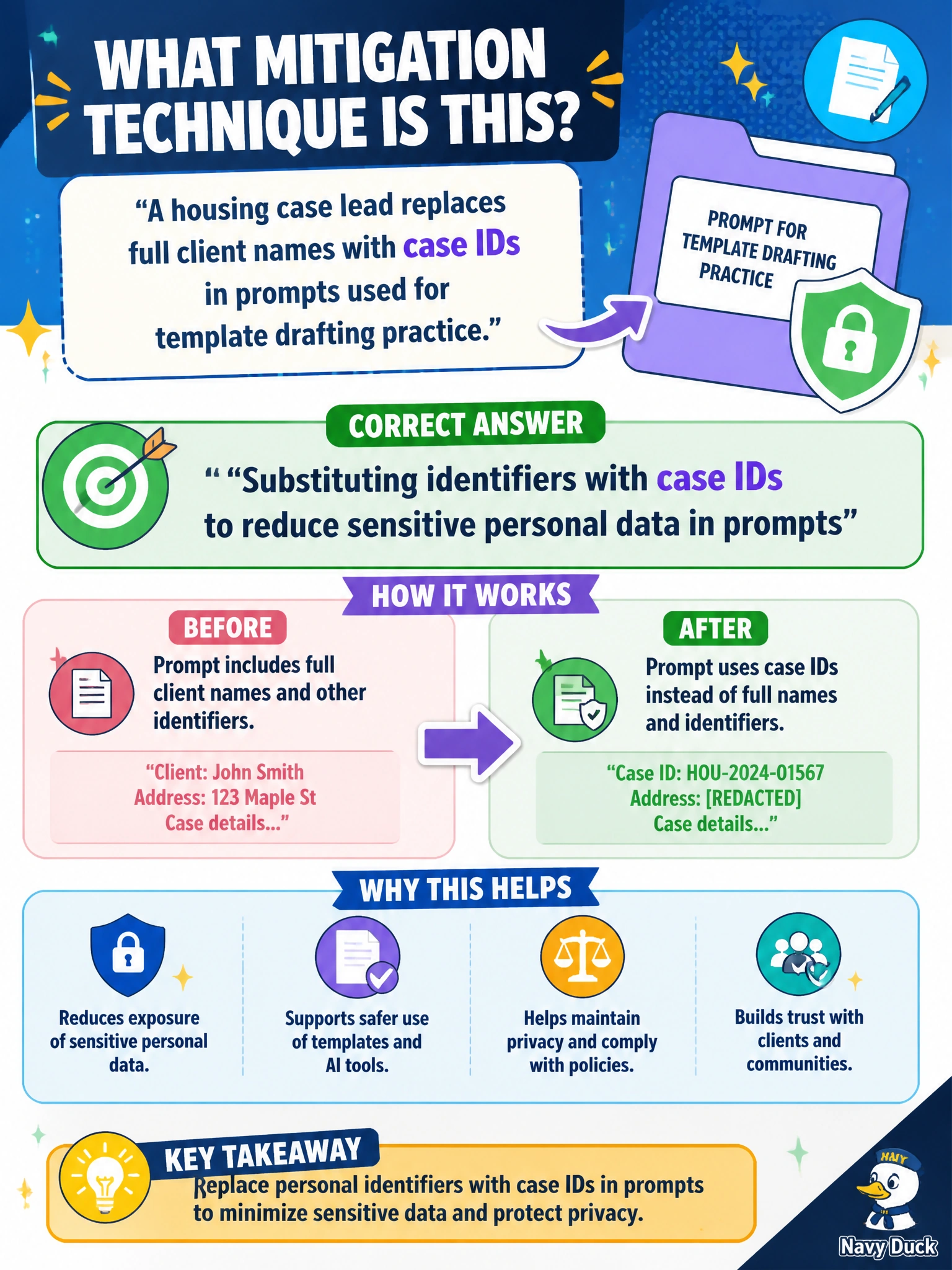
A housing case lead replaces full client names with case IDs in prompts used for template drafting practice. What mitigation technique is this?
Select an answer to reveal the explanation.
Short Explanation
When you’re practicing a template, replace the full client name with a case ID. That de-identification keeps the prompt useful while limiting exposure of personal identifiers.
Full Explanation
Substituting identifiers with case IDs to reduce sensitive personal data in prompts is the mitigation technique used when a housing case lead practices template drafting without full client names. Case IDs preserve workflow referenceability while removing personally identifiable information from the generative context. Practice and template exercises rarely need legal names, so de-identification lowers exposure if a chat is shared, saved, or later reused by housing staff. Increasing prompt injection by embedding every resident SSN fails because SSNs are highly sensitive identifiers, and putting them in prompts increases sensitive-data and adversarial-instruction risk rather than mitigating it. Disabling verification so Copilot can invent client biographies also fails: invented biographies are fabrications, and removing verification removes the human check municipal casework requires. Sharing unredacted client names in Agent Store so all clerks practice together multiplies exposure across the team instead of containing it. Exam caveat: substitution must be consistent and reversible only through authorized case systems; avoid ad hoc aliases that collide with real case IDs or cannot be mapped back in the system of record. Practical check: replace names with official case IDs in practice prompts, confirm the draft has no leftover legal names or SSNs, and store the sanitized prompt—not a named client packet—for recurring housing training.