
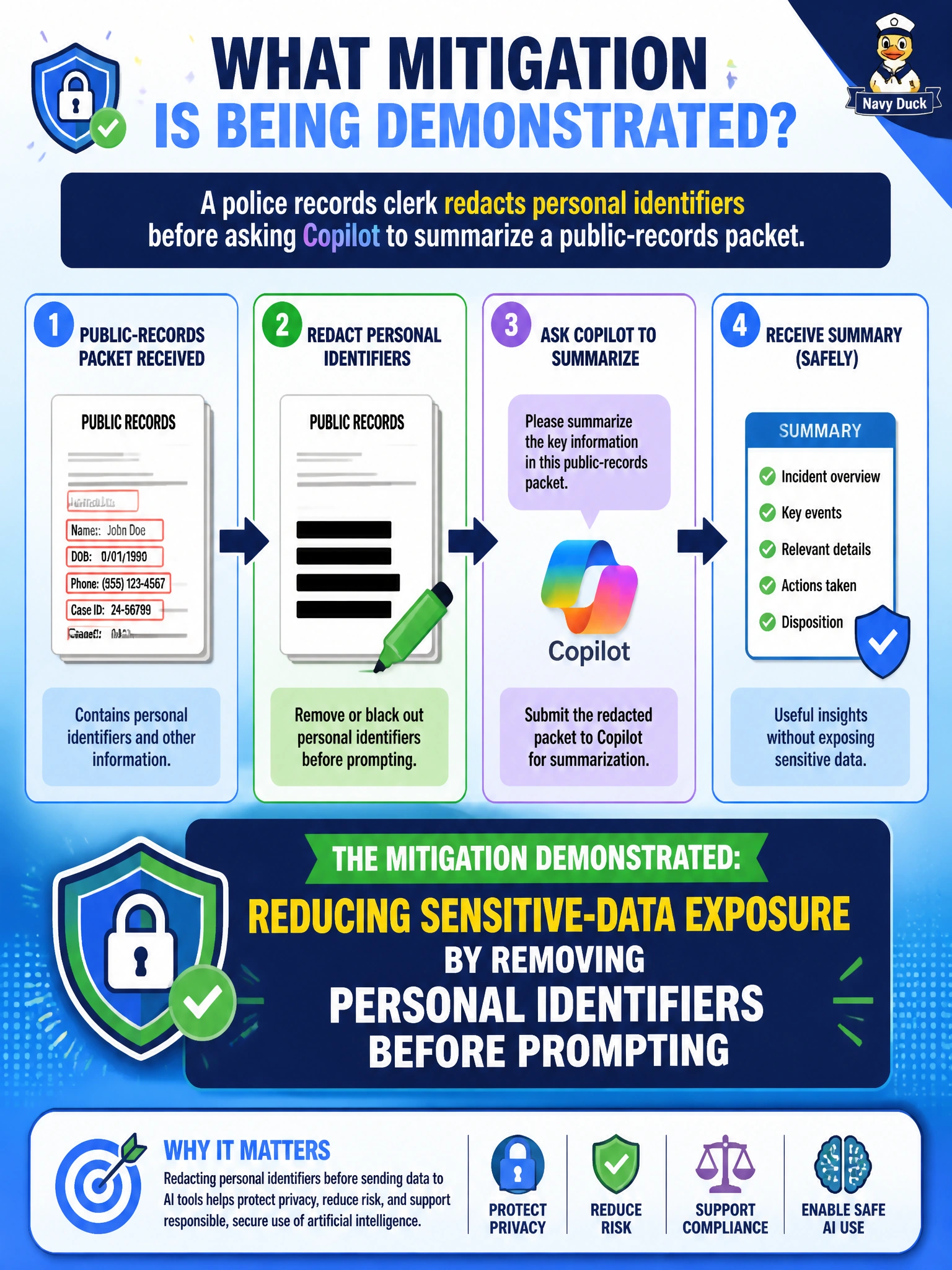
A police records clerk redacts personal identifiers before asking Copilot to summarize a public-records packet. What mitigation does this demonstrate?
Select an answer to reveal the explanation.
Short Explanation
Redact first, summarize second. It’s like covering the name tags before you ask for a plain-language rundown. Copilot still helps — without spraying personal identifiers into the prompt.
Full Explanation
Redacting personal identifiers before asking Copilot to summarize a public-records packet demonstrates reducing sensitive-data exposure by removing personal identifiers before prompting. Police records clerks often handle packets that mix releasable content with protected identifiers. Redaction before prompting shrinks what enters the generative workspace and aligns with data-minimization and public-records handling discipline.
Increasing Copilot accuracy by leaving every identifier visible in the prompt is wrong: identifiers are not required for a useful summary of releasable themes and increase exposure.
Disabling all data protection so Copilot can summarize sealed personnel files contradicts protection controls and expands risk rather than mitigating it.
Using prompt injection deliberately to force Copilot to reveal unredacted names is malicious misuse, not a mitigation.
Exam caveat: redaction-before-prompt maps to sensitive-data exposure reduction; reject options that maximize identifiers, disable protections, or weaponize injection.
Operational check: apply the records unit’s redaction checklist to the packet, confirm identifiers are removed or masked, then run the Copilot summary on the redacted copy and have a records supervisor review before any external release.