
A city clerk drafts replies to permit applications with Microsoft 365 Copilot. What should the clerk understand about where that permit text goes?
Select an answer to reveal the explanation.
Short Explanation
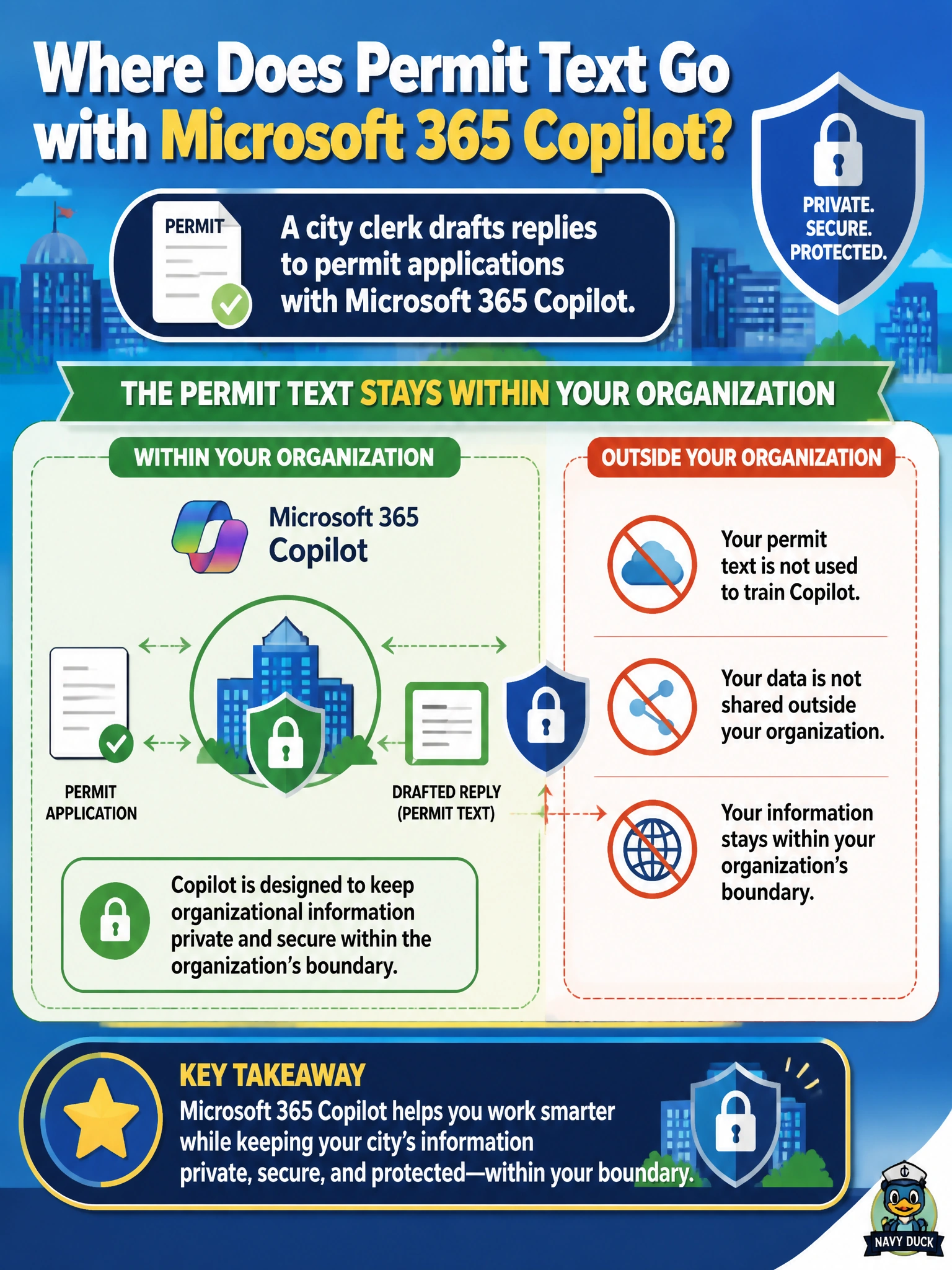
Picture the city's Microsoft 365 tenant like a locked municipal filing room—not the open internet. Copilot works inside that room, so permit wording stays under the city's privacy and security controls instead of wandering off to train some public chatbot.
Full Explanation
Microsoft 365 Copilot for organizational work is designed to keep prompts, drafts, and retrieved content inside the city's Microsoft 365 tenant boundary and under the same privacy and security controls that already govern municipal records. When a city clerk drafts replies to permit applications, the permit wording used in Copilot stays within that organizational scope rather than being treated as open material for a public generative-AI system. That design is why the correct answer emphasizes private, secure handling within the organization's boundary: Copilot is a productivity layer on the city's existing Microsoft 365 estate, not a posting board or a shared training pipeline for other cities.
The public-forum option fails because business Copilot is not built to publish permit drafts to an open generative-AI peer-review community; that would break confidentiality expectations for applicant data and municipal correspondence. The shared-foundation-model option fails by conflating org-scoped Copilot use with contributing city content into a model shared across every other municipal tenant—organizational Copilot scenarios are not equivalent to dumping permit text into a multi-city training corpus. The personal-device-only option fails because Copilot does not bypass municipal records rules by storing work drafts solely on the clerk's personal device; work content remains subject to organizational Microsoft 365 controls and records obligations, not a personal-device escape hatch.
Exam caveat: AB-730 fundamentals stress the distinction between consumer/public chatbot behavior and organizational Copilot privacy. Do not confuse "AI generated this draft" with "this draft left the tenant forever" or "this draft trained a public model." Retention, records classification, and eDiscovery still follow organizational policy.
Operational check: Confirm the clerk is signed into the city tenant, that sensitivity labels and sharing policies still apply to the draft, and that permit replies are saved to the approved records location—not pasted into a consumer chatbot. Spot-check that applicants' personally identifiable details are handled under existing municipal privacy rules even when Copilot assists with wording.