
Munson's Pickles and Preserves has two retention requirements for Exchange email: (1) ALL Exchange email must be retained for a minimum of 7 years for regulatory compliance, and (2) individual employees must be able to mark specific customer complaint emails to be retained for 10 years. Which combination should the compliance administrator deploy?
Select an answer to reveal the explanation.
Short Explanation
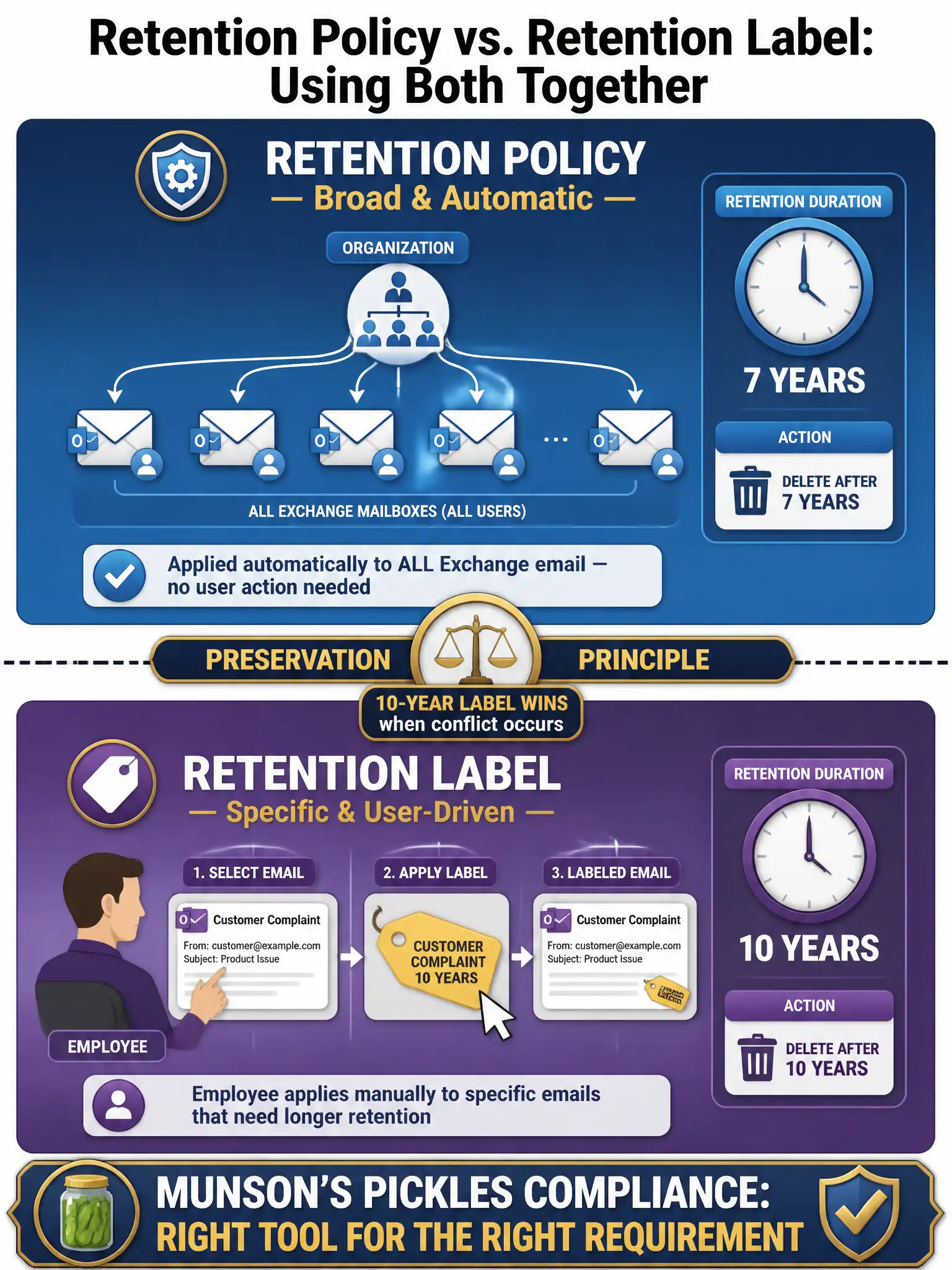
Use a retention policy as the blanket 7-year rule for all Exchange email, then give employees a 10-year retention label they can manually apply to customer complaint emails. The longer label wins on those specific messages, so you meet both requirements without keeping everything for 10 years.
Full Explanation
The correct design is to deploy a retention policy for Exchange with a 7-year retain-then-delete action for the broad organizational requirement, and create a retention label with a 10-year retention period that employees can manually apply to specific customer complaint emails. This scenario requires two different tools working together. The retention policy is the right tool for broad, sweeping requirements because it applies the 7-year retain-then-delete action to all Exchange email automatically, without user action. The retention label is the right tool for granular, user-driven requirements because employees can manually apply a '10-Year Customer Complaints' label to specific emails they identify. Because Microsoft Purview follows the principle of preservation, the longer retention period wins when multiple settings apply, so an email with the 10-year label in a mailbox covered by the 7-year policy will be retained for 10 years. This is exactly the correct design pattern. The approach that creates two retention policies, one with a 7-year retention period and one with a 10-year retention period, applies both policies to Exchange, and relies on preservation to make the longer policy take precedence is incorrect. While applying two retention policies to Exchange is technically possible, it does not give employees the ability to mark specific emails for 10-year retention because policies are automatic and organization-wide, not selectable by end users. Additionally, creating a separate 10-year policy that covers all Exchange would force all email to be retained for 10 years, which exceeds the stated business requirement and may create unnecessary storage costs and legal risk. The approach that creates a single retention label with a 10-year retention period, publishes it to all Exchange mailboxes, and sets it as the default label so all email is retained for 10 years automatically is incorrect. That design would retain all email for 10 years regardless of content, which violates the specific business requirement that only customer complaint emails need 10 years. The requirement is that most email should be deleted after 7 years, so keeping everything for 10 years is overcompliant and potentially creates legal discovery burdens. The approach that creates a DLP policy in Microsoft Purview to detect the keyword 'customer complaint' in emails and automatically tag those emails for 10-year retention using a DLP policy action is incorrect. DLP policies cannot apply retention settings. DLP is designed for protecting sensitive data in transit or at rest, including detecting and blocking, quarantining, or alerting, but tagging content for retention is handled through retention policies and labels in the Records Management and Data Lifecycle Management areas of Microsoft Purview. DLP and retention are separate policy engines. Exam tip: The exam tests this policy versus label distinction frequently. Remember that retention policies are automatic and broad, top-down, while retention labels give users control at the item level, bottom-up. When a scenario mentions employees can mark or users can tag specific items, a retention label is almost always the answer for that part of the requirement.