
A developer configures Azure AI Search as a knowledge source for a Copilot Studio agent. After testing, users report that the agent often returns technically correct but poorly ranked results — a document mentioning the topic once near the end appears above a document that comprehensively covers it. The index already has a scoring profile based on field boost weights. What change would most directly improve result relevance ranking for natural language queries?
Select an answer to reveal the explanation.
Short Explanation and Infographic
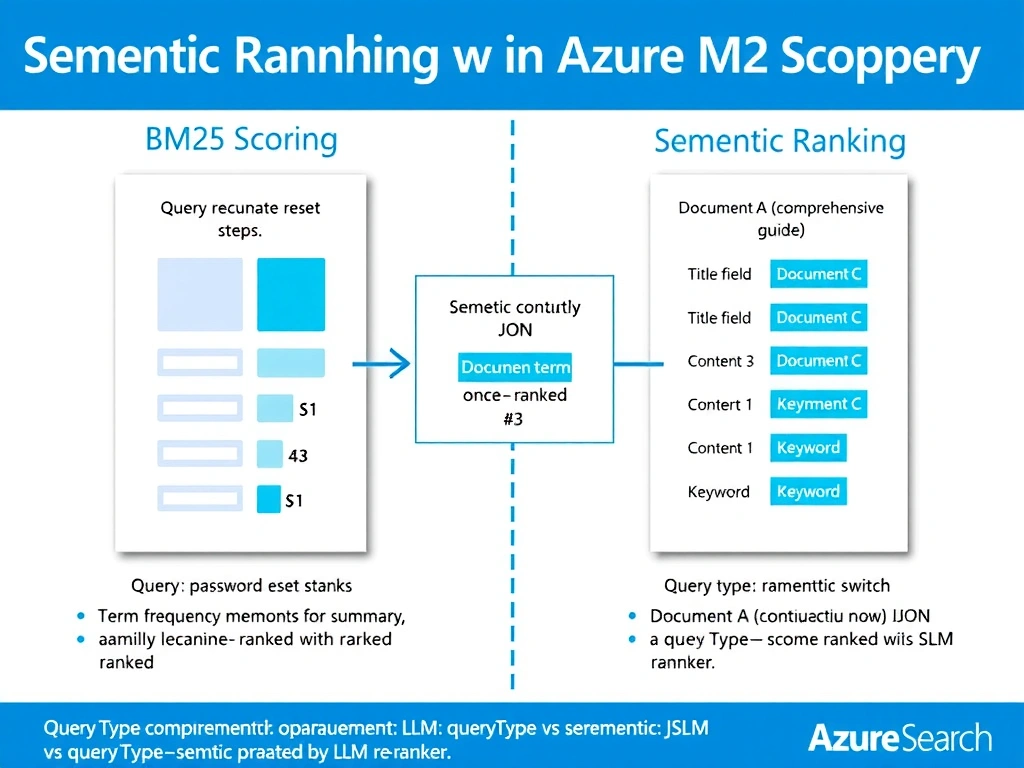
Scoring profiles are like a document beauty contest judged by a tape measure — they count field appearances mechanically. Semantic ranking brings in an actual language professor who reads each document and scores it on how well it answers the question. Natural language queries need the professor, not the tape measure.
Full explanation below image
Full Explanation
Traditional BM25 scoring in Azure AI Search ranks documents based on term frequency and inverse document frequency — essentially counting how often query terms appear and how rare those terms are in the corpus. Scoring profiles layer on top of BM25 with field-specific boosts but remain fundamentally term-counting mechanisms. They do not understand the meaning or context of a query.
Semantic ranking is a separate re-ranking layer that applies language model-based comprehension to the top BM25 results. It reads the title and key content passages of each result and scores them against the query semantically — understanding that 'how do I reset my password' and 'password recovery steps' are the same concept. To enable it, the developer creates a semantic configuration on the Azure AI Search index (specifying which fields hold the title, keywords, and content), then configures the agent's knowledge source to use queryType=semantic and reference the semantic configuration name.
Option A is incorrect because boost weights still operate on term frequency. A document that mentions the topic comprehensively in multiple places may score higher with a boost, but the root issue — semantic understanding — is not addressed by numerical weights.
Option C is incorrect because synonym maps improve recall (finding more relevant documents) but do not affect ranking (ordering found documents by relevance). Adding synonyms would not fix the ordering problem described.
Option D is incorrect because increasing the top-N retrieval pool gives the generative answer model more material to work with but does not change how those results are ranked. The poorly-ordered result would still be at the top of the larger pool.
Exam tip: Semantic ranking re-ranks; it does not replace initial retrieval. The index must have at least the default semantic configuration before semantic queries can be issued. Know that it requires a Standard tier or higher in Azure AI Search.