
In a multi-agent Copilot Studio setup using generative orchestration, how does the parent agent determine when to route a user's message to a child agent versus handling it internally?
Select an answer to reveal the explanation.
Short Explanation and Infographic
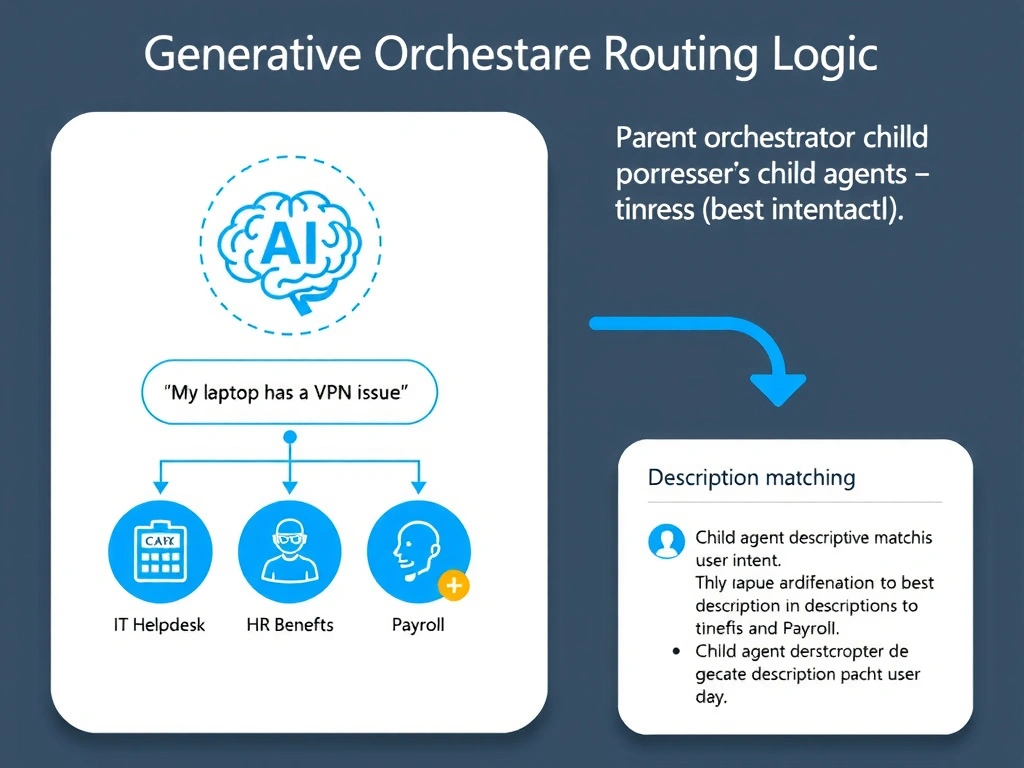
Generative orchestration is the AI equivalent of a smart switchboard operator — it reads the user's intent and matches it against what each child agent is described as capable of handling. The child agent with the best-matching description wins the routing decision.
Full explanation below image
Full Explanation
Generative orchestration is an AI-driven routing mode in Copilot Studio where the parent agent uses a large language model to reason about where each user message should be handled. Each child agent is registered with a name and description of its capabilities. When a user message arrives, the orchestrator evaluates: 'Does this message's intent best match one of my registered child agents, or should I handle it with my own topics and actions?'
This semantic matching is far more flexible than keyword triggers — it can route 'my laptop won't connect to the VPN' to an IT child agent even if the exact phrase 'IT Helpdesk' never appeared in the user's message, because the orchestrator understands the intent.
Option A (keyword matching on agent name) describes classic trigger-phrase routing — not how generative orchestration works.
Option C (round-robin routing) makes no sense for a Q&A agent — routing should be intent-based, not arbitrary.
Option D (explicit Redirect nodes in every topic) describes manual routing — also called classic multi-topic orchestration. Generative orchestration replaces this manual wiring with AI-driven intent matching.
Child agent description quality matters: write clear, specific capability descriptions for each child agent so the orchestrator can make accurate routing decisions. Vague descriptions lead to misrouting.