
An agent author is deciding whether to use a Power Automate cloud flow or a native connector action when adding a tool to a Copilot Studio topic that needs to send an email notification after a refund is processed. Which scenario would make a Power Automate flow the BETTER choice over a native connector action?
Select an answer to reveal the explanation.
Short Explanation and Infographic
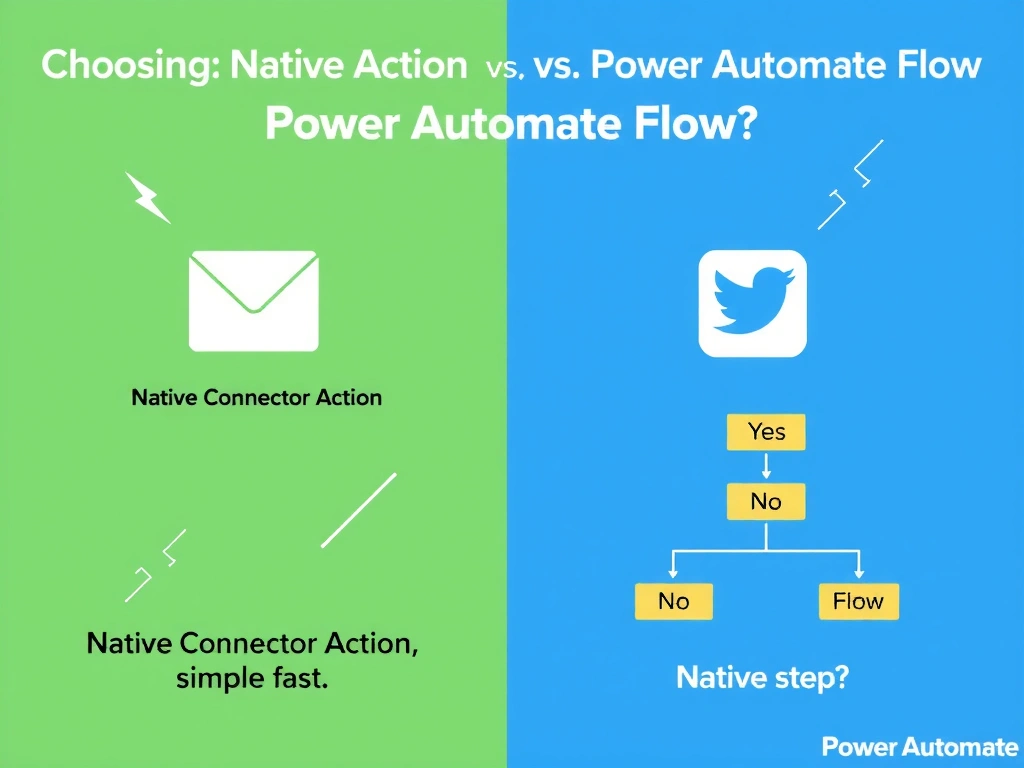
Native connector actions are perfect for single-step, direct API calls. Power Automate flows shine when the logic has multiple steps, branching, or requires orchestrating multiple connectors before returning a result — like fetching recipient data before composing an email.
Full explanation below image
Full Explanation
Choosing between a native connector action and a Power Automate cloud flow comes down to complexity. Native connector actions are ideal for simple, single-operation calls: get a record, send an email, update a row. Power Automate flows are the right choice when the business logic involves: multiple sequential steps, conditional branching, data transformation, calling multiple connectors, error handling, or retry logic.
In the scenario: querying a database for recipient details + formatting a message + sending the email is three steps with potential dependencies. A Power Automate flow handles this cleanly as a visual workflow, returning only the final result to the Copilot Studio topic. The topic node remains simple — one 'Run a flow' action — while the complexity is encapsulated in the flow.
Option A — if the task is simply 'send an email with data I already have,' the native Outlook connector action is sufficient and simpler. A flow would be overkill.
Option C (reduce canvas nodes) — using a flow actually doesn't reduce nodes; it replaces multiple native action nodes with one flow invocation node. This is a benefit but not the primary driver.
Option D is a red herring. Power Automate cloud flows require Power Automate licenses, so an environment without them couldn't use flows.
Exam heuristic: 1 step → native connector action. Multiple steps, multiple connectors, complex logic → Power Automate flow.