
VanArsdel Ltd. needs to build an AI solution where a primary customer-facing agent routes incoming requests to specialized agents: one for billing, one for technical support, and one for account management. Which Copilot Studio architectural pattern should the solution architect recommend?
Select an answer to reveal the explanation.
Short Explanation and Infographic
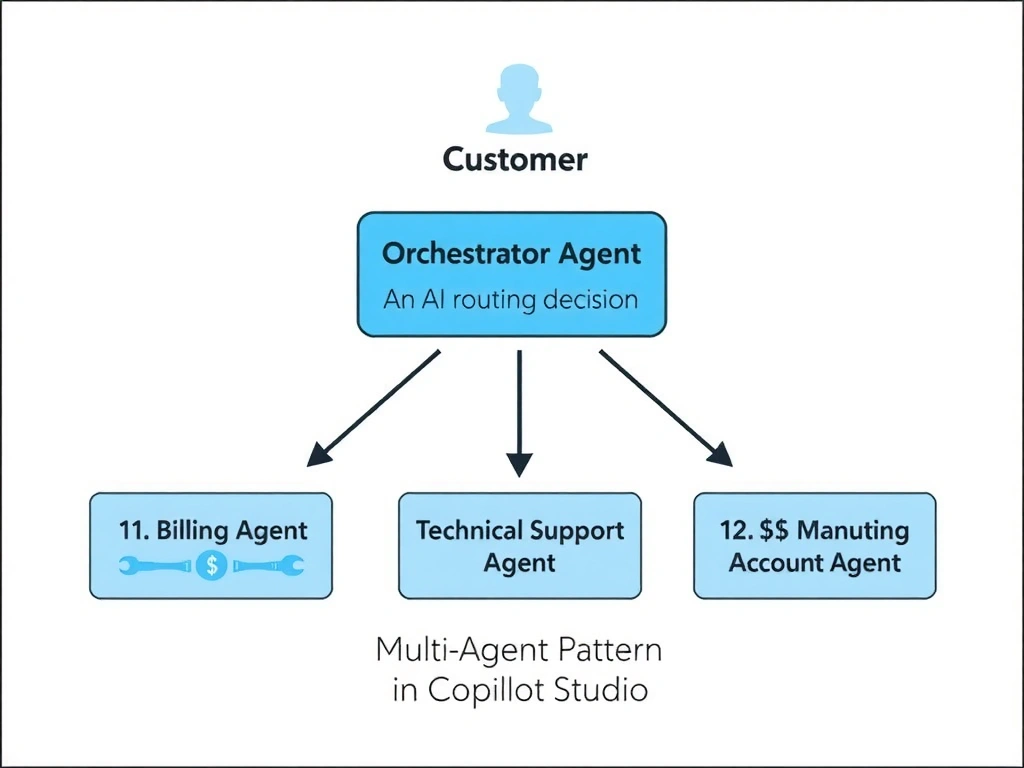
Think of this like a hospital — the triage nurse (orchestrator) assesses incoming patients and routes them to the right specialist. Copilot Studio supports this pattern natively with an orchestrator agent that invokes specialist agents. The correct answer is B.
Full explanation below image
Full Explanation
## Why B is Correct Copilot Studio's multi-agent pattern allows you to designate one agent as the orchestrator that receives all customer requests. The orchestrator uses AI-driven topic matching or explicit routing rules to invoke the appropriate specialist agent (billing, tech support, account management). Conversation context can be passed to the specialist, and results can be returned to the orchestrator to present to the user. This is scalable, maintainable, and aligns with the Copilot Studio multi-agent design pattern.
## Why the Distractors Are Wrong A (One large agent with all topics): A monolithic agent becomes difficult to maintain and test. Topics from different domains can conflict, and the agent's intent-matching accuracy degrades as the topic count grows.
C (Three separate agents with a customer menu): Requiring customers to choose their agent before the conversation starts is a poor UX — customers often don't know which team owns their issue. It also prevents cross-domain conversations.
D (Power Automate flow as orchestrator): A flow can call HTTP endpoints, but Copilot Studio agents are conversational, stateful systems — not simple API endpoints. A flow cannot manage multi-turn conversation context the way an orchestrator agent can.
## Exam Tip Know the multi-agent roles: Orchestrator = routes and coordinates. Specialist = handles a specific domain. The exam may ask which agent type is responsible for intent routing.