
Datum Corporation is building a Copilot Studio agent that handles customer complaints. During conversations, customers often share personal details (SSN, address) that are not needed to resolve the complaint. The architect must ensure the agent handles this data responsibly. Which approach best implements the Privacy responsible AI principle?
Select an answer to reveal the explanation.
Short Explanation and Infographic
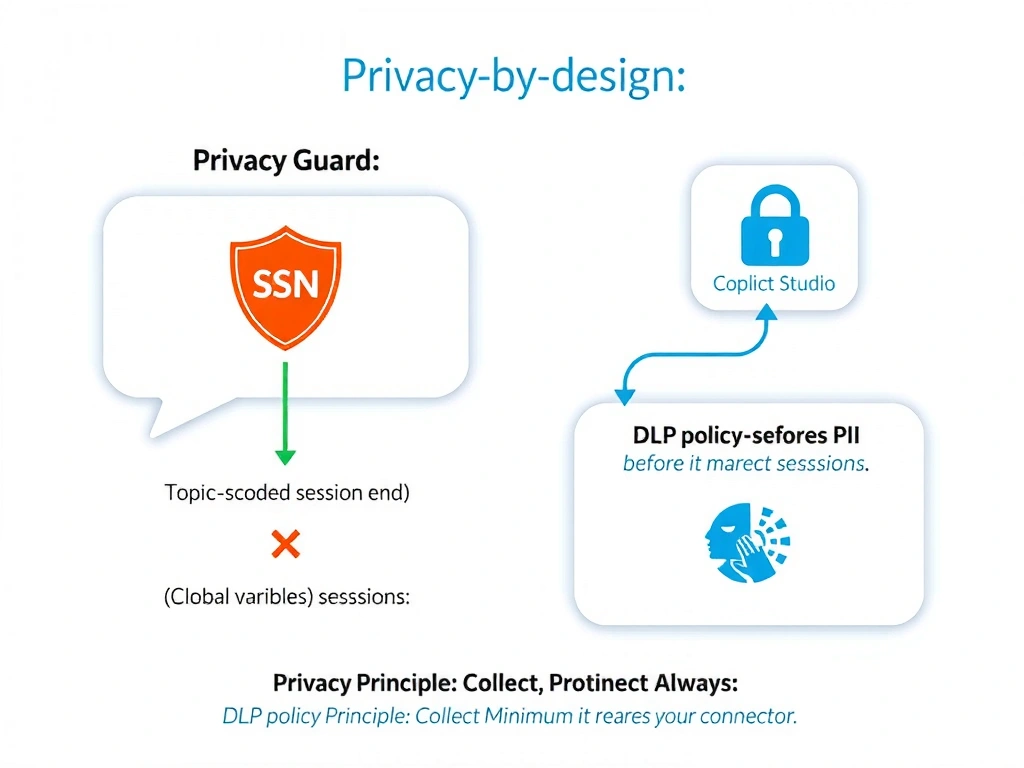
Privacy-by-design means you don't store what you don't need — like a doctor who shreds unnecessary notes rather than filing them. Scoping variables to the conversation and masking PII in transit is the right pattern. The correct answer is B.
Full explanation below image
Full Explanation
## Why B is Correct The Privacy responsible AI principle requires that personal data be collected minimally, used only for stated purposes, and protected appropriately. In Copilot Studio, this is implemented by: (1) using topic-scoped variables (which are cleared at conversation end) rather than global variables that persist across sessions, (2) not passing PII to connectors or flows unless strictly necessary, and (3) configuring data loss prevention (DLP) policies and data masking in any external connector that must handle PII.
## Why the Distractors Are Wrong A (Log all transcripts with PII to Blob): Storing transcripts containing SSNs and addresses in Blob Storage increases the attack surface and regulatory risk. It is the opposite of minimal collection.
C (Disclaimer only): A disclaimer shifts the burden to the user but does not technically prevent PII from flowing through the system or being stored. It does not constitute a technical control.
D (Collect SSN to process complaint): Collecting SSN is unnecessary for resolving most complaints and violates the data minimization principle. Agents should collect only what is required.
## Exam Tip Privacy in agent design = data minimization + scoped variables + DLP policies. The exam may present 'log everything for compliance' as a plausible answer — but logging PII unnecessarily is a privacy risk, not a privacy control.