
Oluwaseun is a knowledge engineer at Bridgemont Legal. The firm's Copilot Studio agent searches a 50,000-document Azure AI Search index of case law. Users complain that simple keyword matches return tangentially related documents ranked above highly relevant ones. Oluwaseun wants to enable semantic re-ranking so the index uses language understanding to score results by contextual relevance rather than pure keyword frequency. What must Oluwaseun configure to enable this capability?
Select an answer to reveal the explanation.
Short Explanation and Infographic
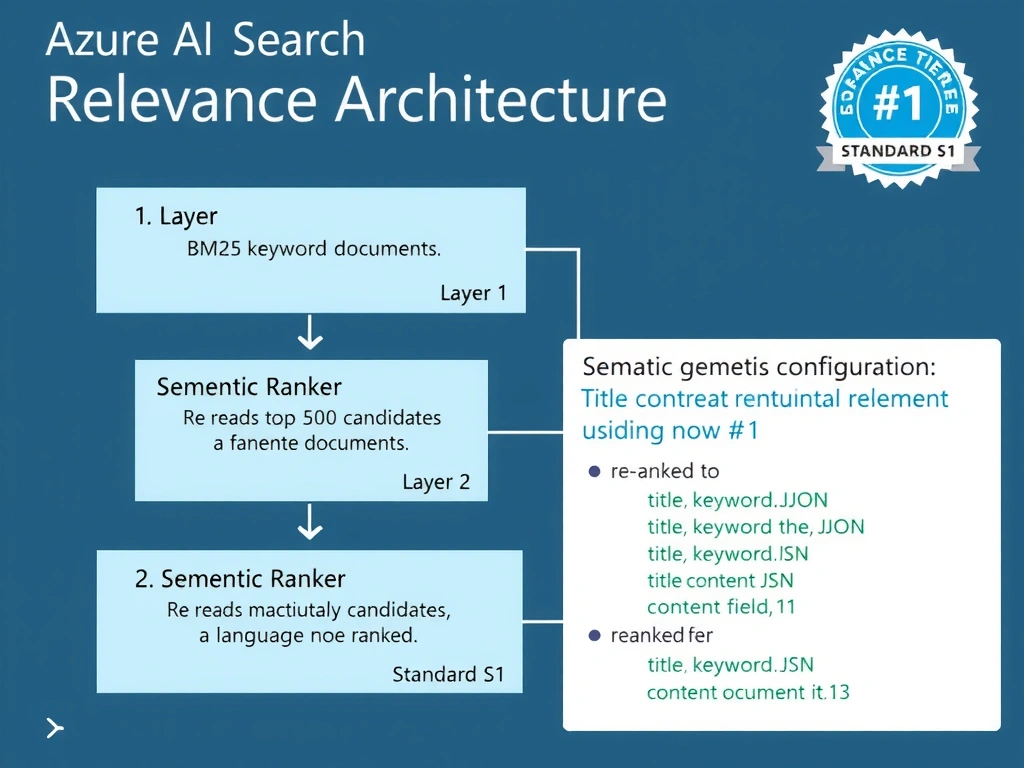
Semantic ranking is a two-switch job: turn it on at the service tier (Standard or higher), then tell the index which fields are title, keywords, and content via a semantic configuration. Keyword boosting via scoring profiles is a different, shallower tuning knob. Answer: B.
Full explanation below image
Full Explanation
Azure AI Search's semantic ranker is a machine-learning-based re-ranking layer that reads the actual content of the top keyword-matched documents and re-scores them based on language understanding. It is distinct from keyword boosting, vector search, and query language settings.
Option B is correct and covers all three required steps. First, the semantic ranker is only available on Standard S1 tier and above — the Free and Basic tiers do not support it, so the service tier must be confirmed or upgraded. Second, a semantic configuration must be defined on the index; this JSON configuration tells the ranker which field holds the document title (for display), which fields contain key phrases, and which field(s) hold the primary content to re-rank against. Third, search queries issued by the agent (or the Copilot Studio connector) must include the 'queryType=semantic' parameter and reference the configuration name — without this, the ranker is not invoked even when properly configured.
Option A is incorrect. Custom scoring profiles use numeric functions to boost documents based on field values, freshness (date proximity), or geographic distance — they do not apply language understanding. Boosting a text field's BM25 score by a multiplier addresses field weight, not contextual relevance of the document's meaning relative to the query.
Option C is incorrect because switching to 'jsonLines' parsing mode and adding embedding skills configures vector search, not semantic ranking. Vector search uses embedding similarity rather than language model re-ranking. The two features serve different use cases and can coexist in the same index, but option C describes vector search, not semantic ranking.
Option D is incorrect because linking a Language resource and setting 'queryLanguage' enables language-specific query parsing (stemming, stopwords) for better keyword matching in non-English languages. It does not enable the semantic re-ranking layer.
Exam tip: Three distinct relevance features often appear on AB-620: scoring profiles (field weighting), semantic ranker (ML re-ranking of text results), and vector search (embedding similarity). Know which feature addresses which problem: poor ranking of relevant documents = semantic ranker; wrong keyword matches = query language + scoring profiles; concept similarity = vector search.