
A solutions architect is designing a worker agent in a multi-agent Copilot Studio solution. The worker agent is responsible for processing document summarization requests from an orchestrator agent. The worker must accept structured input (document URL and summary length preference), perform the summarization using generative AI, and return a structured result to the orchestrator. The worker should not expose any conversational interface to end users. Which design elements are required when configuring the worker agent?
Select an answer to reveal the explanation.
Short Explanation
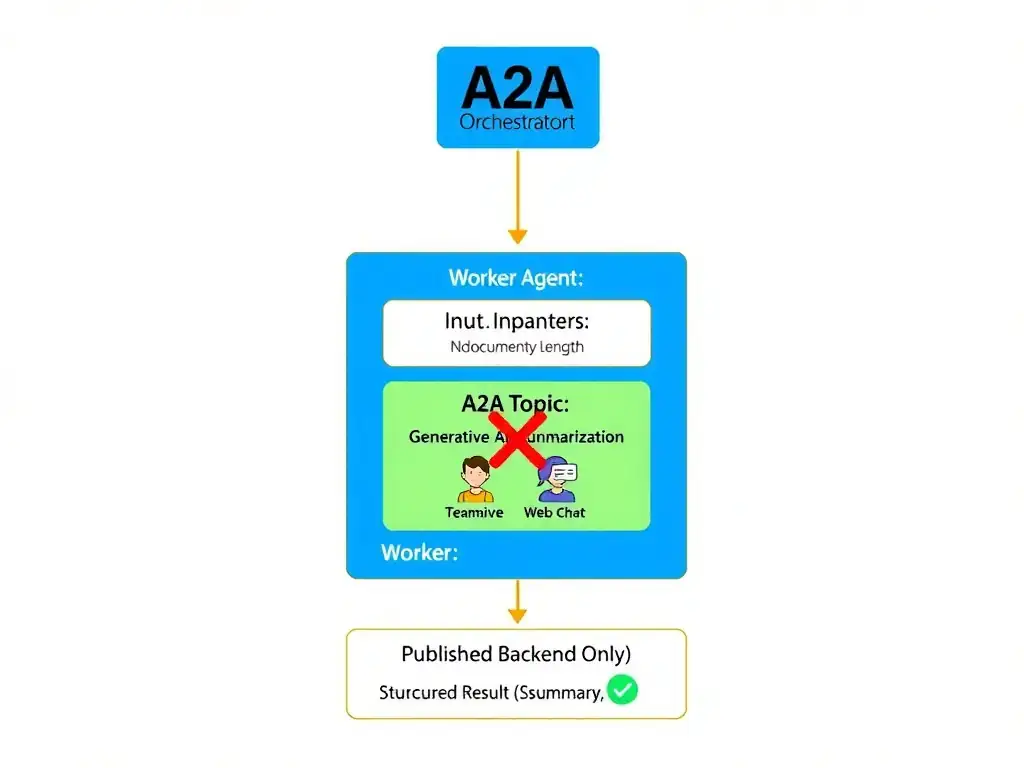
A worker agent is a back-room specialist, not a customer-facing bot. You give it an A2A-invocable topic with typed inputs and a structured return, turn off the conversational UI, and keep it off user-facing channels.
Full Explanation
In Copilot Studio's Agent2Agent (A2A) framework, worker agents are designed for backend task processing. They differ from orchestrator and user-facing agents in three key ways: they do not expose a conversational UI, they are invoked programmatically by other agents (not by end users), and they communicate exclusively through structured parameters.
The correct design is the one that defines the worker agent's entry topic as an A2A-invocable topic with typed input parameters for the document URL and summary length, returns a structured result variable, disables the conversational UI, and publishes the agent without deploying it to a user-facing channel. This captures all three distinguishing characteristics of a worker agent. The entry topic is configured as an A2A-invocable topic, which means the topic can be called by an orchestrator agent passing named input parameters such as document URL as text and summary length as a number or choice. The topic performs its processing and returns a structured result variable to the calling orchestrator. The conversational UI is disabled because worker agents do not interact with end users; they only interact with other agents. Publishing without a user-facing channel ensures the agent is inaccessible to end users while remaining callable by the orchestrator within the same solution.
The design that configures a custom greeting topic, enables the conversational interface for debugging, defines input and output parameters in the agent's A2A topic, and publishes to the Microsoft Teams channel is incorrect because a worker agent should not have a custom greeting topic or conversational interface; these are characteristics of user-facing agents. Publishing to Microsoft Teams makes the agent accessible to end users, which contradicts the requirement that the worker not expose a conversational interface. A2A topics work without a Teams channel.
The design that deploys the worker agent as a standalone Copilot Studio bot with a custom connector interface, exposes its summarization capability via an HTTP endpoint, and configures the orchestrator to call the endpoint using a Power Automate flow is incorrect because exposing the summarization capability as an HTTP endpoint and calling it from a Power Automate flow bypasses the native A2A invocation mechanism. This pattern reverts to a microservices integration style rather than the agent-native A2A design. It also loses the semantic context propagation that native A2A topic invocation provides and creates a maintenance burden for the HTTP endpoint.
The design that configures the worker agent to use a shared Dataverse table where the orchestrator writes request records and the worker polls for new records every 30 seconds, processes them, and writes results back to the same table is incorrect because polling a shared Dataverse table for task records is an asynchronous message queue pattern, not the A2A protocol pattern. While this might work functionally, it introduces 30-second latency, requires additional infrastructure such as the shared table schema, polling logic, and result columns, and is architecturally misaligned with how Copilot Studio's A2A framework is designed to work. A2A invocation is synchronous and direct, not queue-based.
Exam tip: Worker agent checklist: (1) A2A-invocable topic with typed input and output parameters, (2) no conversational UI, (3) not published to user-facing channels. If a question describes a backend-only specialized agent, all three of these characteristics must be present in the correct answer. Watch for distractors that add user-facing elements like greeting topics or Teams deployment.