
A developer has connected a Copilot Studio agent to an Azure AI Search index containing thousands of technical support articles. Users report that search results are often keyword-matched but not contextually relevant—for example, a question about 'printer not connecting to WiFi' returns articles about WiFi routers instead of printer troubleshooting guides. Which Azure AI Search configuration should the developer enable to improve the contextual relevance of retrieved results?
Select an answer to reveal the explanation.
Short Explanation
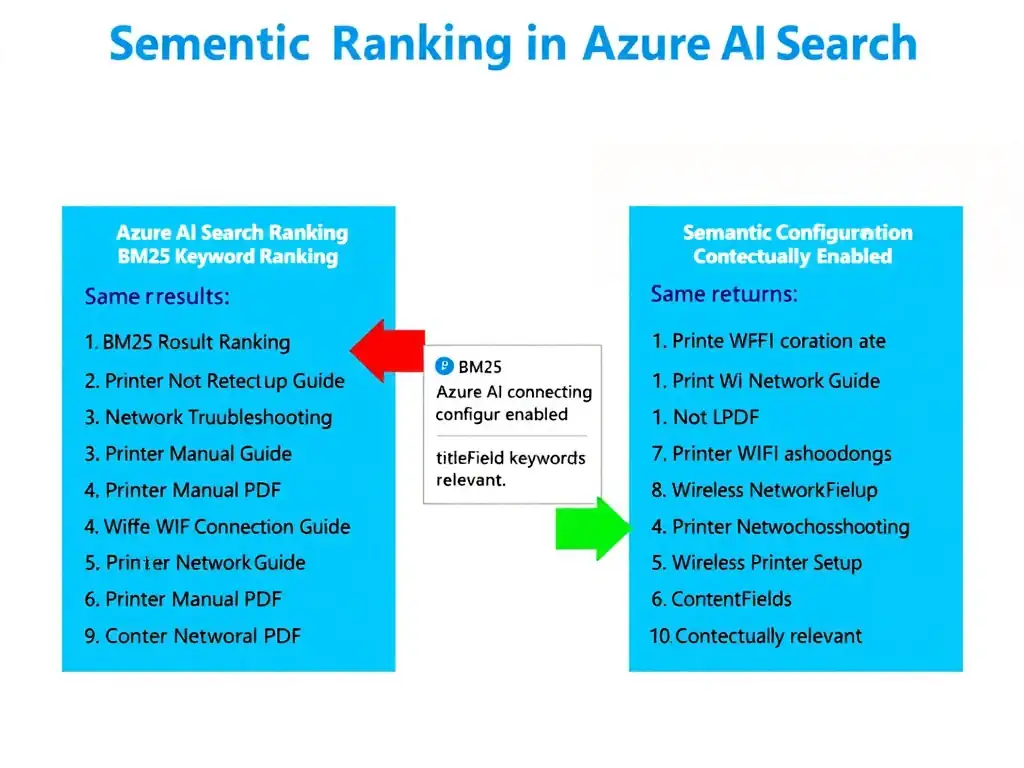
Keyword matching just counts words; semantic ranking reads intent and context. You enable it with semantic configuration so the search surfaces printer troubleshooting guides instead of unrelated router articles.
Full Explanation
Azure AI Search offers multiple ranking mechanisms. The default BM25 keyword ranking counts term frequency and document frequency to score results—effective for exact keyword matches but poor at understanding intent and context. Semantic Ranking is premium Azure AI Search feature applying one deep learning model derived from Microsoft's Bing technology to re-rank BM25 results based on semantic relevance, understanding the meaning behind the query and the content.
The semantic ranking configuration is correct because enabling Semantic Ranking and creating semantic configuration specifying which index fields contain the title, keywords or summary, and main content allows Azure AI Search to understand that 'printer not connecting to WiFi' is semantically about printer troubleshooting, not WiFi router configuration. The semantic ranker re-orders results to surface the most contextually relevant articles at the top.
The approach of increasing the 'top' parameter is wrong because returning more results with higher 'top' value does not improve relevance ranking—it just gives the agent more results, most of which may still be irrelevant keyword matches. The agent then has to process more noise without better signal.
The approach of switching query type from 'full' to 'simple' mode is wrong because simple query mode actually reduces search capability—it disables the full Lucene query syntax. Simple mode performs less sophisticated keyword matching, not more contextual understanding. This would worsen relevance, not improve it.
The approach of adding recency-based scoring profile is wrong because it would surface recently modified articles, not contextually relevant ones. Recently updated WiFi router article would still outrank older printer troubleshooting guide. Recency boosting addresses freshness, not semantic relevance.
Exam tip: When the exam describes scenario where search results are technically keyword-matched but contextually wrong, semantic ranking is the answer. Know the three components of semantic configuration: titleField (document title), keywordsFields (summary or keywords), contentFields (main body). Semantic ranking is licensed feature that must be enabled at the Azure AI Search service tier.