
Your Copilot Studio agent uses an environment variable to store the base URL of a backend API. The development environment points to dev.api.contoso.com and production should point to api.contoso.com. When you deploy the solution from dev to prod, what happens to the environment variable value?
Select an answer to reveal the explanation.
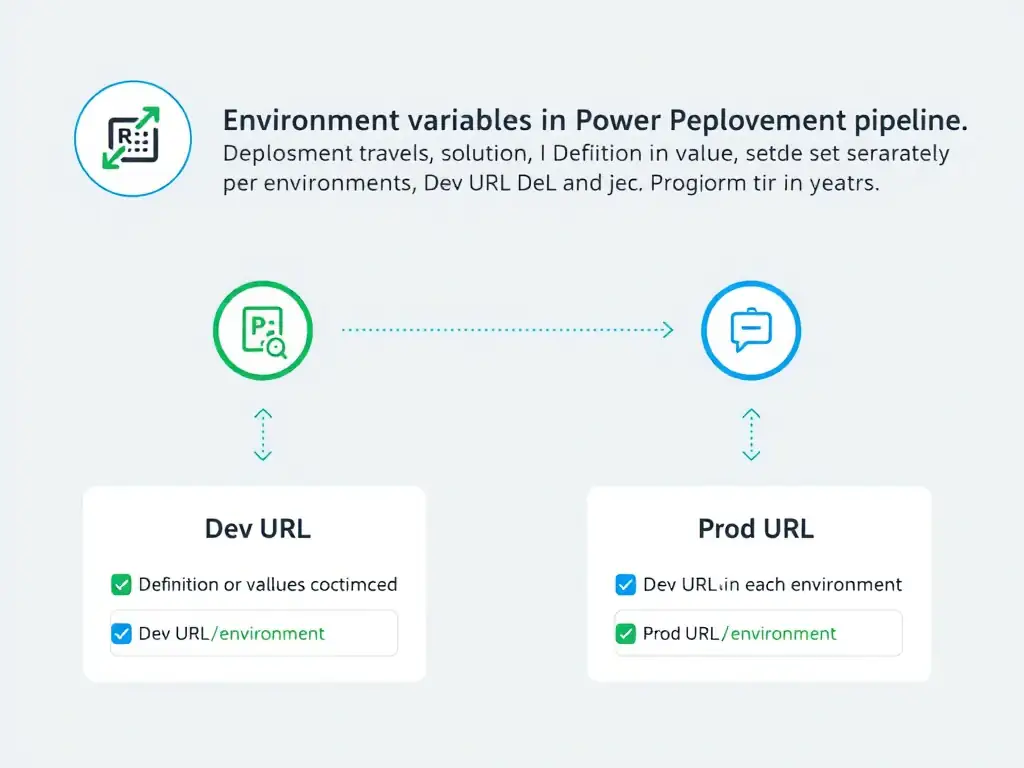
Short Explanation
The definition travels in the solution like an empty jar, but you set the production value after deployment. That keeps environment-specific config separate from the deployed artifact.
Full Explanation
The correct behavior is that the environment variable definition is deployed, but its value must be set separately in the production environment after deployment. Power Platform environment variables have two parts: the definition (name, type, description) and the current value. When a solution containing an environment variable is deployed, the definition is created or updated in the target environment. The value, however, is environment-specific and is set independently in each environment. This design is intentional and correct behavior for application lifecycle management: development, test, and production should point to different backend endpoints, secrets, and configuration. If values traveled with the solution, deployments would overwrite production configurations with development values — a dangerous outcome. After deploying the solution to production, an administrator opens the environment variable in the production environment's solution layer and sets the value to api.contoso.com. The agent in production then reads this value at runtime. The claim that production automatically detects the correct URL based on the environment name is wrong because Power Platform has no such auto-detection capability. The claim that the dev URL (dev.api.contoso.com) is carried over to production and overrides any existing production value is wrong because the deployed value does not overwrite an existing production value. If a current value is already set in production, it is preserved. Only if no current value exists will the default value (if defined in the definition) apply. The claim that environment variables are not supported in Copilot Studio solution deployments is wrong because environment variables are fully supported in Copilot Studio solutions and are the recommended mechanism for environment-specific configuration. Exam rule: environment variable definition deploys with solution; value is set per-environment post-deployment.