
Kenji is a search engineer at Pinnacle Insurance. The company's Copilot Studio agent queries an Azure AI Search index of regulatory compliance documents. Users complain that the agent cites outdated regulations from 2018 even when updated 2024 versions of the same document exist in the index. Both versions score equally under the current BM25 keyword ranking because their text is similar. Kenji wants the search engine to automatically rank newer documents higher. What should he configure?
Select an answer to reveal the explanation.
Short Explanation
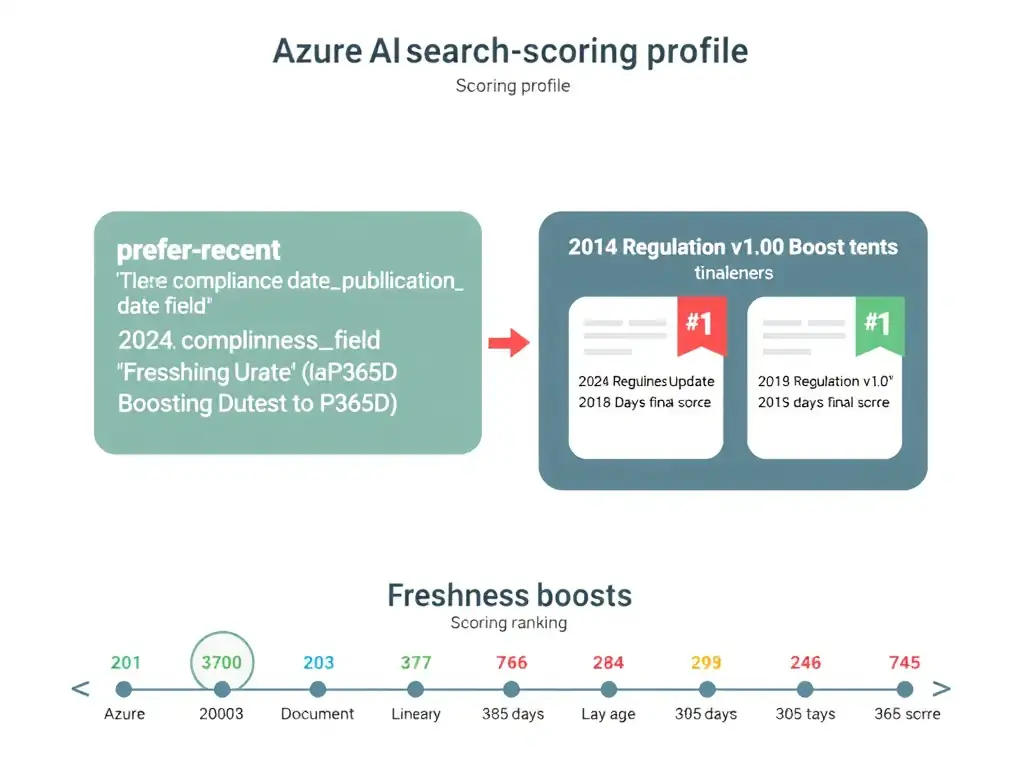
Scoring profiles let Azure AI Search apply a freshness function that gives a time-based decay score, so newer documents get a higher boost and older ones fade naturally. You don't need to delete old data or hard-filter dates; the profile handles recency ranking automatically.
Full Explanation
Azure AI Search scoring profiles provide a mechanism to adjust relevance scores based on field values and functions, allowing the index to incorporate document freshness as a ranking signal alongside keyword relevance. The correct configuration is to create a scoring profile on the index that applies a 'freshness' function to the 'publication_date' field with a defined boosting duration, and set that scoring profile as the default so newer documents automatically score higher in all queries. The freshness function uses a 'boostingDuration' parameter to define the time window over which the boost decays — for example, documents published within the last 365 days receive the full boost, while older documents receive progressively less boost as they age beyond that window. The profile also includes a 'boost' multiplier that controls how strongly freshness influences the final score relative to BM25 keyword relevance. Setting this profile as the default means every query automatically benefits from freshness ranking without requiring any per-query configuration change. The semantic configuration approach that designates the 'publication_date' field as the title field is incorrect. The semantic configuration's 'title field' designation is used by the semantic ranker to generate result summaries and identify the document's primary topic — it is not a date ranking mechanism. Designating a date field as the title field would cause the ranker to treat the date string as the document's conceptual summary, producing nonsensical results. The Power Automate pre-processing approach that calls the search API and filters results using '$filter=publication_date ge 2023-01-01' before passing results to the agent is incorrect. Using a '$filter' clause to hard-cut results by date creates an absolute exclusion — documents from 2022 or 2021 would not appear at all even if they contain the only authoritative information on a specific regulation. Hard filtering is appropriate for access control or compliance requirements, such as showing only documents the user is authorized to see, not for relevance tuning. The deletion approach that removes all documents with publication dates before 2024 from the index is incorrect. Deleting historical documents removes potentially valuable historical context and creates a maintenance burden as old documents must be continuously pruned. More importantly, historical compliance documents are often retained for audit and legal reasons — they cannot simply be deleted. Exam tip: Azure AI Search scoring profiles support four function types: magnitude, freshness, distance, and tag. The freshness function is specifically designed for the 'recent documents should rank higher' use case. Know the function types and when to apply each.