
Parkway Insurance has deployed a Copilot Studio agent integrated with Dynamics 365 Customer Service omnichannel. When the agent escalates to a live agent, the human agent receives no context about the prior conversation, forcing them to ask the customer to repeat everything. The developer needs to configure the escalation node to pass a summary and key variables to the live agent's queue. Which properties of the Transfer to Agent node should the developer configure to resolve this problem?
Select an answer to reveal the explanation.
Short Explanation
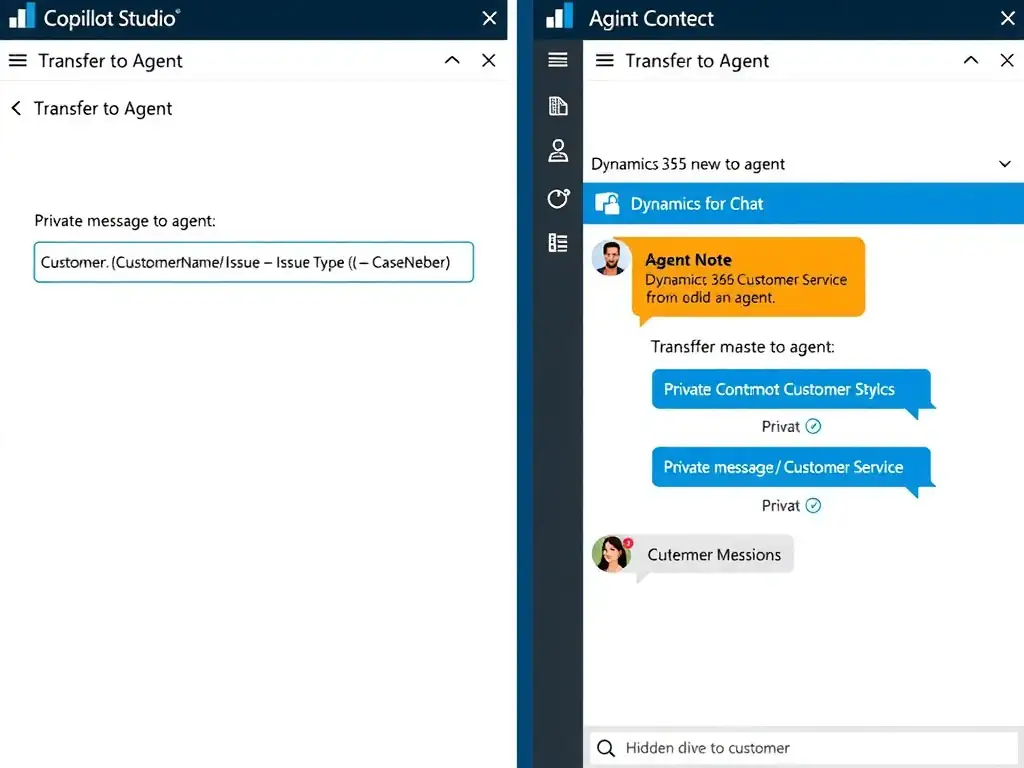
The 'Private message to agent' property on the Transfer to Agent node is the handoff note slipped from the bot to the human. It doesn't go to the customer, just to the live agent picking up the queue item. You can embed variable values into a structured context summary that appears in the agent's interface when they accept the conversation.
Full Explanation
In Copilot Studio, the Transfer to Agent node, used for omnichannel handoff to Dynamics 365 Customer Service or similar platforms, has a key property called 'Private message to agent.' This is a text field that accepts variable references using the {variable_name} syntax and is sent as a hidden context message to the live agent when the conversation is transferred. The human agent sees this message in their conversation panel before they begin responding to the customer, giving them the case summary they need. The correct configuration is to set the 'Private message to agent' property with a message template that includes conversation variable values such as customer name, issue type, and case number. Populate this field with a template like: 'Customer: {CustomerName} | Issue: {IssueType} | Case Number: {CaseNumber} | Summary: {IssueSummary}', drawing on variables already captured in the topic flow. This directly solves the described problem using the built-in node property. Enabling the 'Include conversation transcript' toggle in the Copilot Studio agent settings to automatically send the full transcript as a file attachment to the live agent is wrong. There is no such toggle that automatically sends a transcript file to the live agent. While conversation transcripts are stored in Dataverse and can be accessed by supervisors, there is no automatic file-attachment mechanism for live agent handoff. Configuring a Power Automate flow that runs before the Transfer to Agent node and writes conversation variables to a Dataverse case record that the human agent reviews is wrong. It is a viable workaround, but it requires the live agent to separately open the Dataverse record to see the context, which adds a manual step and does not surface information automatically in the omnichannel conversation panel. It also requires additional development effort for the flow, while the private message property solves this directly. Adding a Set Context Variables node before the Transfer to Agent node to define key-value pairs that are displayed in the live agent's Dynamics 365 conversation panel is wrong. There is no 'Set Context Variables' node in Copilot Studio's standard node palette. Copilot Studio uses 'Set a Variable' nodes to assign values to topic variables. Context variables for omnichannel are passed through the Transfer to Agent node's configuration, not a separate context node. Exam tip: Know the Transfer to Agent node's main configurable properties: the 'Private message to agent' context handoff note visible only to the live agent; and routing configuration for queues. The exam will test whether you know that the private message is for agent context, not for the customer.