
A team building a custom connector is reviewing four requirements and wants to use policy templates wherever possible and custom code only where it is truly needed. Which requirement can only be met by custom code on the connector?
Select an answer to reveal the explanation.
Short Explanation
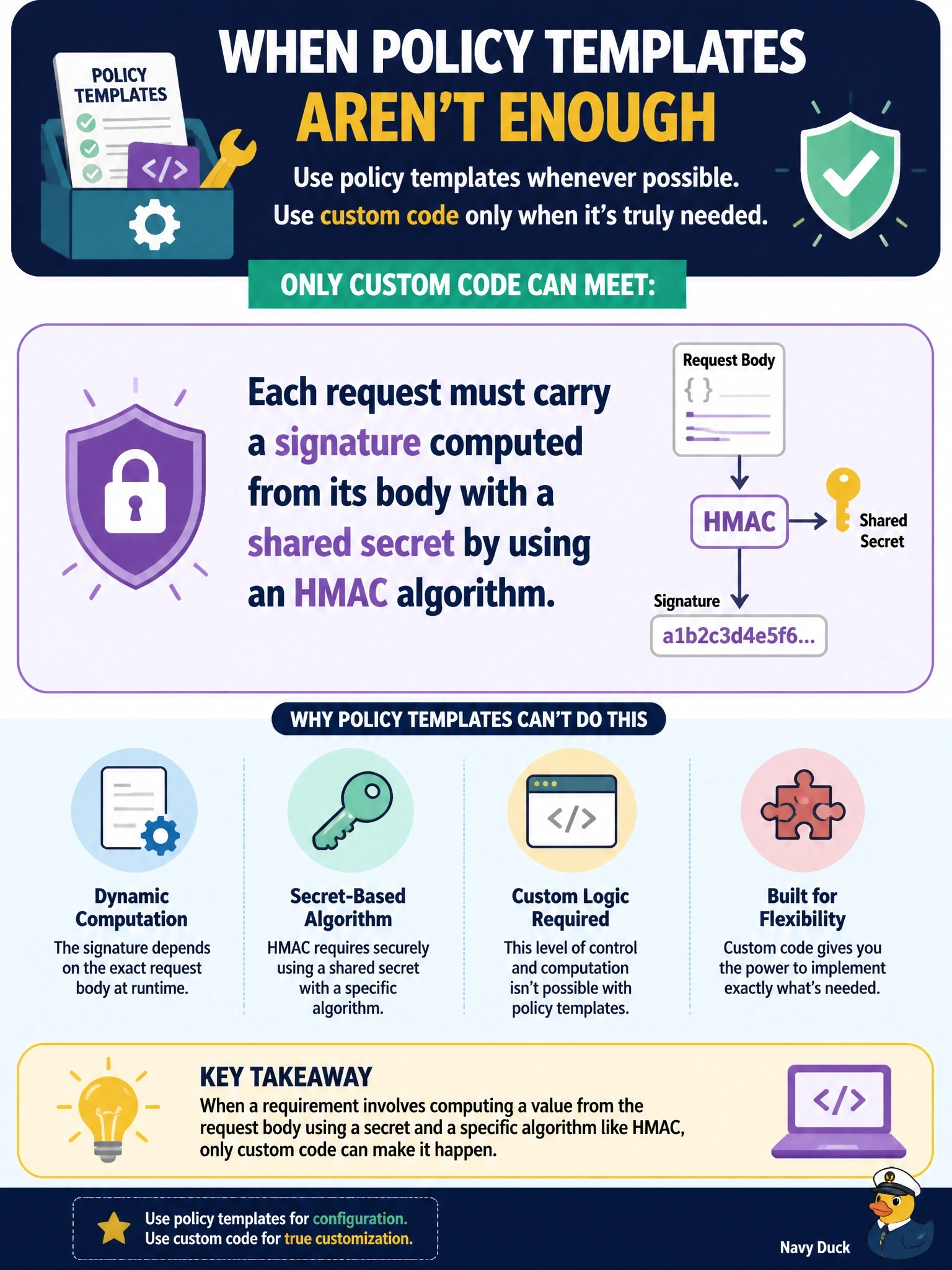
Policy templates are a toolbox of standard moves: set a header, swap the host, reshape arrays. The moment you need real computation, like hashing the body with a secret, you've left the toolbox and you're writing C#. Learn which jobs the templates already cover, because that's the trap.
Full Explanation
Policy templates handle common runtime changes declaratively. Set HTTP header adds a fixed header, and leaving its operations list empty applies it to every operation including new ones. Set host URL builds the destination host from expressions such as a connection parameter, which covers per-region routing. Convert an array to an object turns name and value entries into one object with named properties. None of these templates computes a cryptographic signature over the request body, which requires reading the body, combining it with a secret and running a hashing algorithm such as HMAC. That is the kind of transformation custom code exists for: a C# Script class whose ExecuteAsync reads the request content, computes the signature with the supported cryptography namespace, adds it as a header, and forwards the request with Context.SendAsync. Exam caveat: custom code takes precedence over the codeless definition for the operations it covers and runs under execution and size limits, so keep it focused and use templates for everything else. Operational check: implement the script for the affected operations, call one from the Test tab, and confirm the backend validates the signature while the other three requirements are still handled by their templates.