
Two integration requirements arrive. Every contact update must be posted unchanged to a Service Bus queue. Opportunity data may leave Dataverse only when the opportunity's probability is above a value that the business can change, so no other opportunity data may reach Azure. Both use the same registered service endpoint. What is the best implementation?
Select an answer to reveal the explanation.
Short Explanation
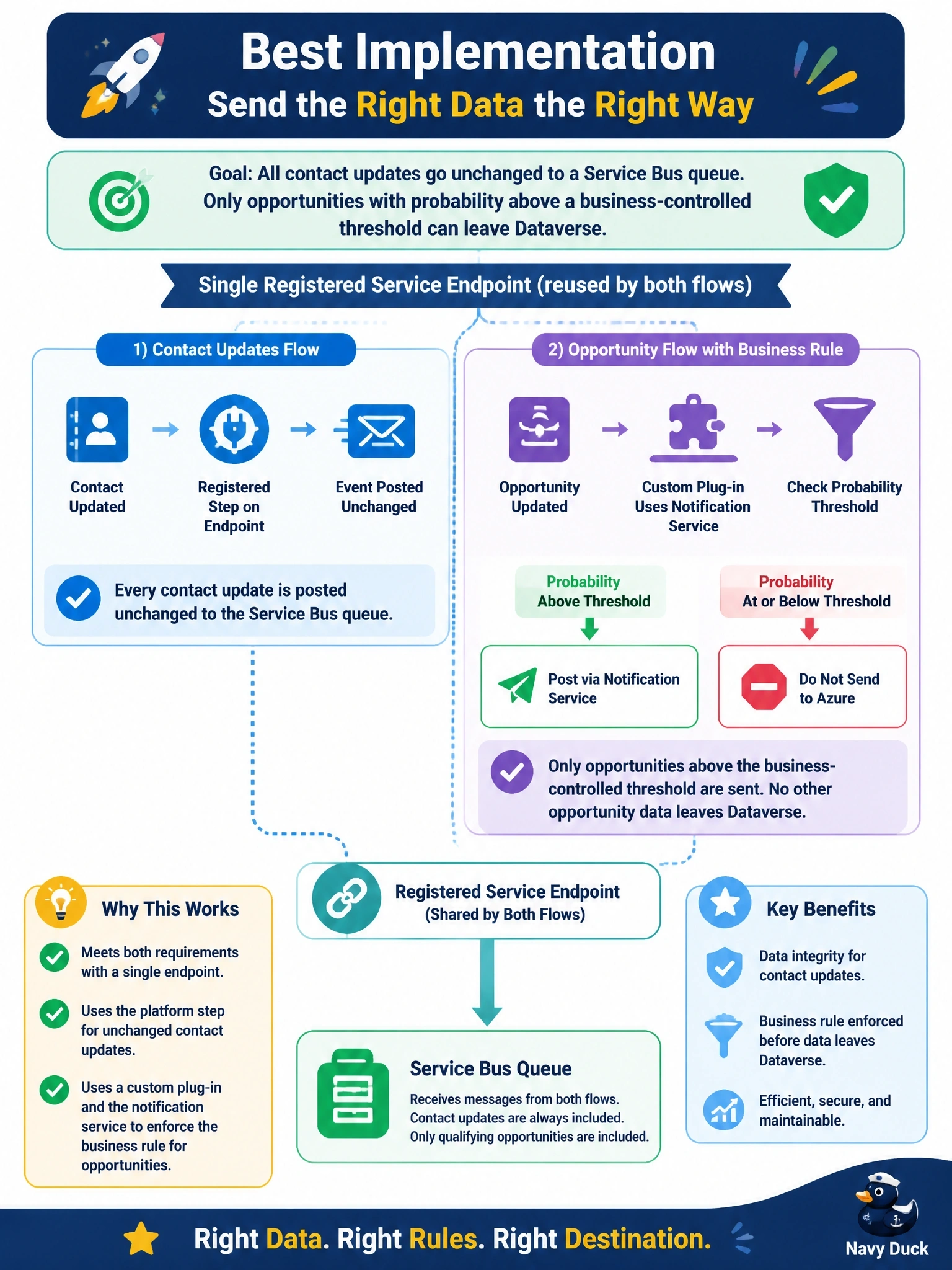
You use the simplest tool that meets each rule: contacts need no logic, so a plain registered step does it. Opportunities need a decision before anything leaves Dataverse, and that takes code calling the notification service. Letting the consumer throw messages away is too late; the data already left.
Full Explanation
A step registered directly on a service endpoint uses the built-in Azure-aware plug-in to post the execution context whenever the message and table fire, with no custom code, which is ideal for contact updates that need no logic. The opportunity requirement is conditional and the condition can change, so a custom plug-in evaluates the probability rule and calls IServiceEndpointNotificationService.Execute only when the rule passes, keeping other opportunity data inside Dataverse. Claiming that endpoint steps cannot run asynchronously is false; asynchronous registration is in fact the recommended mode for posting to Azure, so code for contacts adds maintenance without benefit. Filtering attributes decide which changed columns trigger an Update step; they cannot compare a column value with a threshold, so every opportunity update touching the column would still be posted. Discarding messages in the consumer meets a functional need but violates the data constraint, because the full opportunity context has already been sent to Azure. Exam caveat: choose registration-only posting whenever no decision is required, and code only where logic must run first. Operational check: update a contact and two opportunities on either side of the threshold, then confirm the queue holds the contact message and exactly one opportunity message.