
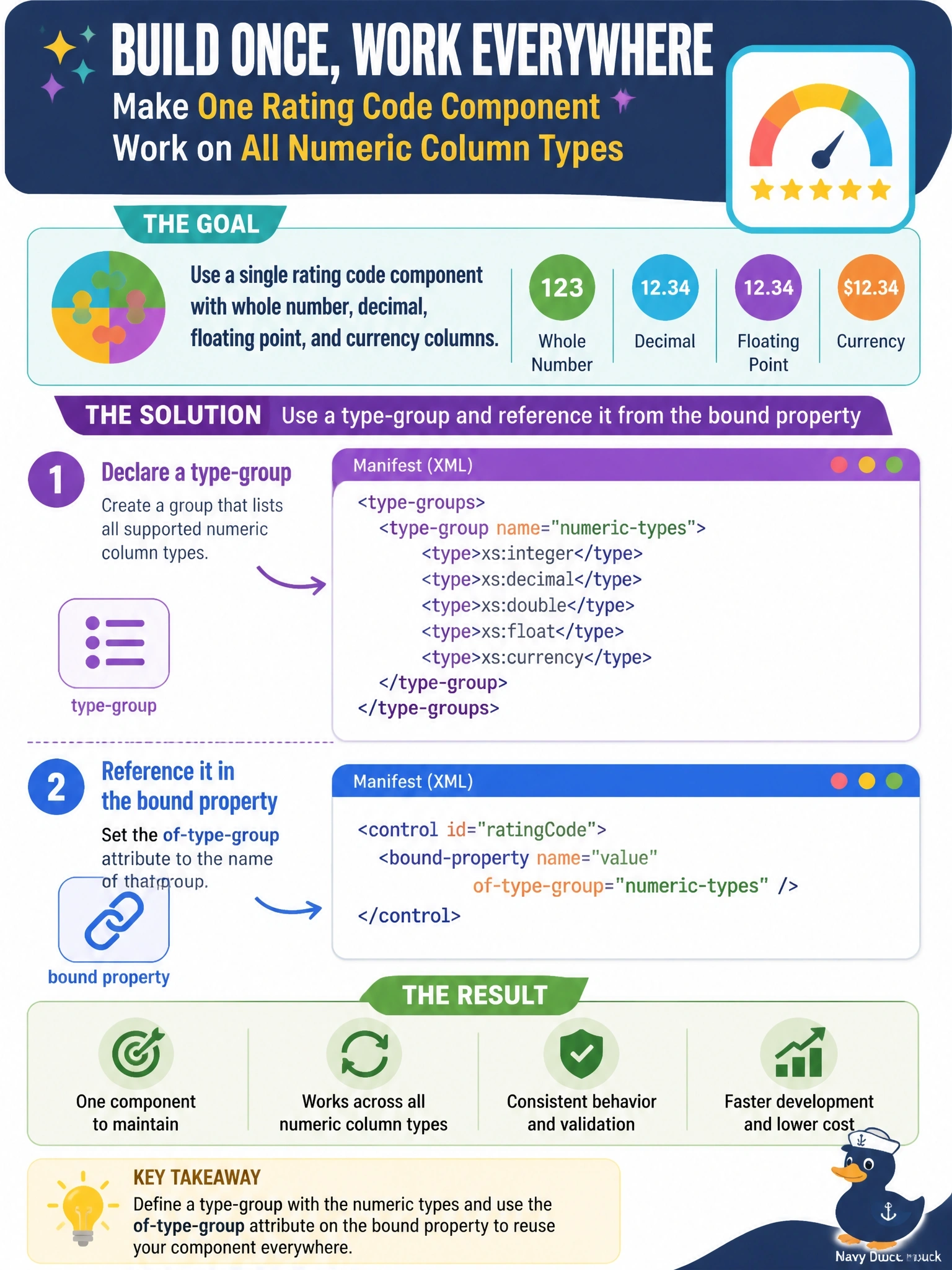
A rating code component must be configurable on whole number, decimal, floating point and currency columns without maintaining four copies of the component. How should the manifest support this?
Select an answer to reveal the explanation.
Short Explanation
A type-group is a guest list for column types: you name the group once, list the numeric types, and point your property at the group. Then you've got one component that fits all four columns instead of four look-alikes.
Full Explanation
The manifest's type-group element defines a named set of column types, such as whole number, currency, floating point and decimal. A property then uses the of-type-group attribute with that name instead of a single of-type, and the form designer offers the component for any column whose type is in the group. In code, the component reads the raw value and formatting information from the context, so it can handle each numeric type without separate builds. Declaring only Decimal binds the component to decimal columns; type compatibility is enforced by the declared type, not by whether one numeric type could in theory hold another's values, so the other columns would not offer the component. Four separate bound properties would require makers to bind all four, while only one column exists, and a bound property that cannot be bound leaves the component unconfigurable on most columns. Treating the value as text binds the component to text columns only, and it gives up the platform's numeric validation and formatting. Exam caveat: a type-group applies to bound and input properties; dataset components use a data-set element instead, with column types handled per column. Operational check: import the solution, open the form designer, and confirm the component is offered on a whole number, a currency and a decimal column.