
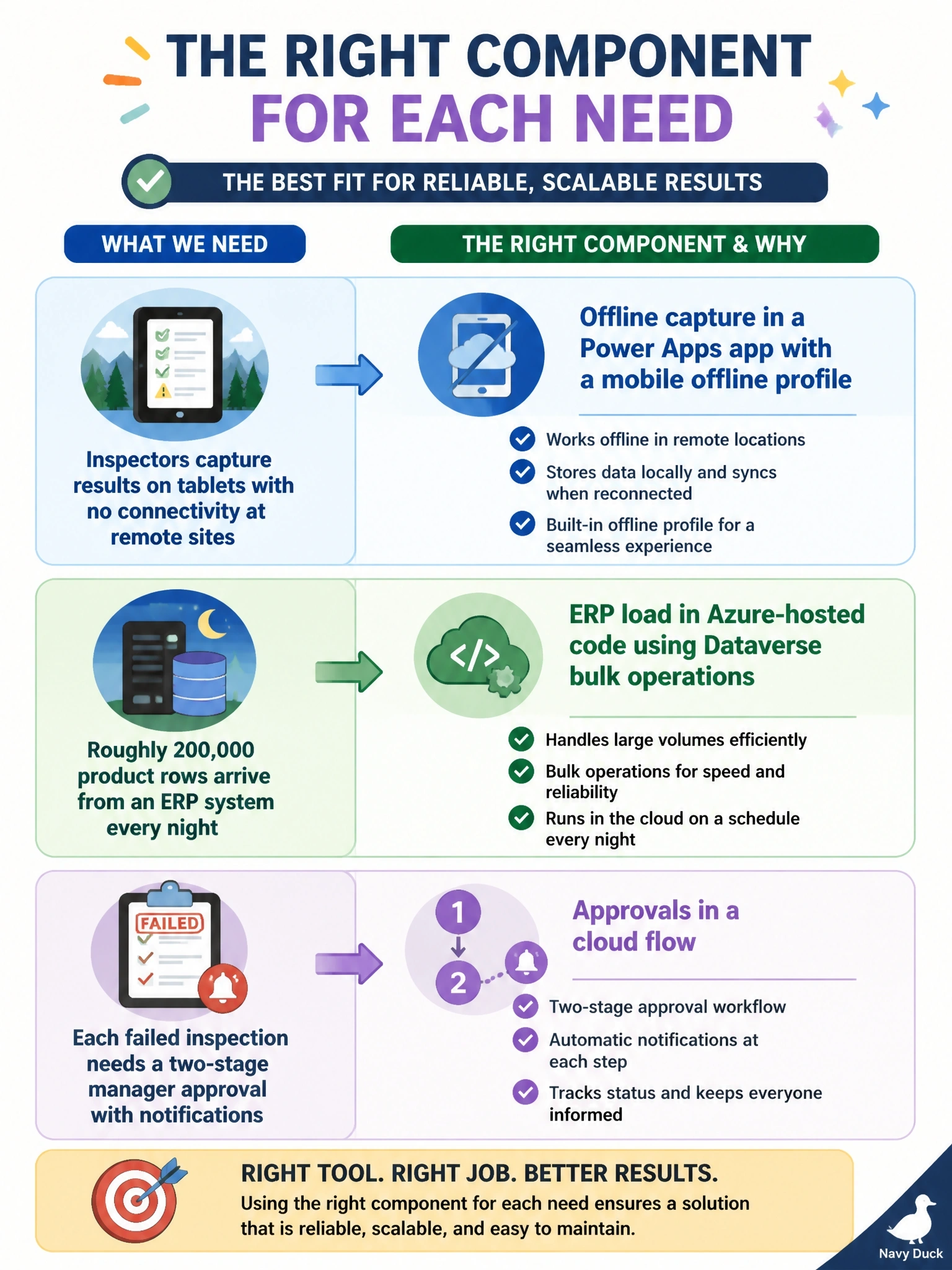
A requirements workshop for a field-inspection solution produced three items: inspectors capture results on tablets with no connectivity at remote sites, roughly 200,000 product rows arrive from an ERP system every night, and each failed inspection needs a two-stage manager approval with notifications. Which mapping of requirement to component type is the most appropriate design?
Select an answer to reveal the explanation.
Short Explanation
Think of it like staffing a project: you don't ask the receptionist to drive the truck. Offline capture is an app job, a big nightly load is a server-side integration job, and a people-in-the-loop approval is an automation job. The trap is picking one tool you like and forcing every requirement through it.
Full Explanation
Decomposing requirements by implementation approach is the first architecture step: user interaction belongs in an app, bulk system-to-system movement belongs in server-side integration code, and human-in-the-loop process steps belong in automation. A Power Apps app with a mobile offline profile is the supported way to let users work against Dataverse rows without connectivity and synchronize later. A nightly load of hundreds of thousands of rows fits Azure-hosted code that batches writes with bulk messages such as CreateMultiple and UpdateMultiple and honors service protection limits. A cloud flow with the Approvals connector provides staged approvals with Teams and Outlook notifications. Caching rows in a web resource is not a supported offline mechanism, and a synchronous plug-in runs inside a single Dataverse operation, so it cannot pull an external feed. A chat agent is not an offline data-capture surface, a per-row flow multiplies runs and throttling, and business rules cannot route approvals. A hand-built local queue in a code app reinvents synchronization, and client script cannot run an approval that outlives the form. Exam caveat: expect the answer that matches each requirement to its native component type. Operational check: list every requirement with its trigger, volume and actor, then confirm each has exactly one owning component.