
A consultant is rolling out conversation intelligence for a sales team with reps in the United States and the European Union who record customer calls in Microsoft Teams. Legal counsel requires the rollout to meet call-recording consent laws in each rep's location and to honor the customer data-handling commitments written into the EU contracts. (Select TWO.) Which two actions should the consultant take before enabling call recording and analysis broadly?
Select all correct answers, then click Submit.
Short Explanation
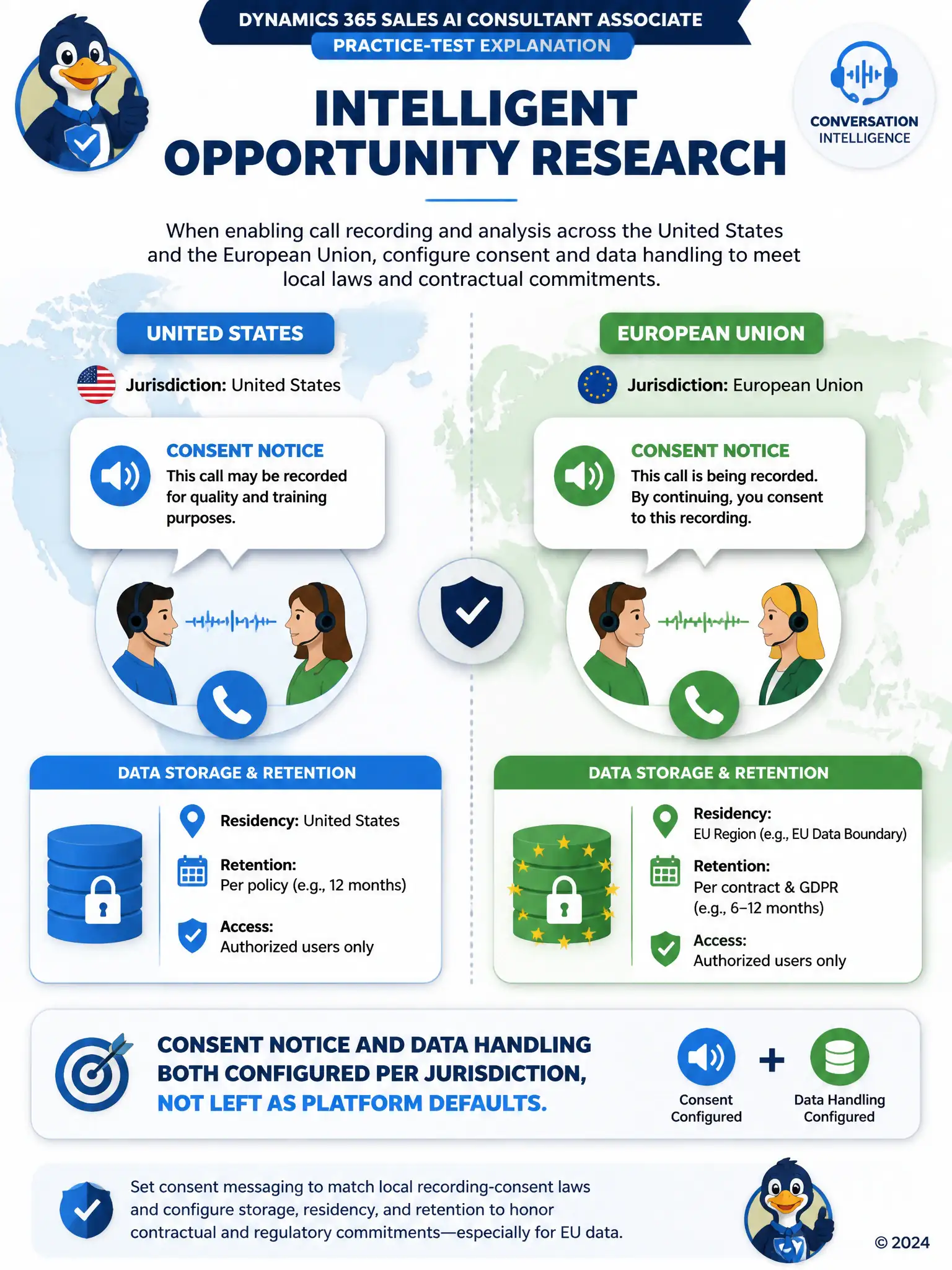
You've got to configure consent messaging or notification for call participants that matches each jurisdiction's recording-consent requirements, and you've got to review and configure data storage, residency, and retention so EU customer call data is handled consistent with the contractual and regulatory commitments. Don't assume defaults or skip EU reps; consent and data handling have to be deliberately set.
Full Explanation
The correct actions are configuring consent messaging or notification for call participants that matches each jurisdiction's recording-consent requirements, and reviewing and configuring data storage, residency, and retention so EU customer call data is handled consistent with the contractual and regulatory commitments. Call-recording consent laws vary by jurisdiction, so participants need notice appropriate to where the rep or customer is located, and that notification must be configured rather than assumed. Separately, EU contracts impose data-handling commitments, so where call data is stored, how long it is retained, and how it is processed must be reviewed and set to match those terms, not left at a global default. The approach of enabling conversation intelligence only for US-based reps, on the premise that EU consent laws do not apply to calls captured through a CRM integration, is incorrect because EU consent laws apply regardless of CRM integration, and excluding EU reps does not eliminate the legal requirement; it only avoids implementing the feature for them. The approach of relying on Microsoft Teams' default recording settings without additional configuration, on the premise that Dynamics 365 Sales enforces jurisdiction-specific consent automatically, is incorrect because Teams defaults are not jurisdiction-aware and do not automatically satisfy consent or data-residency obligations. The consultant must actively configure notification and data handling rather than trust an out-of-the-box default to cover legal requirements that differ by country. Both consent and data handling have to be deliberately set, not inherited by default.