
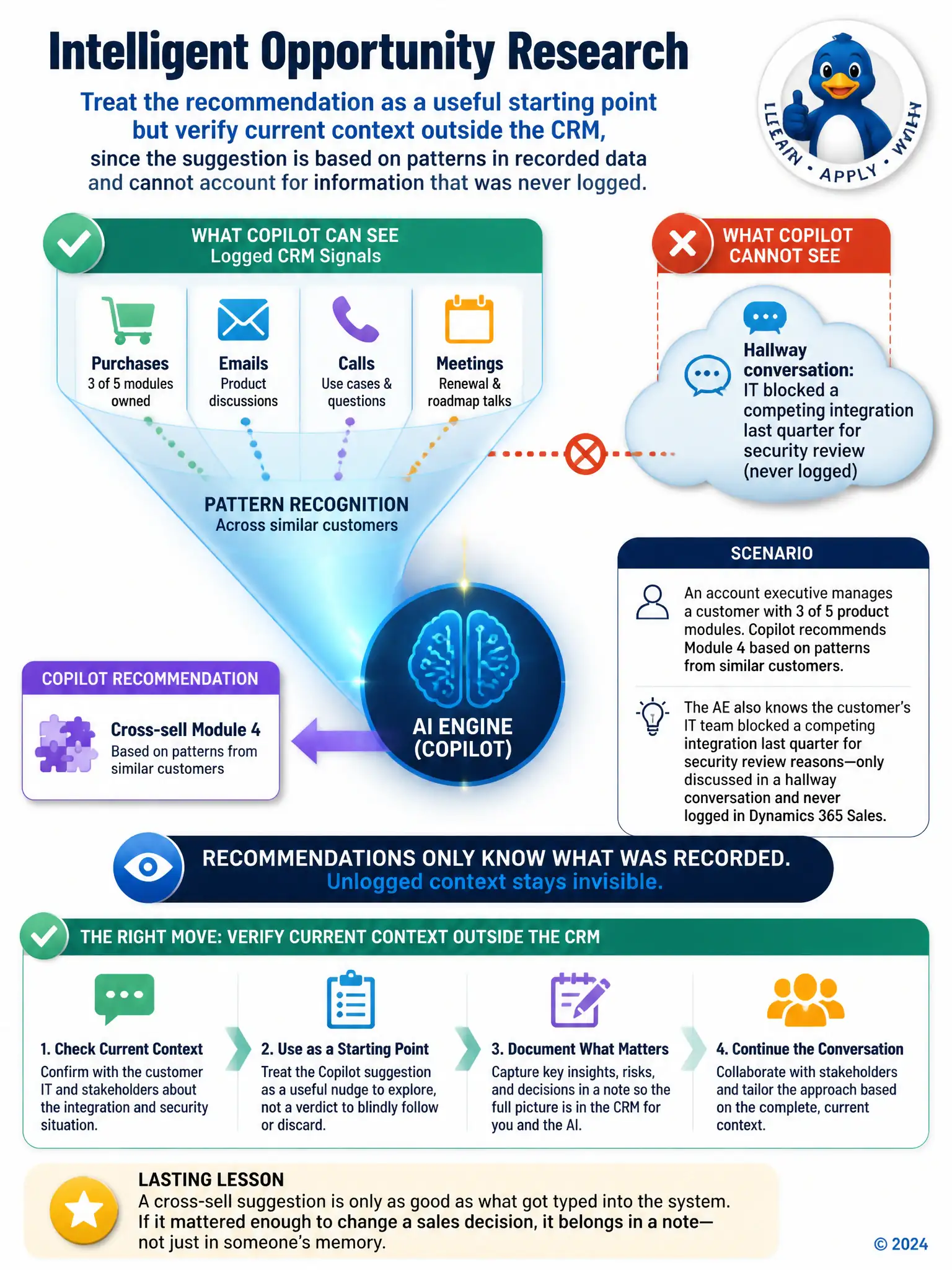
An account executive at a software company managing a customer with three of the vendor's five product modules asks Copilot for cross-sell ideas. Copilot recommends module four, based on patterns from similar customers, but the AE also knows the customer's IT team blocked a competing integration last quarter for security review reasons that were only discussed in a hallway conversation and never logged in Dynamics 365 Sales. What should the AE do before acting on the recommendation?
Select an answer to reveal the explanation.
Short Explanation
A cross-sell suggestion from Copilot is only as good as what got typed into the system, and a hallway conversation about a blocked integration never made it there. You should treat it as a useful nudge, not a verdict, and verify the current context outside the CRM before acting. The lasting lesson is that unlogged context stays invisible to any artificial intelligence feature pulling from the CRM, so anything that mattered enough to change a sales decision belongs in a note, not just in someone's memory.
Full Explanation
The correct answer is the recommendation to treat the Copilot suggestion as a useful starting point but verify current context outside the CRM, since the suggestion is based on patterns in recorded data and cannot account for information that was never logged. Copilot's cross-sell recommendation is generated from patterns across similar customers' recorded purchase and engagement data; the customer's existing three modules were part of that input, but the unlogged security-review pushback was not, because it never entered the system. The recommendation is not wrong on its face, but it is incomplete, so the account executive's job is to bring outside knowledge to bear before reaching out. The suggestion to disregard the recommendation entirely, because Copilot's cross-sell suggestions never take a customer's existing product mix into account, is incorrect because the recommendation did factor in the existing product mix; the gap is the unlogged context, not a blind spot about owned modules. The suggestion to ask the consultant to retrain the scoring model on the security review outcome before proceeding with any outreach is incorrect because retraining a model is a disproportionate, slow response to one customer's undocumented situation and would not be how a consultant addresses a single account's context gap. The suggestion to escalate the recommendation to Microsoft support, since it appears to contradict an internal note that was never recorded, is incorrect because this is normal behavior of a recommendation built from available data, not a support-worthy defect, and Microsoft support cannot resolve missing internal notes. The practical fix going forward is logging the security-review outcome so future recommendations account for it.