
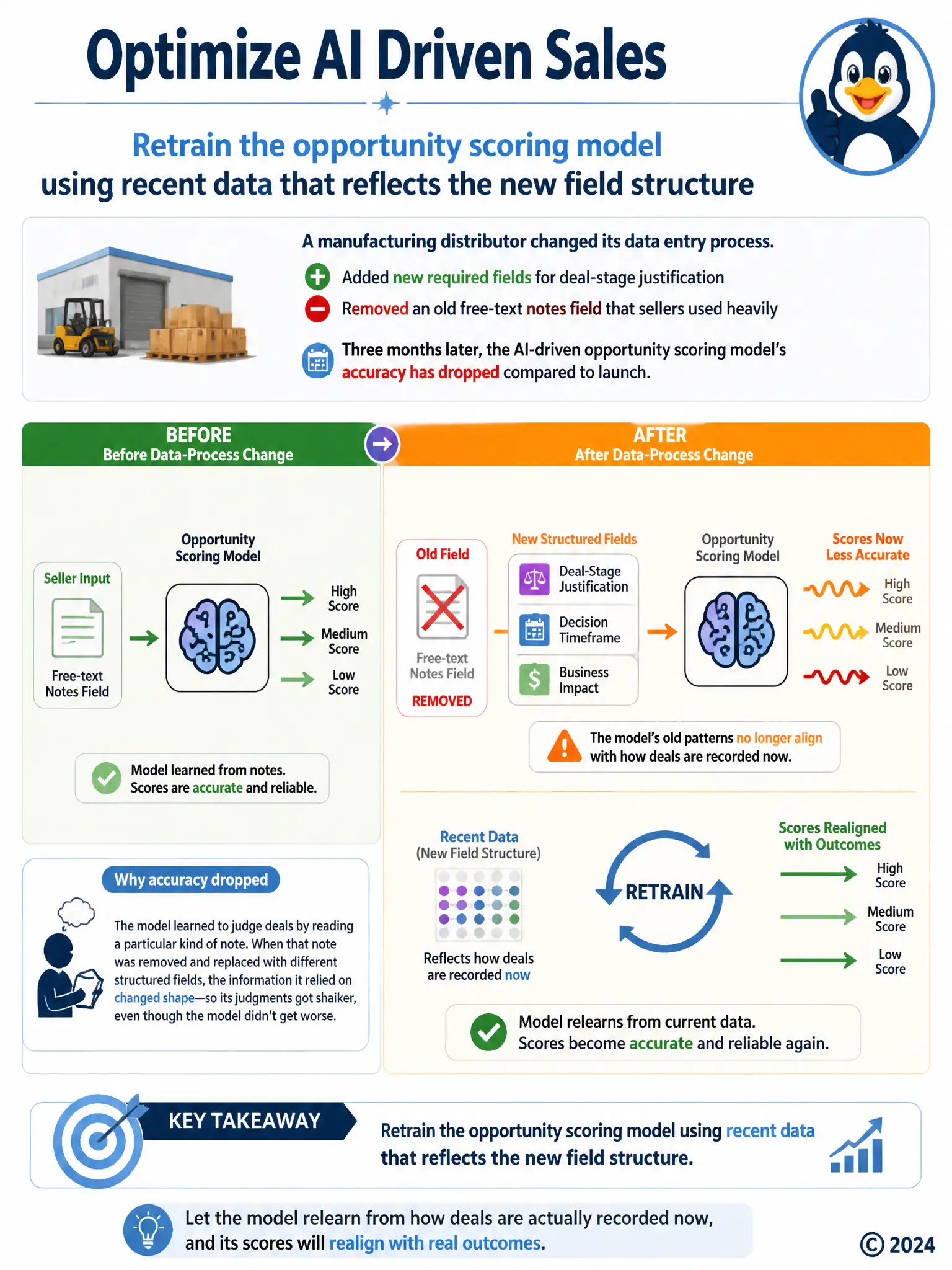
A manufacturing distributor recently changed its Dynamics 365 Sales data entry process, adding new required fields for deal-stage justification and removing an old free-text notes field that sellers used heavily. Three months later, a consultant reviewing the AI-driven opportunity scoring model finds its accuracy has dropped compared to launch. Which action should the consultant recommend first?
Select an answer to reveal the explanation.
Short Explanation
Think of the model like a person who learned to judge deals by reading a certain kind of note. You changed the form, so its old instincts no longer line up; you need to retrain it on recent data that reflects the new field structure.
Full Explanation
The recommended action is to retrain the opportunity scoring model using recent data that reflects the new field structure. The data entry process change altered which fields carry signal for the model: a heavily used free-text field disappeared and new structured fields appeared, so the patterns the model originally learned no longer match how deals are recorded. Retraining on recent data that reflects the new structure lets the model relearn which fields now predict outcomes, restoring accuracy. Rolling back the data entry process changes to restore the original notes field is incorrect because the new fields were a legitimate process improvement; reversing them disrupts the business to chase a symptom instead of fixing the model's alignment with current data. Increasing the number of opportunities included in the historical training window without changing the fields used is incorrect because simply widening the historical window without updating which fields are used still trains on a mix of old and new field structures, which does not resolve the mismatch causing the drift. Disabling opportunity scoring until the next major Dynamics 365 release is incorrect because disabling the feature discards a working capability over a fixable, well-understood cause and leaves sellers without prioritization support for months. The right response treats this as an expected consequence of changing input data, not a reason to abandon or delay the model.