
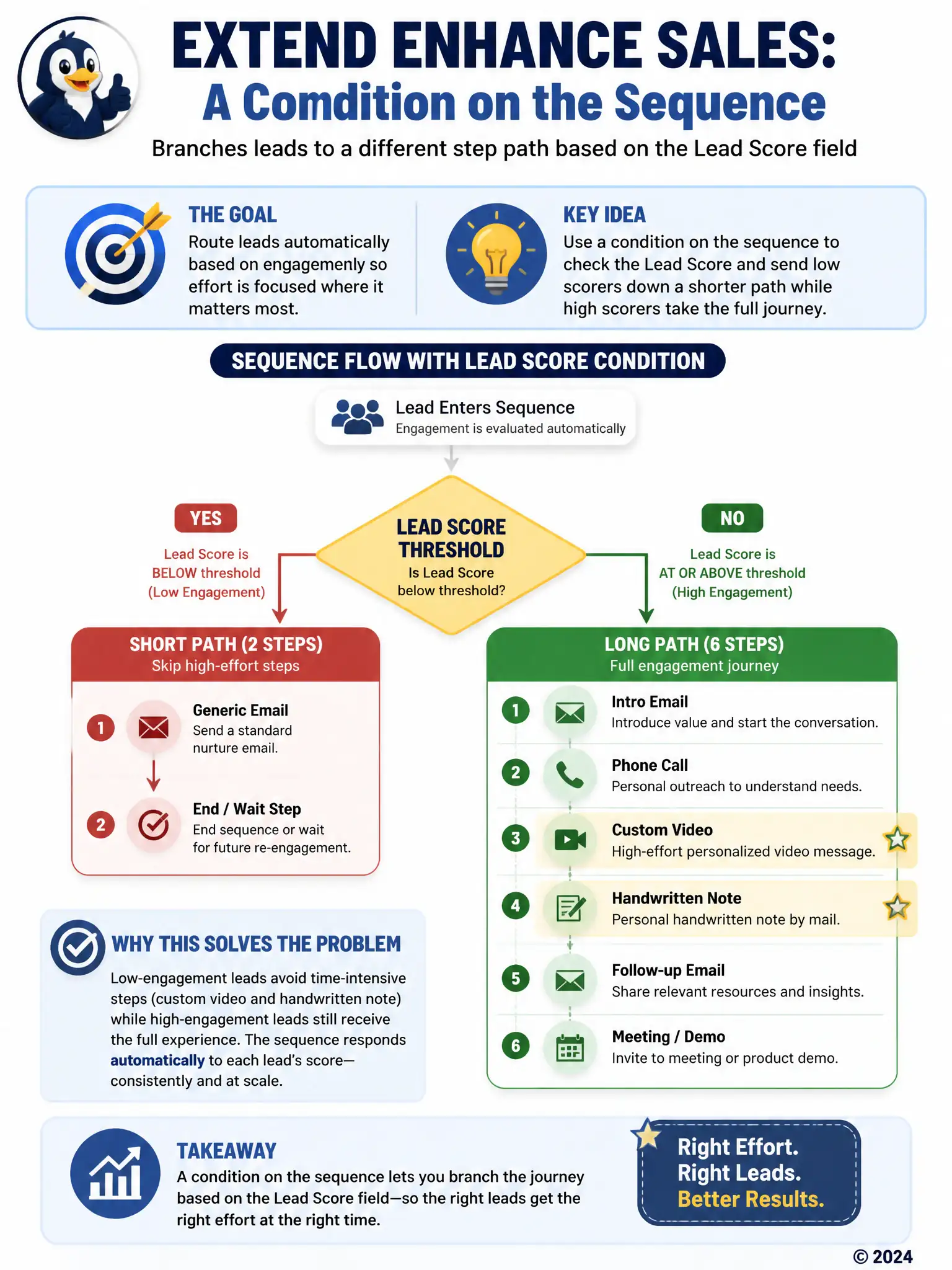
A consultant is customizing a sales accelerator sequence for a subscription software company. The sequence currently sends every lead through the same six touchpoints regardless of engagement level. The sales manager wants leads whose lead score falls below a set threshold to skip the two highest-effort steps, a custom video and a handwritten note, and move straight to a generic email step instead. Which configuration should the consultant use?
Select an answer to reveal the explanation.
Short Explanation
You need the sequence to check the lead score and automatically send low scorers down the shorter path. That keeps the custom video and handwritten note for engaged leads without making reps remember to skip steps.
Full Explanation
The correct configuration is a condition on the sequence that branches leads to a different step path based on the lead score field. Sales accelerator sequences support conditional branching, so a condition evaluated against the lead score field can automatically route low-scoring leads onto a shorter path that omits the custom video and handwritten note, while high-scoring leads continue through the full sequence. The workflow that removes the two high-effort steps from the sequence template for every lead is incorrect because removing the steps from the template applies to every lead, which contradicts the requirement that only low-scoring leads should skip them; it eliminates the choice rather than conditioning it. The Copilot Studio topic that reps invoke manually to skip steps is incorrect because a manually invoked topic depends on a rep remembering to trigger it for each lead, which is inconsistent and effort-heavy, the opposite of the automatic behavior the manager wants; it also is not how sequence step routing is configured. The business rule on the lead form that hides the lead score field for low-scoring leads is incorrect because hiding a field from the form changes what a rep can see or edit, it has no effect on how the sequence engine routes a lead through its steps, so the high-effort steps would still run for everyone. Branching logic tied to lead score is the mechanism built for this exact scenario.