
(Select TWO.) A consultant is preparing to turn on predictive opportunity scoring for a client's Dynamics 365 Sales environment. Before enabling the feature, the consultant reviews the environment's data. Which two conditions should the consultant confirm are true so the resulting scores are reliable?
Select all correct answers, then click Submit.
Short Explanation
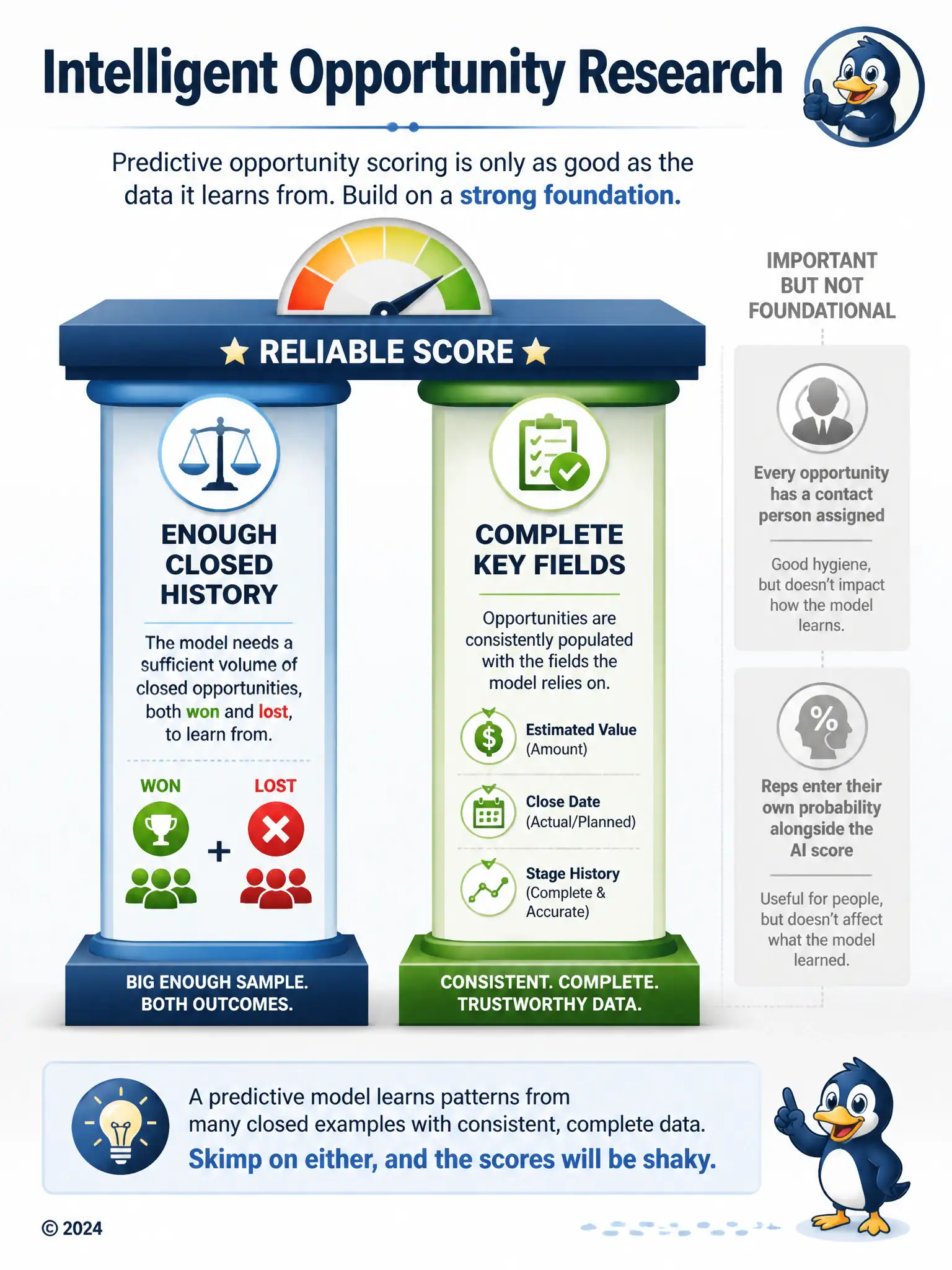
You need enough closed-won and closed-lost opportunities for the model to learn real patterns, and you need the fields it uses—like estimated value, close date, and stage history—to be filled in consistently. If either the sample size or the data quality is weak, the scores won't be trustworthy. A missing primary contact or manual probability entries don't decide whether the model can learn.
Full Explanation
The correct conditions are that the environment has a sufficient volume of closed opportunities, both won and lost, for the model to learn from, and that opportunities are consistently populated with the fields the model relies on, such as estimated value, close date, and stage history. Predictive opportunity scoring is a learned model, so it needs a meaningful volume of past won and lost opportunities to recognize patterns, and it needs the fields it actually uses, such as estimated value, close date, and stage progression, to be populated consistently across records; without both, the model either has too little to learn from or is learning from gaps and inconsistencies that produce unreliable scores. The condition that every opportunity currently in the pipeline has an assigned primary contact is incorrect because a primary contact assignment, while good CRM hygiene, is not one of the data conditions the scoring model depends on, so its completeness does not affect score reliability. The condition that the sales team has disabled manual probability-of-close entry so it does not conflict with the AI-generated score is incorrect because manual probability-of-close entry and the AI-generated score are separate fields that can coexist without conflict; there is no requirement to disable manual entry, and doing so would remove information reps may still want to record rather than improve the model's accuracy.