
A sales leader wants whitespace analysis to include product usage data drawn from an ERP system, which relationship analytics does not ingest natively. Which approach extends the platform to support this cross-sell analysis?
Select an answer to reveal the explanation.
Short Explanation
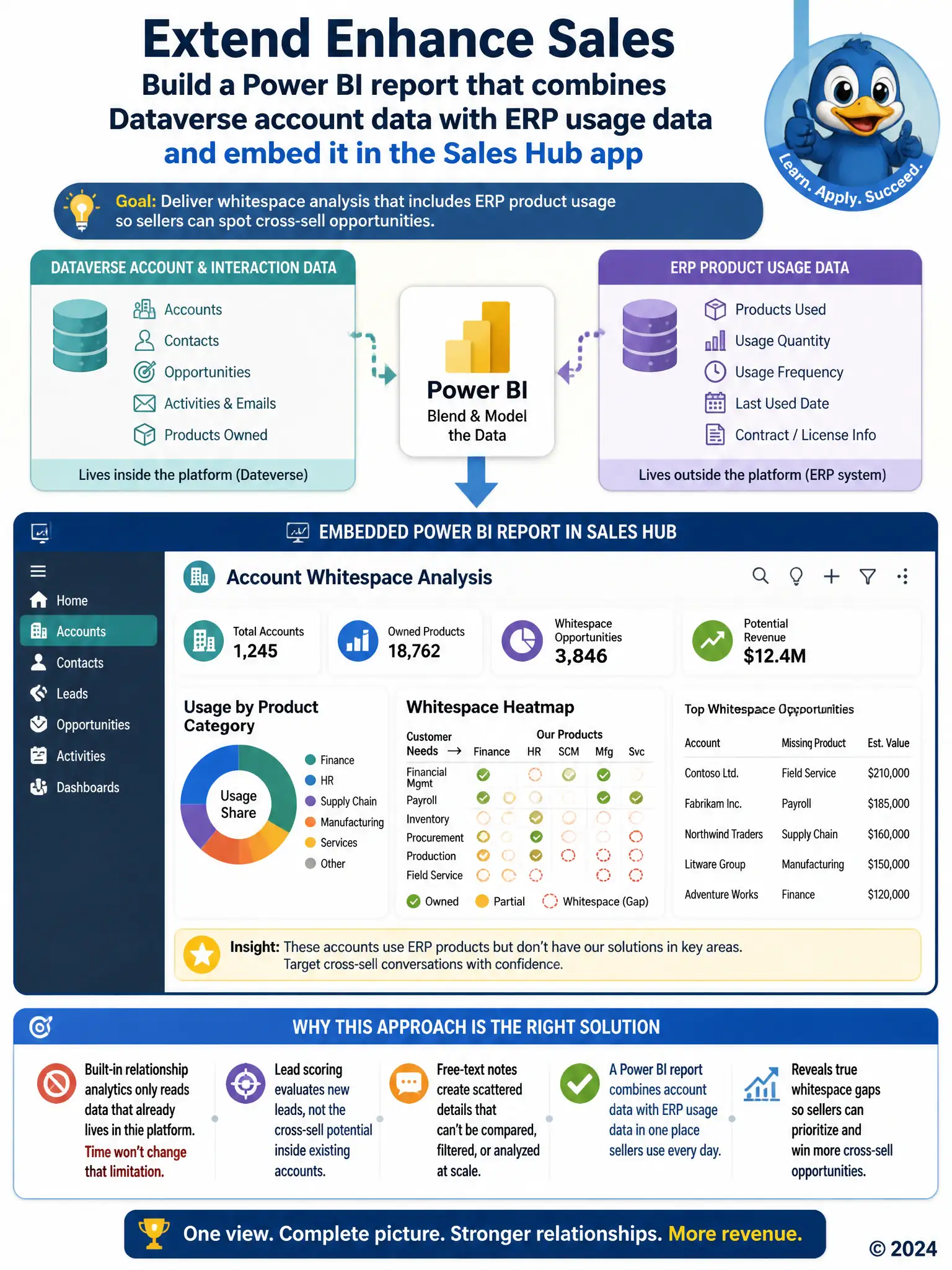
You need to bridge the data gap. Build a Power BI report that combines Dataverse account data with ERP usage data and embed it in Sales Hub. That gives you structured cross-source analysis where reps already work.
Full Explanation
The obstacle is a data boundary: relationship analytics evaluates interaction data already captured inside Dataverse, so it has no path to ingest product usage history stored in a separate ERP system. Combining the two data sets requires a reporting layer built for that purpose, which a Power BI report can provide by blending Dataverse account records with ERP usage data and then embedding the result directly in the Sales Hub app where the sales team already works. Turning on the standard relationship analytics feature and waiting is incorrect because simply enabling the standard feature does not add any new data connections; it will keep analyzing only the sources it already supports, regardless of how long the team waits. Configuring the Sales Qualification Agent to score leads using ERP usage history is incorrect because that agent is built to assess and score individual leads for qualification purposes, not to identify cross-sell whitespace across an existing account's product footprint. Adding a manual field to the Account form where reps type in ERP usage notes is incorrect because a free-text field filled in manually by reps produces scattered, inconsistent, unstructured notes that cannot be compared, filtered, or analyzed the way real cross-sell whitespace analysis requires, and it does not scale across the account base.